
Healthcare Software in the UK: A Plain-English Map of the Market
"Healthcare software" is close to useless as a search term, and everybody using it knows that within about two clicks. It covers a hospital's patient record system and a care agency's rota, a prescribing engine and a dental practice's billing, a symptom checker and a compliance register. The buyers have nothing in common except that people are involved.
This is a map rather than a sales page. It sets out what the phrase actually covers in the UK, who buys what, which regulation applies where, and how to work out which corner of the market you are standing in. Most readers should leave this page for a more specific one, and the map says which.
Our own position, stated up front so you can weigh everything else: CareOS builds software for social care providers, which is one segment on the map. We are not a clinical system and will say so wherever it is relevant.
What counts as healthcare software
Six segments, distinguished by what they are for rather than what they are called. The narrower phrase healthcare management software covers only the operational four of these, leaving out diagnostics and governance, which is why that guide counts four where this one counts six.
1. Clinical record systems
The system of record for clinical care. Electronic patient records in hospitals, the clinical systems GP practices run on, and equivalents in mental health and community services. Holds diagnoses, prescribing, results, correspondence and referrals. Long procurement cycles, heavy interoperability requirements, integration with national infrastructure.
Bought by: NHS trusts, GP practices, independent hospitals.
2. Practice and clinic management
The administrative and commercial layer around clinical delivery: appointments, patient communications, billing and insurance, room and capacity management, reporting. Common in dentistry, physiotherapy, optometry, private GP and allied health, sometimes bundled with the clinical record and sometimes separate.
Bought by: private practices and clinics.
3. Care management (social care)
The operational system a regulated social care provider runs on: care records and plans, rostering, mobile recording by carers at the point of care, electronic medication records, workforce compliance, invoicing and payroll. The record is a care record, not a clinical one, and the regulator is the CQC or Ofsted rather than an NHS procurement framework.
Bought by: home care agencies, care homes, supported living services, children's homes, care staffing agencies. Covered properly in care management software.
4. Clinical decision support and diagnostics
Software that contributes to a clinical decision: triage and symptom assessment, imaging analysis, risk scoring, prescribing safety. This is the segment most likely to be regulated as a medical device, because it makes claims about clinical outcomes.
Bought by: NHS organisations and clinical providers, often alongside a record system.
5. Governance, compliance and information systems
Information governance, clinical risk and safety tooling, policy management, audit, incident management and quality systems. Sits alongside the operational systems rather than replacing them. See compliance software for healthcare for how this differs between clinical and care settings.
Bought by: anybody regulated, which is everybody.
6. Workforce, finance and back office
Rostering, HR, payroll, training and finance products that are not health-specific but are widely sold into health and care. Good at staff, ignorant of care delivery. Fine if that is all you need, a problem if you assumed otherwise.
Bought by: anybody, which is both the appeal and the risk.
Who is buying, and what they actually mean
The same phrase from different people means different segments. Roughly:
| If you are | You probably mean | Start with |
|---|---|---|
| An NHS trust or ICB | Clinical records, governance, decision support | Segments 1, 4 and 5 |
| A GP practice | Clinical record plus practice management | Segments 1 and 2 |
| A private clinic or dentist | Practice management, sometimes clinical records | Segments 2 and 1 |
| A home care agency | Care management | Domiciliary care software |
| A care home | Care management, residential | Care home management software |
| A supported living provider | Care management, tenancy-based | Supported living software |
| A children's home | Care management, Ofsted-regulated | Children's home software |
| A care staffing agency | Shifts, compliance packs, client rates | Care staffing software |
| A digital health startup | Decision support, patient apps | Segment 4, and medical device regulation |
Regulation: what applies where
This is the part that most distinguishes UK healthcare software from the American content that dominates search results for these terms.
CQC. Registers and inspects health and adult social care services in England: NHS trusts, GP practices, independent hospitals, care homes, domiciliary care agencies. The assessment framework has been revised and remains under review, so read CQC's own current guidance rather than any vendor's version of it.
Ofsted regulates children's homes and children's social care. Different standards, different evidence. Adult social care software leaves gaps.
The devolved regulators. Care Inspectorate in Scotland, Care Inspectorate Wales, RQIA in Northern Ireland. If you operate across borders, check coverage rather than assuming.
MHRA and software as a medical device. If software diagnoses, screens or drives a treatment decision, it may be regulated as a medical device with the conformity assessment and post-market obligations that follow. Segment 4 lives here. Operational systems in segments 2, 3 and 6 generally do not, and a vendor implying otherwise is either confused or claiming a badge they have not earned.
DCB0129 and DCB0160. Clinical risk management standards for the manufacture and deployment of health IT. Central to segments 1 and 4 in an NHS context. Not usually the applicable frame for a social care operational system.
DTAC. The Digital Technology Assessment Criteria, the baseline NHS organisations use when procuring digital tools, covering clinical safety, data protection, technical security, interoperability and usability. If you are buying inside the NHS, this is your checklist.
NHS DSPT. The Data Security and Protection Toolkit: an annual self-assessment on handling health and care data, applying to social care providers as well as NHS organisations. Your vendor holds your data, so their posture affects your submission.
DSCR. NHS England's Digital Social Care Records programme, moving social care towards assured digital record systems, with assurance affecting access to associated funding. Segment 3 only.
UK GDPR and the Data Protection Act. Health and care records are special category data: lawful basis, retention, subject access and breach reporting all sit at a higher bar than ordinary business data.
Why social care is a separate market
It is worth being blunt about this, because it is the mistake this whole map exists to prevent.
Social care is not a junior version of healthcare with simpler software. It is a different job. A care worker supporting somebody to get up, washed, fed and to their medication is not delivering clinical treatment, and the record that matters is not a clinical record. The daily operational problems, building a deliverable rota, getting the right person to the right address, proving care was delivered, keeping a dispersed workforce compliant, invoicing several funders at different rates, barely exist in a hospital and dominate a care agency.
The consequences of buying across the boundary run in both directions. A clinical system in a care setting has no rota worth the name and no concept of a visit. A generic workforce system has an excellent rota, no care plan, no medication record and nothing an inspector will accept. Both leave providers running a second system on paper, which is worse than either alone.
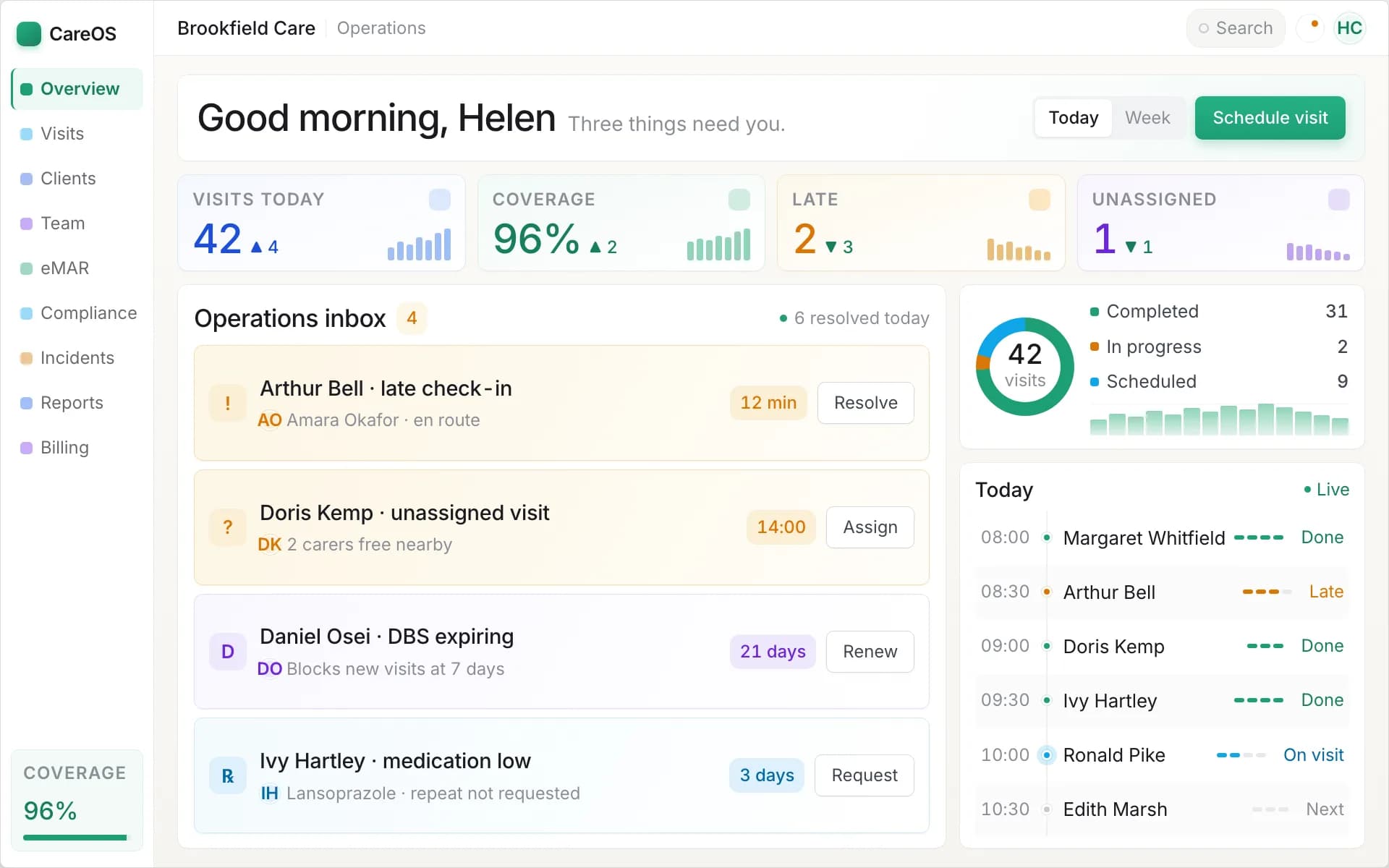
Segment three in practice: an operational view of care delivery, with the day's alerts and outstanding actions.
The buying mistakes that recur
Buying by category name rather than by job. Two products described identically can be built for completely different work. Ask what a product was originally built for and what has been added since. There is nearly always a specific answer.
Assuming American content applies. Most search results for these terms describe a different healthcare system, different regulation and different funding. HIPAA is not your framework. Be careful what you carry across.
Treating regulation as a feature. A vendor listing standards is telling you what they have done, not what you will be able to evidence. The useful question is what your service can produce at an inspection, which is a question about your daily work, not their certificates.
Ignoring the mobile experience. In care, most of the data is captured by somebody standing up, in a hurry, on a phone, sometimes with no signal. If that part is weak, nothing downstream is trustworthy, however good the office screens look.
Underestimating migration. Getting existing records into a new system is the largest hidden cost in this market, and "you retype them" is rarely said until after signature.
Never testing the bad day. Every demo is the good day. Bring the Sunday two people called in sick, the person with a complicated medication regime, the funder who pays differently at weekends.
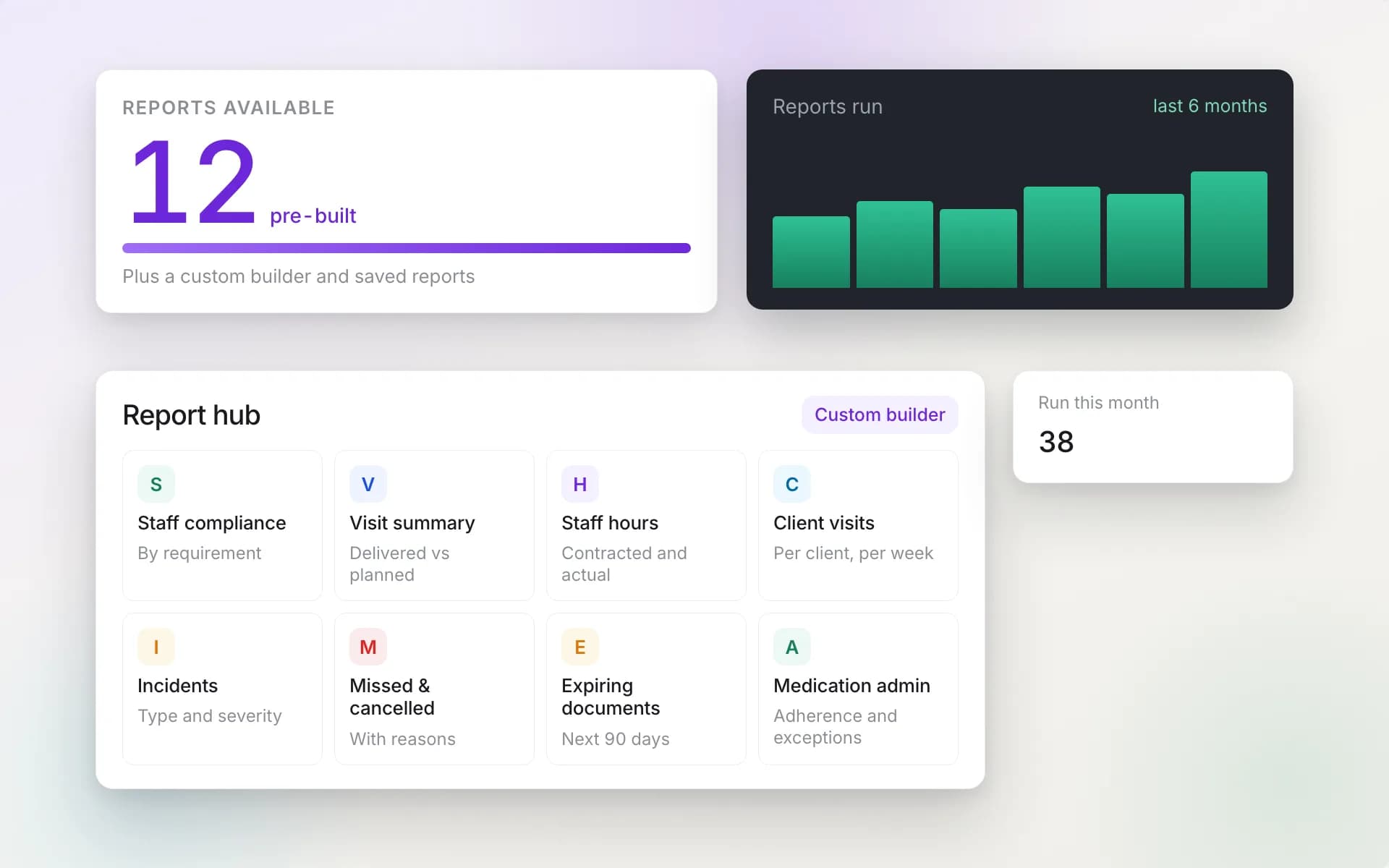
What an inspector asks for, produced as a report rather than assembled as a project.
How to shortlist, whatever segment you are in
- Name your segment. Use the table above. Everything else is wasted until this is settled.
- Write down your three worst operational moments. Not requirements: moments. The sick call, the medication error nobody caught, the invoice query you could not answer.
- Make every vendor do those three, live. On their system, with you watching. This single practice tells you more than any feature comparison.
- Get total cost at two sizes. Today, and double. Include setup, migration and any per-user charges.
- Interrogate migration and exit together. Who moves your data in, and what happens to it if you leave. Both answers in writing.
- Test support properly. Care runs at seven on a Sunday morning. Ask who answers and how fast.
- Speak to a reference who switched recently, in your segment, at your size. Ask about the first month specifically.
- Check the regulation that applies to you, not the regulation the vendor likes talking about.
Where to go next
For the social care segment specifically, the guide to AI care management software covers what the AI layer genuinely does across rostering, assessment, medication and compliance.
If you are in social care, which is most of the readers who arrive here, the useful route is care management software for the category, then your setting: domiciliary care software for home care, care home management software for residential, or supported living software.
For specific modules: care rostering software, eMAR software, and CQC compliance software. For the compliance landscape across both markets, compliance software for healthcare. For the relationship layer and where it stops, CRM for healthcare. Everything is listed on the blog index.
If you are in a clinical segment, this is not our market and we have no product to sell you. The map above should at least tell you which words to search next.
CareOS is care management software for UK social care providers, covering home care, care homes, supported living, children's services and care staffing, with rostering, mobile recording, eMAR, care plans, compliance and finance in one CQC-ready system. If that is your segment, book a demo and bring your three worst operational moments rather than a feature list.
Frequently asked questions
What is healthcare software?
In the UK the phrase covers six distinct segments: clinical record systems in hospitals and GP practices, practice and clinic management, care management for social care providers, clinical decision support and diagnostics, governance and compliance systems, and generic workforce and back-office products sold into health and care. The buyers have almost nothing in common, which is why the term alone is not a useful search.
Is social care software the same as healthcare software?
No. Social care is a different job rather than a simpler version of healthcare. The record is a care record, not a clinical one, and the daily problems, building a deliverable rota, proving care was delivered, keeping a dispersed workforce compliant, invoicing several funders at different rates, barely exist in a hospital and dominate a care agency. Buying across that boundary in either direction leaves you running a second system on paper.
Which UK regulations apply to healthcare software?
It depends on the segment. Care providers deal with CQC or Ofsted, the devolved regulators, NHS DSPT and UK GDPR, plus DSCR if they are moving to assured digital care records. Clinical and NHS settings add DTAC for procurement, DCB0129 and DCB0160 for clinical risk in health IT, and MHRA regulation where software diagnoses, screens or drives a treatment decision.
Does American healthcare software advice apply in the UK?
Mostly not, and it dominates search results for these terms. The healthcare system, the regulation and the funding are all different. HIPAA is not the UK framework, and guidance written around US payer models will mislead you on everything from data protection to how services are commissioned and paid.
How do I know which type of healthcare software I need?
Two questions usually settle it. What is the primary record you keep: a clinical record with diagnoses and prescribing, or a care plan and a daily record of support delivered? And who regulates you: NHS procurement and clinical assurance, or the CQC as a social care provider, or Ofsted for children's services? The answers point at clinical systems or care management respectively.
What is the most common mistake when buying?
Buying by category name rather than by job. Two products described identically can be built for completely different work, so ask what a product was originally built for and what has been added since. After that, the commonest mistakes are underestimating data migration, and never testing the bad day: every demo is the good day, so bring the Sunday two people called in sick.
Keep reading
- Care Management Software: What It Does and How to ChooseWhat the category actually covers, the six modules a complete system needs, why social care and healthcare are different markets, and how to compare vendors against your own worst week rather than their demo.
- National Living Wage Compliance in Home Care: The 2026 Guide for UK Domiciliary Care ProvidersPaying a carer £13 per contact hour does not mean they receive the National Living Wage. Which hours and payments count, how to calculate the effective hourly rate, and how to find shortfalls before payroll.
- Electronic Care Planning: What Makes a Care Plan Live Rather Than LaminatedA paper care plan is accurate on the day it is printed and quietly wrong thereafter. What separates electronic care planning from electronic paper: linked risks, tracked reviews, point-of-care access, and an audit trail that makes the record evidence.
CareOS by care setting
The platform is one system with a workspace per setting. See what it looks like for yours:
See CareOS against your own worst-case Monday
CareOS is UK care management software: rostering, eMAR, care plans, compliance and finance in one system, with a workspace built for each care setting and designed around CQC, Ofsted and DSCR requirements.
Book a demo