
AI Care Management Software in 2026: Every Native Capability, and What It Does for a Care Manager
Ask a registered manager what they want from software and almost nobody says "artificial intelligence". They say they want to stop finding out about problems too late. They want the rota to survive a Monday. They want the care plan to be current without someone spending a Sunday on it. They want to walk into an inspection knowing the evidence is there.
AI is not the point. It is only interesting insofar as it does those things. The trouble is that every vendor now sells AI care management software, and the badge on the website tells you nothing about whether the thing underneath saves you an hour or costs you one.
This guide is an attempt to fix that. It walks through the working week of a care manager and, at each point, sets out what AI can genuinely do, what it should never be allowed to do, and how to tell the difference during a demo. It is written to be useful whichever system you end up choosing. Towards the end we show how CareOS maps onto it as a worked example, because abstract capability lists are easy to write and hard to check.
AI care management software: bolted on, or built in?
There are two ways a care system ends up with AI in it, and they produce very different products.
The first is a bolt-on. An existing platform adds a chat box in the corner, or a "summarise" button on the notes screen. The AI sits beside the product, reads a bit of text, writes a bit of text, and goes away. It is easy to build, it demos beautifully, and it changes very little about your week, because the hard parts of running a care service are not writing tasks. They are noticing, deciding, and evidencing.
The second is native. The AI is wired into the substrate the product is built on, so it can read the same data the rest of the system reads, write proposals into the same records the rest of the system writes, and be governed by the same controls. That is much harder to build and it looks less impressive in a thirty-second clip, but it is the only version that touches the work.
You can tell them apart with three questions, and you can ask all three in a demo:
Does the AI read my actual data, or only what I paste into it? A summariser you feed by hand is a bolt-on. A nightly pass that reads every resident's charted observations without anyone asking is native.
Can I turn it off, and does the product still work? A native implementation degrades. Switch the AI off and you get the underlying facts, the deterministic figures, the alerts, without the prose on top. A bolt-on either disappears or breaks.
Where does the output go? If it lands in a chat window it is a novelty. If it lands in the record as a draft, with an author, a timestamp and an approval step, it is part of the operating system of your service.
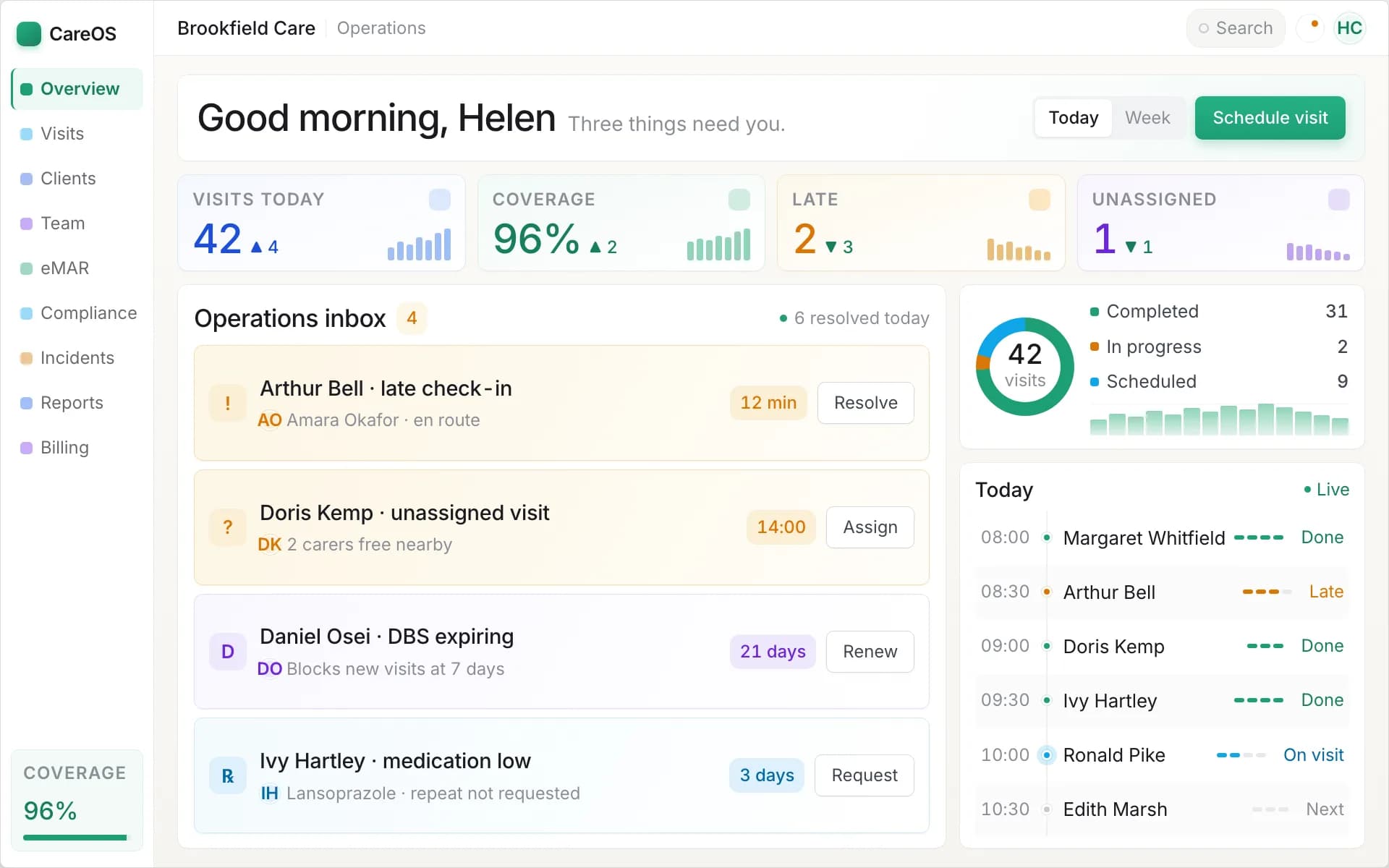
The operations dashboard: the day's position, the alerts raised overnight, and what still needs a decision.
Four tests for AI in a regulated care setting
Before any capability list, the tests. Care is a regulated, safety-critical setting where the record is a legal document and a person can be harmed by a wrong number. AI belongs in it, but only on terms. These four are the terms we would hold any vendor to, including ourselves.
One: the numbers must be deterministic; only the words should be generated. If a system tells you a shift needs four carers, that number must come from a dependency tool or a staffing calculation you can show an inspector, not from a language model's impression. The model may write the rationale, flag the gaps, and put it in plain English. It must not decide the number. The distinction sounds academic until an inspector asks how you arrived at your staffing level and the honest answer is that the software guessed.
Two: anything that writes to a clinical or regulatory record proposes; a named human disposes. A care plan amendment, a risk assessment, a policy, a safeguarding referral. Every one of those should arrive as a draft with an approval step and an audit trail showing who accepted it. This is not caution for its own sake. It is the difference between AI that helps you and AI that quietly authors your clinical record while nobody is looking.
Three: absence of data must never be reported as a good result. This is the failure mode that catches people out. A home with no doses due today has no on-time medication percentage. It does not have a score of zero, and it does not have a score of one hundred. A resident with nothing charted for two days has not been stable; they have been unobserved. Software that renders "not recorded" as a clean green figure is actively dangerous, because it hides exactly the gaps you needed to see.
Four: every AI call must be logged, meterable and switchable off. You are a data controller. You need to be able to say what was sent, when, by which part of the system, on whose behalf, and what it cost. And you need a switch, because the day may come when you want the system to stop.
If a vendor cannot speak to all four, the AI is decoration.
Monday morning: the rota
The rota is where most managers feel the pain first, and it is where AI is most often oversold. The fantasy is a button that builds a perfect week. The reality worth buying is narrower and far more useful: a system that understands the constraints well enough to propose something valid, explain why, and let you change it.
Scoring the match, and showing its working. The useful unit is not "who is free" but "who is the right person for this call". A scoring engine that weighs skills against the client's needs, availability, travel distance from the previous call, continuity of care, workload balance, compliance status, and fatigue produces a ranked list rather than an alphabetical one. The crucial part is not the ranking. It is that each factor returns a plain-English explanation, so when you override the top suggestion, you can see exactly what you are trading away.
Sizing the shift to the actual need. In a care home, the number of staff a shift requires is not a flat minimum. It is the higher of the care floor and what the residents' assessed dependency actually demands, plus anyone on enhanced observation. A rota builder that sizes to the flat minimum will understaff a high-dependency week and nobody will notice until something happens. One that sizes to the binding requirement, keeps the recommended figure visible when a manager overrides it, and records the deviation, is doing something a spreadsheet cannot.
Filling the gaps when Monday goes wrong. The genuinely valuable moment is 8am when someone calls in sick. What you want is a proposal: here are the affected visits, here is who could cover each, here is why. Not an automatic reassignment. A proposal you can accept, edit, or reject in one pass, with the same conflict, working-time and compliance checks running on the result that would run on a manual change.
The guards that should never be AI. Double-booking, working time limits, a carer whose mandatory training has lapsed, approved leave. These are hard rules and they should be enforced deterministically, in code, on every path. AI can suggest; only the rules engine should be allowed to permit.
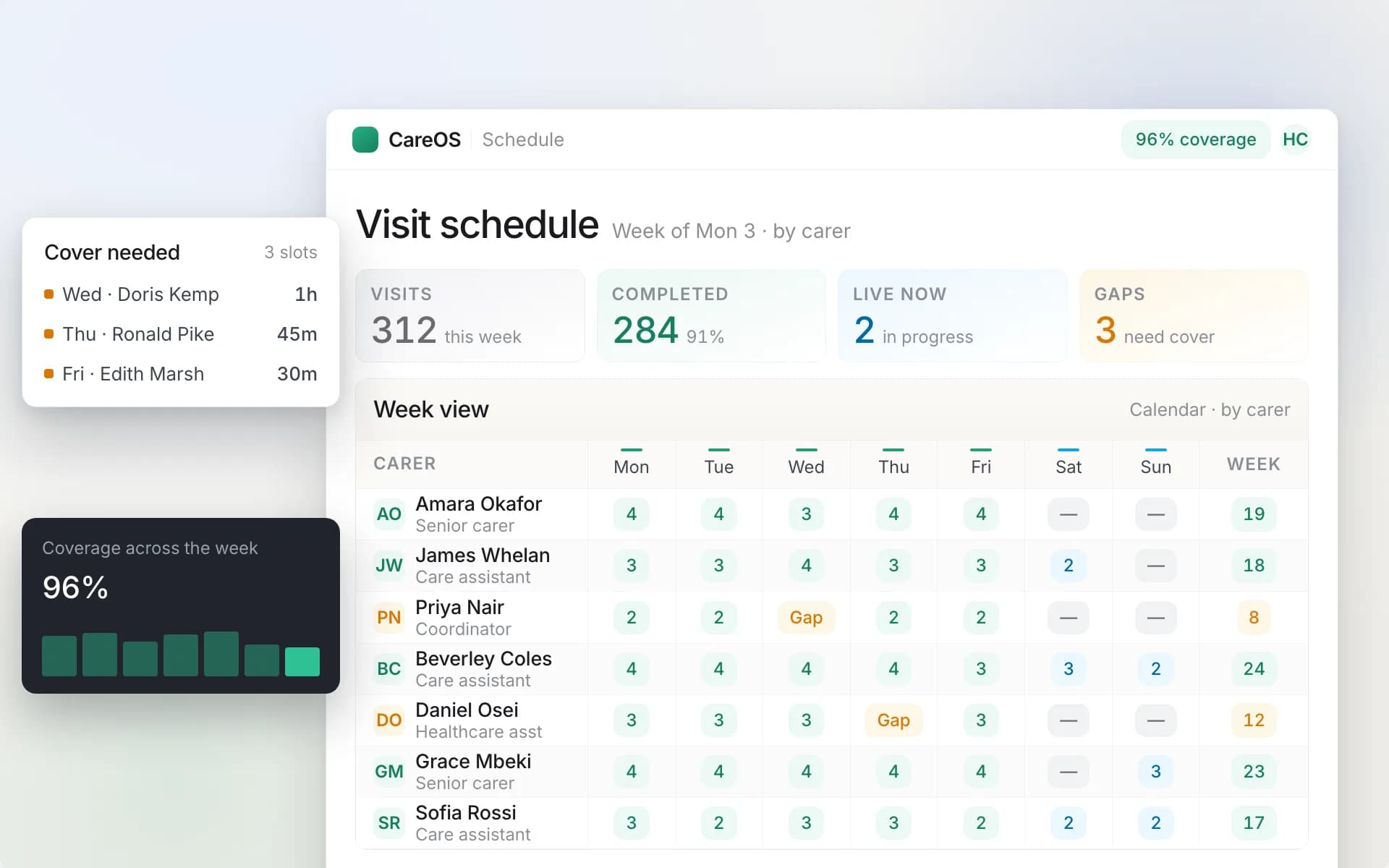
The scheduling board: recurring patterns generated forward, with conflict and compliance checks on every change.
Getting a new person on the books
This is the part of the week nobody budgets for and everybody loses days to. An enquiry arrives, usually as an email, often from a local authority broker with a response window measured in hours. Someone has to work out whether you can take it, get the assessment done, and turn a pile of documents into a care plan, a risk assessment and a rota entry.
Reading the enquiry. An inbound email can be turned into a structured enquiry automatically: the person's details, the hours requested, the postcode, the funder, the start date. Not to act on unattended, but so the coordinator opens a form that is already ninety per cent filled in rather than a blank one.
Answering "can we take this?" in seconds. For home care this is the question that wins or loses local authority work, because brokerage windows are short and the honest answer usually requires someone to stare at a map and a rota. A capacity check that takes the postcode and the requested times and tests them against your actual coverage, your carers' locations and your existing calls turns a forty-minute exercise into a few seconds. It also stops the opposite failure, which is accepting a package you cannot staff and discovering it three weeks later.
Scoring which enquiries to chase. When ten enquiries land in a week and you can service six, the ranking matters. A conversion likelihood with a short written reason gives a coordinator somewhere to start, without pretending to be a decision.
Turning documents into records. This is where the hours actually go. A new client arrives with a hospital discharge summary, a social worker's assessment, a previous provider's care plan, and a medication list. Historically someone retypes all of it. Document extraction reads them and produces a draft client record, a draft needs assessment, and a draft care plan with outcomes, risks and carer tasks, each linked back to the source so a manager can check any field against the document it came from. Nothing is committed until a human confirms it.
Paper, without pretending paper is gone. Plenty of assessments still happen at a kitchen table with a pen, and any vendor who tells you that stops on day one has not worked in the sector. A printed form with machine-readable anchors, photographed on a phone and read back into a draft assessment, respects how the work actually happens while still ending up as structured data.
Drafting the risk assessment. A risk assessment is the document most likely to be thin, because writing a good one is slow. AI drafting that reads the person's health conditions, incident history, behaviour support plan and the products in their home, then works through the sector's CQC risk categories and drafts the ones that genuinely apply, with a residual rating, who is at risk, control measures and what to do if it occurs, changes the economics of doing it properly. Critically, it proposes into the editor. The manager picks what to apply and saves through the normal route, so the assessment is theirs.
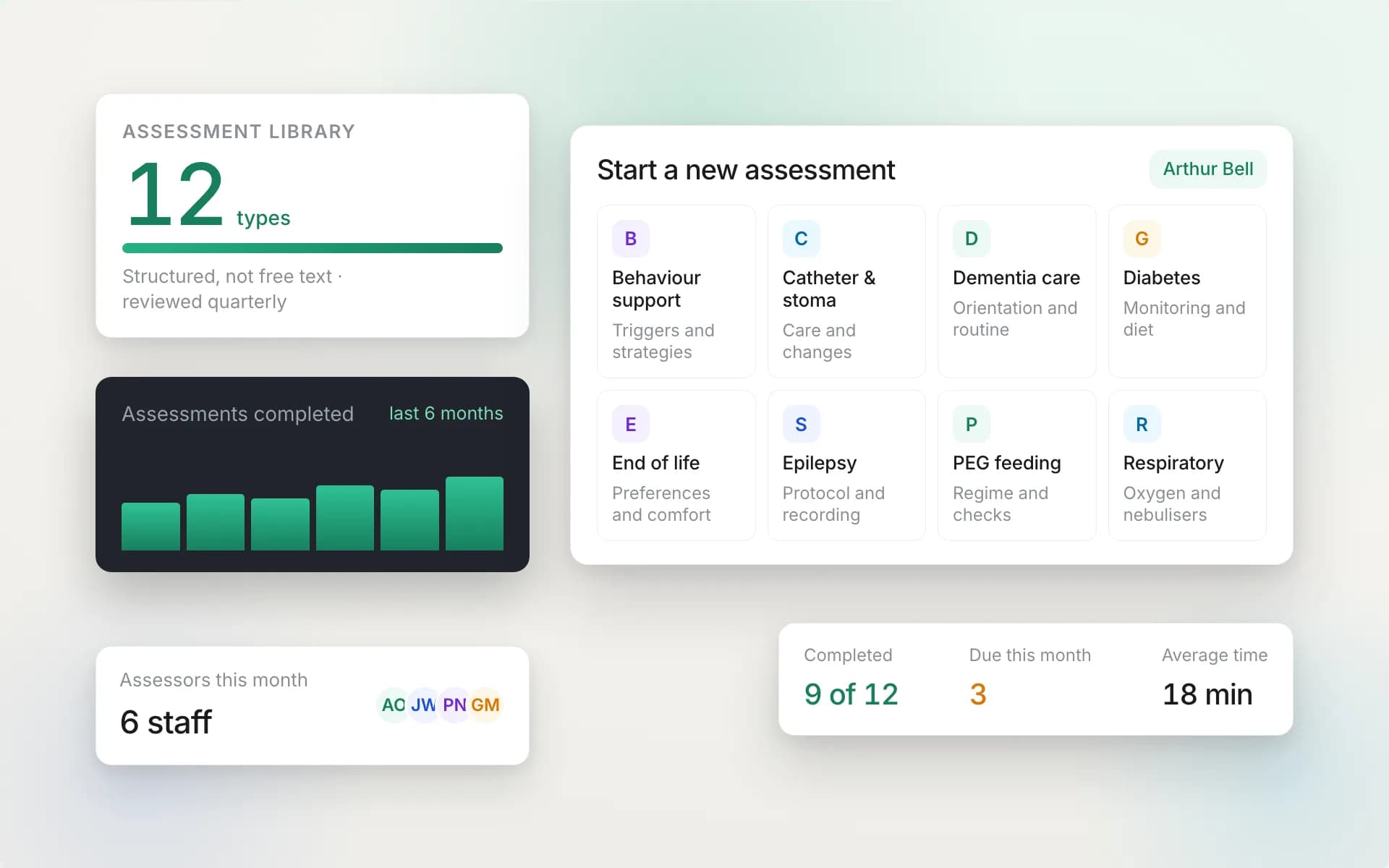
Assessments captured as structure, not prose, so the care plan and the risk assessment can be built from them.
The care record that writes itself
Care recording is a tax on the person delivering the care. Every minute a carer spends typing is a minute not spent with the person, and the quality of what gets typed at the end of a long shift is not what anyone wants in a clinical record.
Voice, structured. A carer speaks a note. The system maps it into the domains the service already charts: food and fluid, continence, mood and wellbeing, sleep, skin integrity, activity. The carer reviews and corrects what came back before anything is saved. The result is a structured entry that reports and audits can actually read, produced in the time it takes to say a sentence, and confirmed by the person who was there.
Notes that keep their meaning. A polish pass that tidies grammar and spelling without altering clinical content helps a note written in a hurry become a note an inspector can read. The line to hold is that it must not rewrite the substance, and the original must survive.
Amendments that say they are amendments. When an office corrects a carer's note, the correction must be visibly a correction, with who made it, when and why, and the carer's original words preserved. Anything less quietly rewrites history, and history is what an inspection examines.
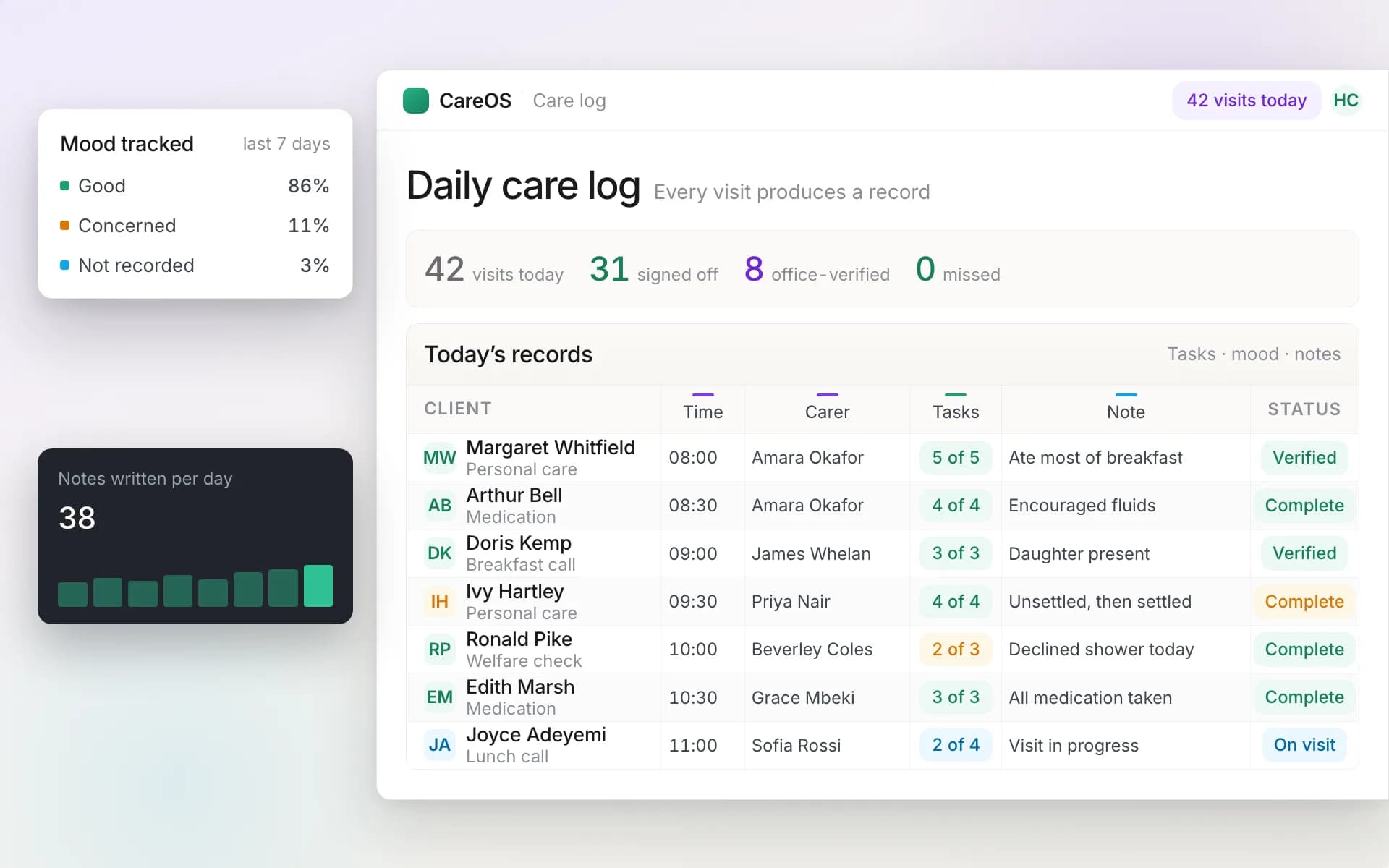
The care log: what was delivered, what was observed and what was said, per person per day.
Families, without the ten phone calls
Family contact is unbudgeted work that lands on the same people who are already running the rota. Most of it is a relative wanting reassurance that something happened, which the system already knows.
A family portal that shows relatives what care was delivered, when and by whom removes the majority of those calls on its own. Where AI helps is the update nobody has time to write: a periodic summary of how someone has been, drafted from the actual records rather than from memory, for a manager to read, correct and publish. The drafting is the slow part; the reviewing is quick.
Two rules keep it safe. What a family sees is a decision the service makes, not a default, so the boundary between the care record and the family view is explicit and configurable. And nothing reaches a family unreviewed, because a generated paragraph about a person's mother is precisely the wrong place to discover that a model has drawn the wrong inference from a thin week of notes.
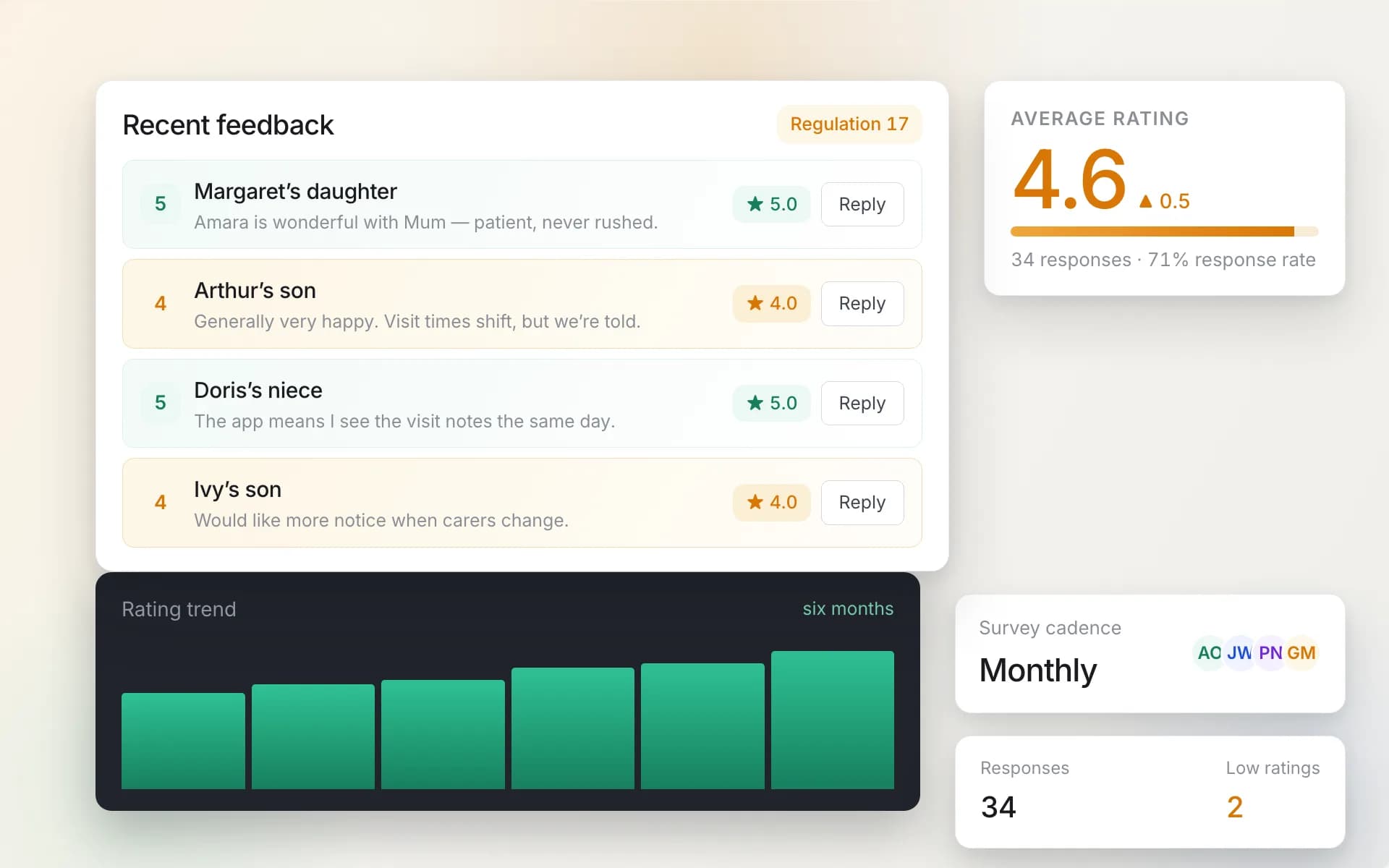
Family updates drafted from the care record, reviewed by a manager before anyone outside the service sees them.
Knowing before you would otherwise find out
This is the section that matters most, and it is the one most vendors have the least in. Almost every serious incident in a care service was visible in the record before it happened. Not obvious, but present, spread across a fortnight of small entries nobody had time to read together.
A daily brief that only speaks when it should. A pass over the last twenty-four hours of care records that flags what changed, then writes it up in a paragraph a manager can read with a coffee. The design decision that makes it useful is that it stays silent on days when nothing is flagged. A digest that arrives every morning regardless is a digest people stop opening, and then it is worse than nothing, because everyone assumes someone is reading it.
Early warning across clinical signals. In a care home, a nightly pass can score each resident across a set of clinical signals built from what is already charted, persist the result as a dated snapshot, and then look for movement between bands rather than absolute values. This is early warning, not prediction: it is not forecasting a fall, it is noticing that fluid intake, weight, skin integrity and continence have all drifted the same way over three weeks, which is the pattern a human would spot if a human had time to look at all of it at once.
Turning an escalation into a proposal. The step that closes the loop is the one that usually goes missing. A signal escalates. Rather than adding another alert to a list, the system reads the person's current care plan, works out whether anything already covers the escalated signal, and drafts a specific amendment for a clinical lead to accept or reject. The alert becomes a decision waiting to be made rather than a notification waiting to be dismissed.
Behaviour patterns in supported living. Where a positive behaviour support plan is in place, an analysis across recorded antecedent-behaviour-consequence charts, restrictive practice records and strategy effectiveness can surface time-of-day patterns, antecedent clusters and setting events, with an explicit confidence score and a drafted plan update. The confidence score is what makes it safe to act on: below a threshold it is a hypothesis for the team to consider, above it the PBS lead is told directly.
Safeguarding language in messages. Concerns often surface first in an ordinary message rather than an incident form, because the person raising it is not yet sure it is a concern. Keyword detection with sensitivity a manager can tune, raising an alert and optionally an incident record for confirmation, catches the ones that would otherwise be a line in a thread nobody escalated.
Absence as a signal. Perhaps the most valuable and least glamorous item on this list. Residents with nothing charted in forty-eight hours. Medications due today with nobody rostered to give them. Post-fall neurological observations that never happened. A night shift with no registered nurse on it. Care tasks left unfinished yesterday. None of these need AI at all, and all of them need someone to be looking. A system that scans for the absence of expected records is doing something spreadsheets structurally cannot.
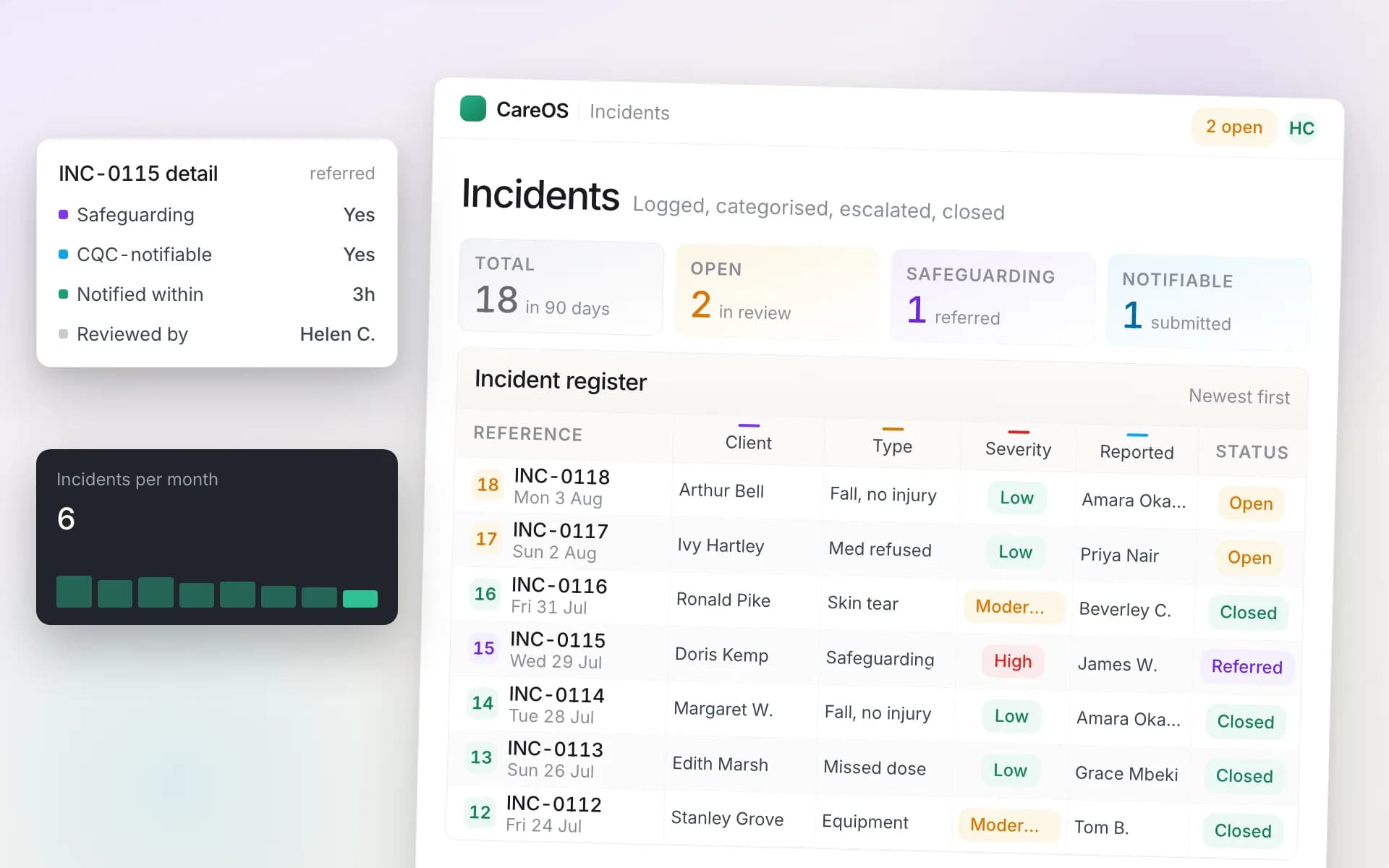
Incidents with severity, safeguarding status and notifiability tracked, so nothing notifiable sits unreported.
Medication
Medication is where a care service carries the most risk per minute, and where the difference between a digital form and a real electronic MAR shows up fastest.
The baseline is a MAR that presents each due dose to the carer at the point of care and records administered, refused, withheld or unavailable with a reason. What raises it above a digital form is what happens when a dose is not recorded.
Overdue and uncovered. A dose that passes its window without a record should tell the office while there is still time to do something. Separately, and more usefully, the system should tell you at the start of a day that a person has medication due and nobody scheduled to give it, which is the failure that produces a missed dose before anyone has had a chance to make a mistake.
Allergy and interaction checks. Cross-checking a person's recorded allergies against their active medications, and surfacing potential clashes for clinical review, is a cheap safety net for a class of error with severe consequences.
A home-wide position, honestly reported. Managers need to answer "is our medication practice safe right now" without opening thirty resident records. The trap is that the honest version of that figure has to handle "no doses due" as a non-answer rather than a perfect score, and has to compare a wall-clock dose time against a stored timestamp correctly, or it reports every dose an hour late for two-thirds of the year and looks fine all winter.
A record that can be corrected properly. Carers make recording mistakes. The right answer is a correction that supersedes the original, preserves it, records a reason and shows on the chart as a correction, not an edit that overwrites what was there.
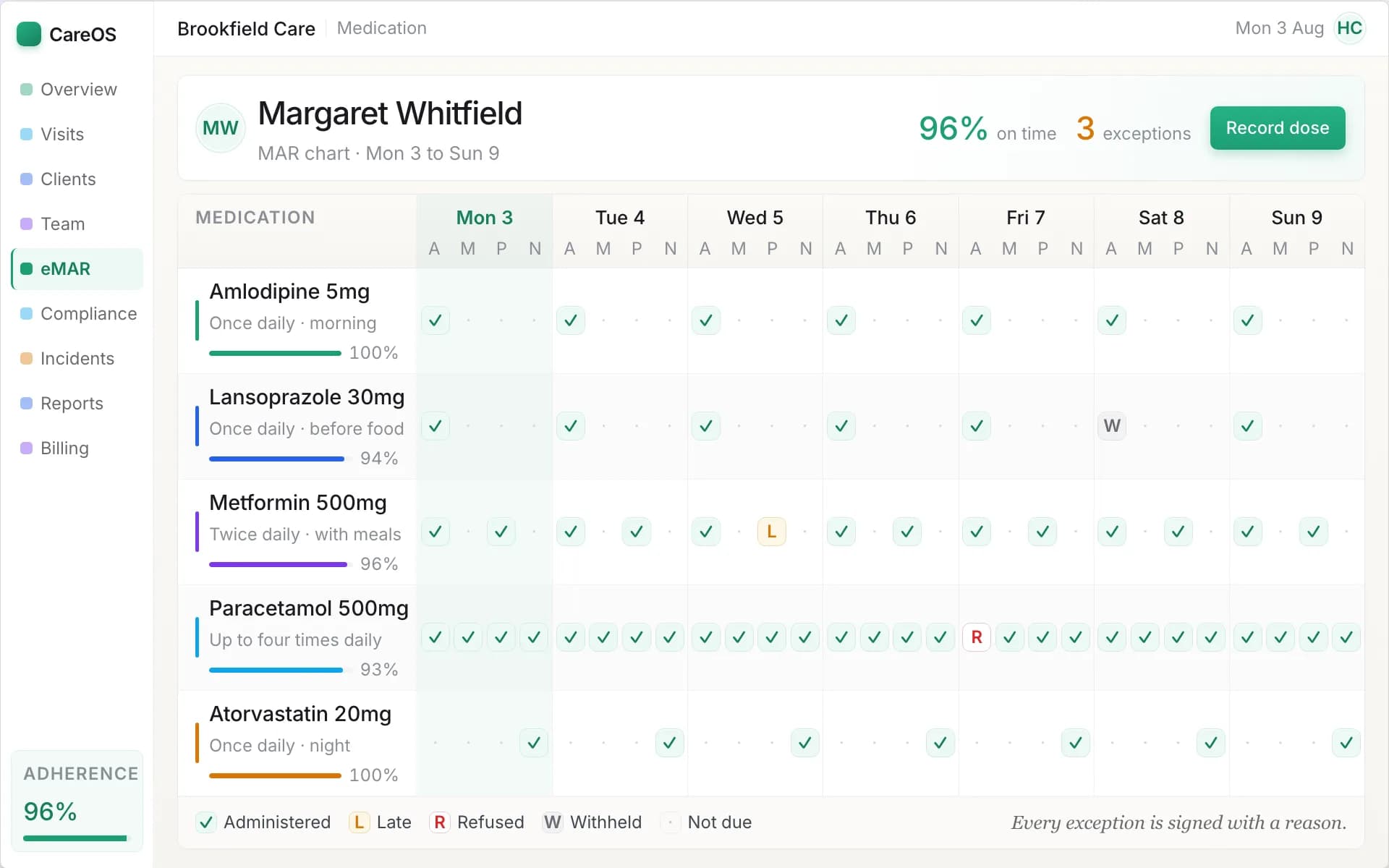
The eMAR chart: every dose accounted for, with missed and late doses surfaced to the office in real time.
The money leaking out of the timesheets
Every care service loses money it cannot see, in both directions. Visits that ran long and were never claimed. Visits claimed that did not happen. A local authority rate applied to a private client. A pay rate that expired mid-period, so half the month priced correctly and half fell through to something lower without a word. Mileage estimated rather than calculated. None of it is fraud and all of it is invisible until somebody reconciles a year.
The reason this is an AI section rather than a finance section is that the useful version is exception detection, not calculation. The arithmetic should be deterministic and auditable. What is worth automating is deciding which of four hundred timesheets a human should actually look at.
Confidence and flags per timesheet. Scoring each submitted timesheet against the shift it belongs to, the booking behind it and the recorded attendance, then surfacing only the ones that disagree, turns a full reconciliation into a short exceptions list. A weekly view grouped by worker with totals is the version a manager can act on in twenty minutes rather than two days.
An explanation for any line. The question that costs the most time is not what an invoice says but why it says it. Being able to open a single invoice line or a single visit and get a written explanation of how the figure was reached, which rate applied, which band, which uplift, which travel rule, ends a category of dispute with funders and with staff that otherwise consumes a finance day a month.
Rates that expire without telling you. A rate rule with an end date falling inside a billing period is one of the quietest failure modes in care finance. The period prices normally up to the boundary and then silently resolves to something else. Detecting a rate that expires mid-period and raising it before the run rather than after the invoice is a small piece of engineering that saves a genuinely awkward conversation.
Blocking versus warning. This distinction matters more than it sounds. A missing pay rate should stop a payroll run, because the alternative is paying somebody nothing and hearing about it from them. A rate that fell back to a default should warn, because the person is still paid and a human needs to decide. Systems that treat every exception identically train people to click through all of them.
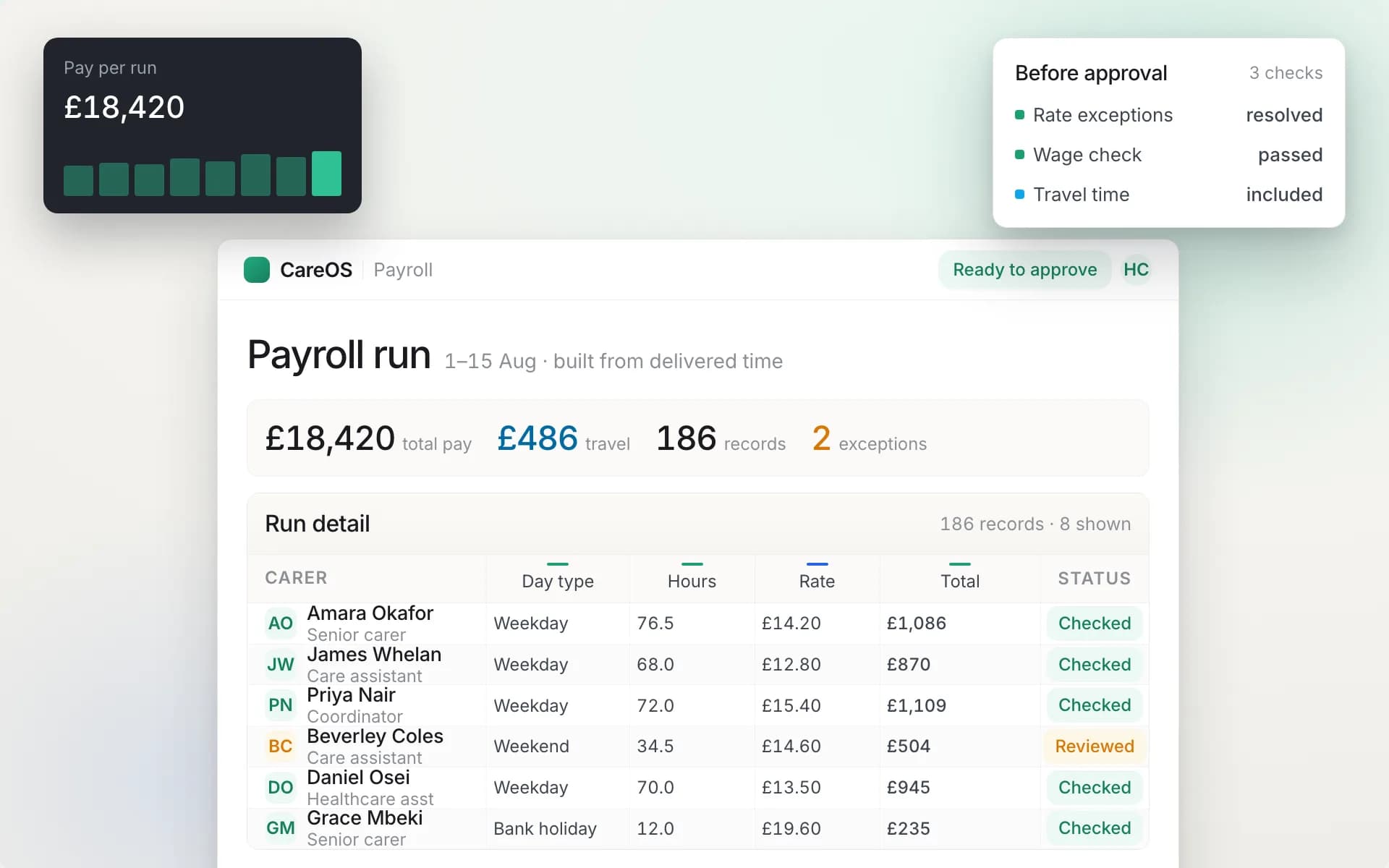
Payroll built from what actually happened, with the exceptions a human needs to see raised before the run is approved.
Compliance, and the inspection you have not had yet
Compliance is where AI earns its place quietly, because most compliance failures are not failures of intent. They are failures of attention over long periods.
Policies that are grounded, not generated. A policy drafted by a general-purpose model is a liability: it will cite regulations confidently and sometimes wrongly. Grounded drafting works differently. A curated sector skeleton supplies the required sections and the permitted legal basis. The service's own profile is injected so the policy is about your organisation rather than a generic one. And every citation the model produces is checked against the allowed sources, with anything ungrounded dropped rather than published. The draft then sits behind an approval step, because a policy nobody approved is not a policy.
Watching the law change. Policies go stale because legislation moves and nobody notices. Fingerprinting the actual pieces of law and statutory guidance your policies cite, checking them on a schedule, and summarising what changed turns policy currency from an annual panic into a standing process. The important design choice is that flagging which of your policies are affected stays a human decision, and that an unreadable page is reported as unreadable rather than as a change, because a false "the law changed" alert is worse than none.
Documents that drift from practice. For children's services in particular, the Statement of Purpose is a regulated document that describes what you do, and services change faster than documents do. A periodic review that compares the published document against the last quarter of real operational records and reports where practice has drifted is the sort of check nobody has time to run manually and everybody is judged on.
Staff compliance as a live position. DBS, right to work, mandatory training, supervisions, appraisals, professional registration. The value is not the matrix; it is the chasing. Alerting before expiry is table stakes. Continuing to chase after expiry is the part that is usually missing, and the lapsed certificate nobody chased is the one that appears in a report.
Notifications, drafted. When an incident is notifiable, the regulatory notification needs writing and it needs writing now. A draft assembled from the incident record that a manager reviews and sends removes the blank page at the moment when everyone is busiest.
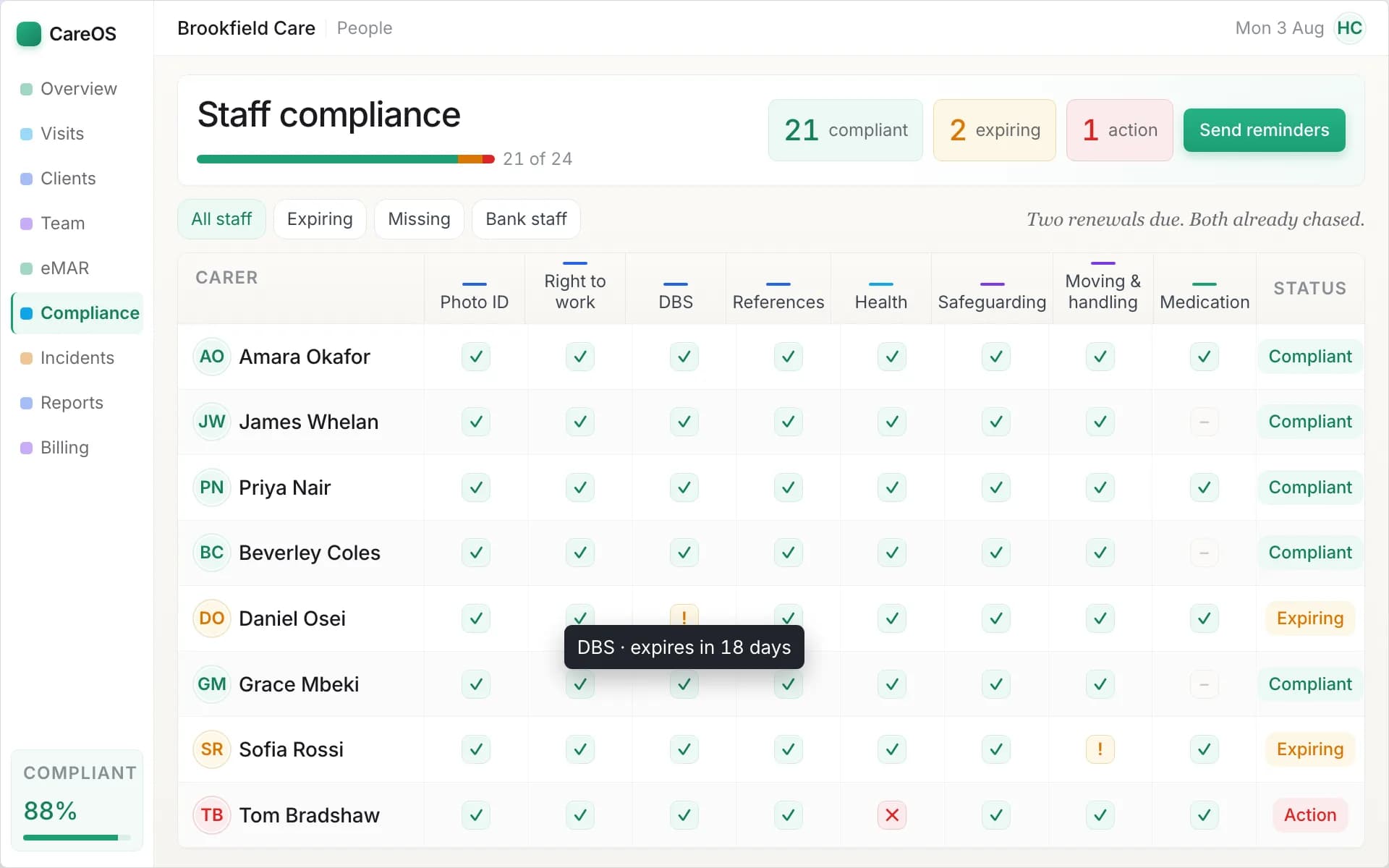
The compliance matrix: every requirement per person, with expiring and expired items chased rather than merely displayed.
Supported living, children's services and the rest
Care is not one service model, and AI built on the assumptions of one setting produces confident nonsense in another. A visit-based domiciliary agency, a twenty-four-hour supported living tenancy, a children's home and a residential nursing home differ in what a shift means, what a record is for, and which regulator is asking.
Supported living. The documents that matter are person-centred and slow to write: a one-page profile, a communication passport, a routine, a support plan under the Care Act. All of them draft far better from records the service already holds than from a blank template, and all of them are reviewed by someone who knows the person before they count. Alongside them sit mental capacity assessments, restrictive practice recording with its own analysis, and, where relevant, structured support for a learning disability mortality review. The common thread is that AI reduces the cost of doing the person-centred thing properly, which is otherwise the first casualty of a busy month.
Children's services. A children's home is judged partly on whether its published Statement of Purpose still describes what it actually does. Analytics over the running daily log, mood trend, significant events, restraint counts, with a deterministic flag when the pattern regresses, gives a manager a view of a young person's fortnight that reading forty entries individually would not. The narrative on top is generated; the flag underneath is not, which is the right way round when the flag is the thing you would act on.
Care homes. Occupancy, dependency and the acuity-driven staffing described earlier, plus admissions: a pipeline that carries an enquiry through to a placement with readiness checks and the funding pathway recorded rather than remembered.
Staffing agencies. A different shape again, where the client is an employer rather than a person, and where the timesheet exception work above is most of the operational load.
The question to ask a vendor separates products quickly: was this built for my service model, or adapted from another one? A system that assumes everyone is under one roof will get home care travel wrong, and a system built around discrete visits will not know what to do with a waking night.
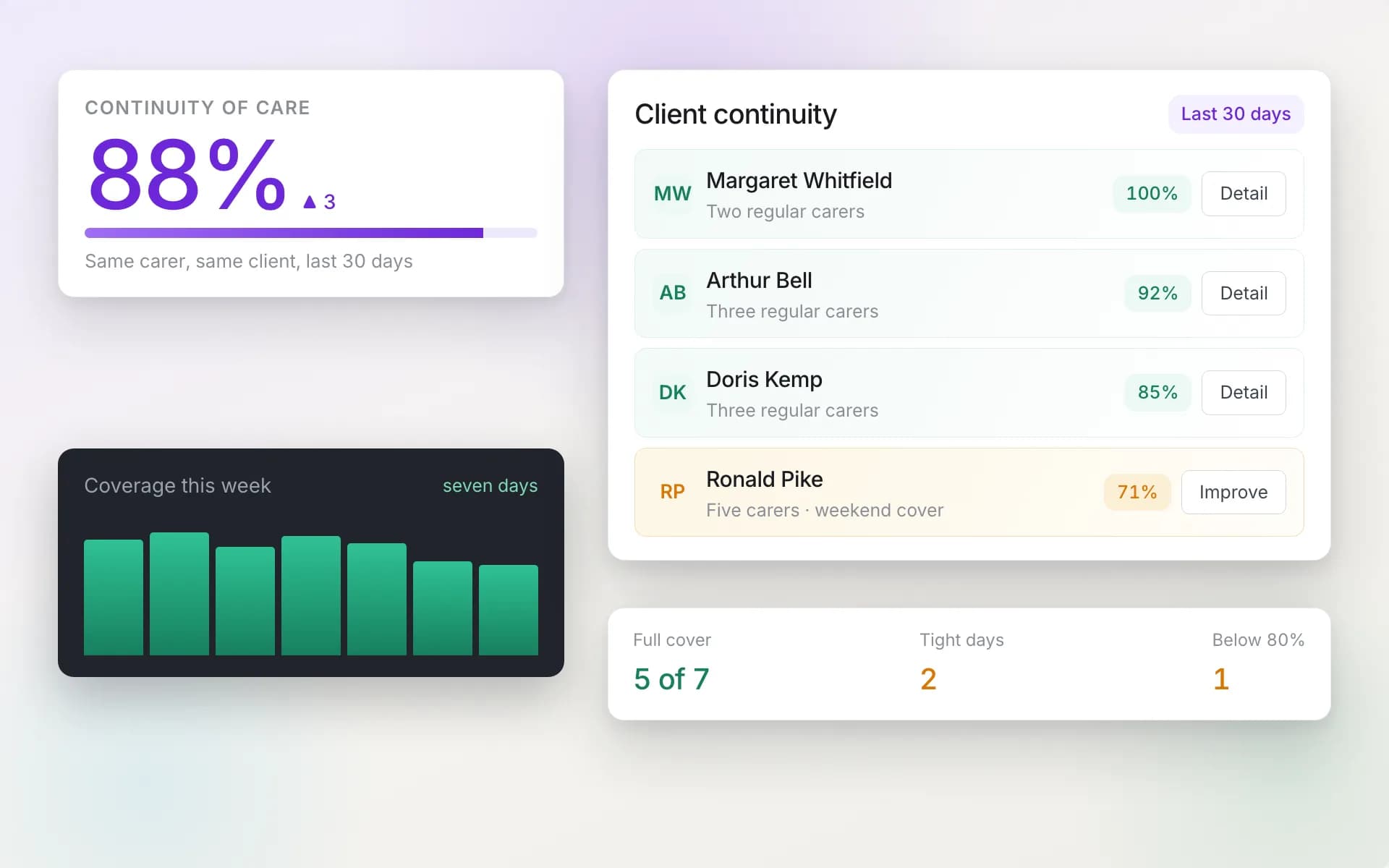
Operational reporting shaped to the service model, rather than one shape stretched over all of them.
Recruitment, which is also an operations problem
Vacancy time is a rota problem before it is an HR problem, and the slowest part of hiring in care is usually the pre-screening.
A recruitment pipeline that lets candidates apply, answers pre-qualification questions, and scores the result automatically can move genuine candidates forward within minutes rather than days. Two design points make it safe: knockout questions are evaluated before the pass mark, so a candidate who cannot legally work is declined for the right reason and told so, and any free-text answer forces manual review, because no machine should decline a person on a question no machine read. Every automatic decision is attributed as automatic in an append-only history, so a rejected applicant's file shows exactly what happened and why.
Around it, right-to-work, DBS, professional register and driving licence checks can be recorded against the person's compliance profile, including the ones with no employer API, where the honest implementation records that a human performed the check rather than pretending a machine did.
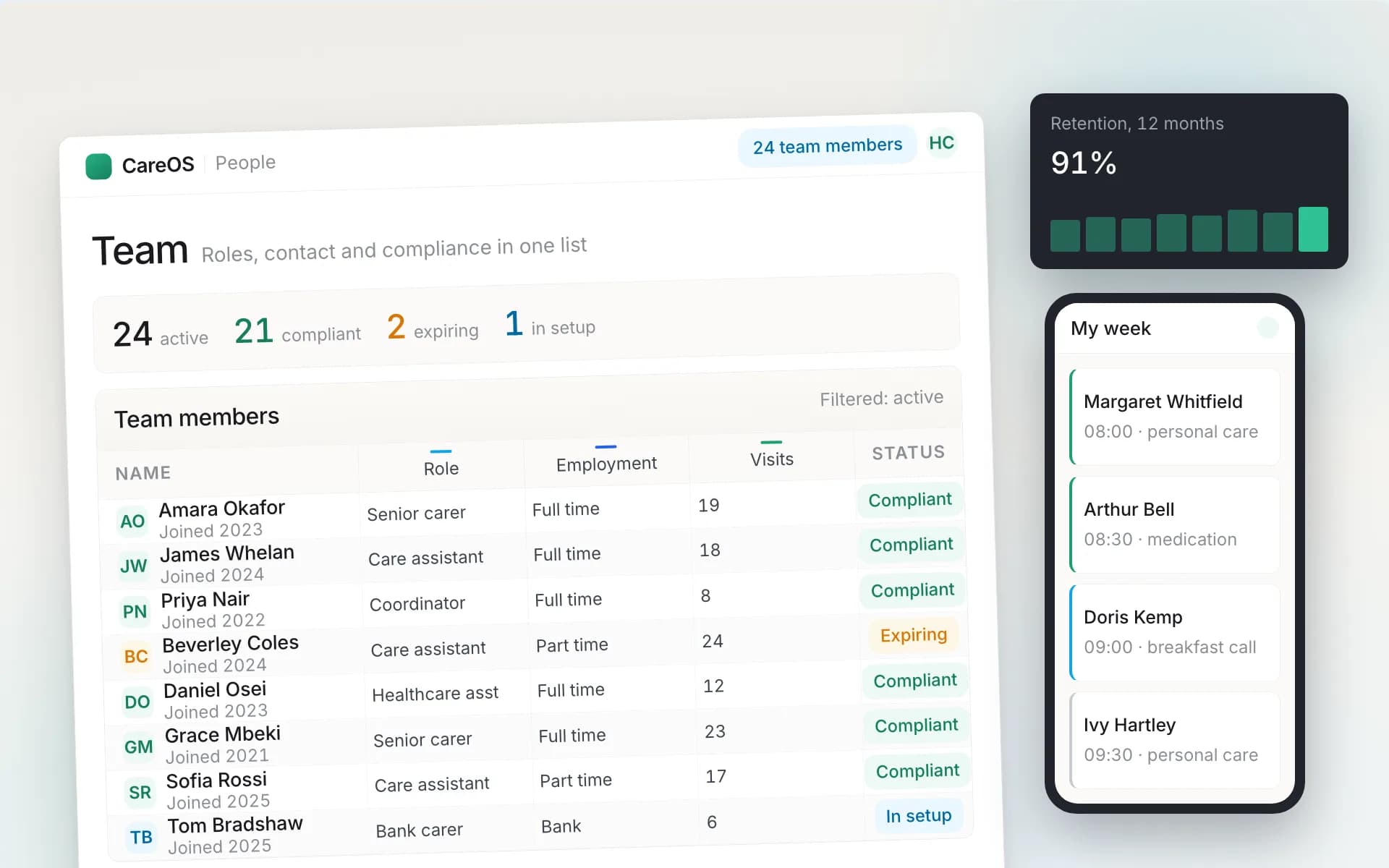
Staff records, roles and compliance in one place, so the rota knows who is safe to send.
Asking the system a question
Every manager has questions the reports do not answer. An in-product assistant that can answer questions grounded in your own help library and your own data closes the gap between "the system knows this" and "I can get at it".
The two things to check are scope and permission. Scope, because an assistant that will confidently answer anything will confidently answer wrongly. Permission, because an assistant is a route to data, and it must disclose only what the person asking could already reach by navigating. Where something is withheld, it should say so, rather than reporting that the data does not exist, which is both untrue and a hint.
The governance layer nobody demos
This is the part that never appears in a sales deck and the part your data protection officer will ask about.
A switch. You should be able to turn AI off for your organisation entirely, and the product should keep working, with deterministic facts in place of generated prose.
A log. Every call recorded: which part of the system made it, on whose behalf, which model, how many tokens, what it cost, whether it succeeded. Without this you cannot answer a subject access request properly and you cannot audit your own AI use.
A meter. AI has a running cost and it should be visible and bounded, so usage cannot surprise you.
A boundary. Clear separation between what leaves your tenancy and what does not, and a clear statement of which capabilities need an external model at all. Several of the most valuable things on this list, the absence detection, the compliance chasing, the staffing calculations, involve no model whatsoever.
Graceful degradation. The tell for a native implementation. With AI switched off, does the morning briefing still produce its facts and lose only its narrative, or does the page break?
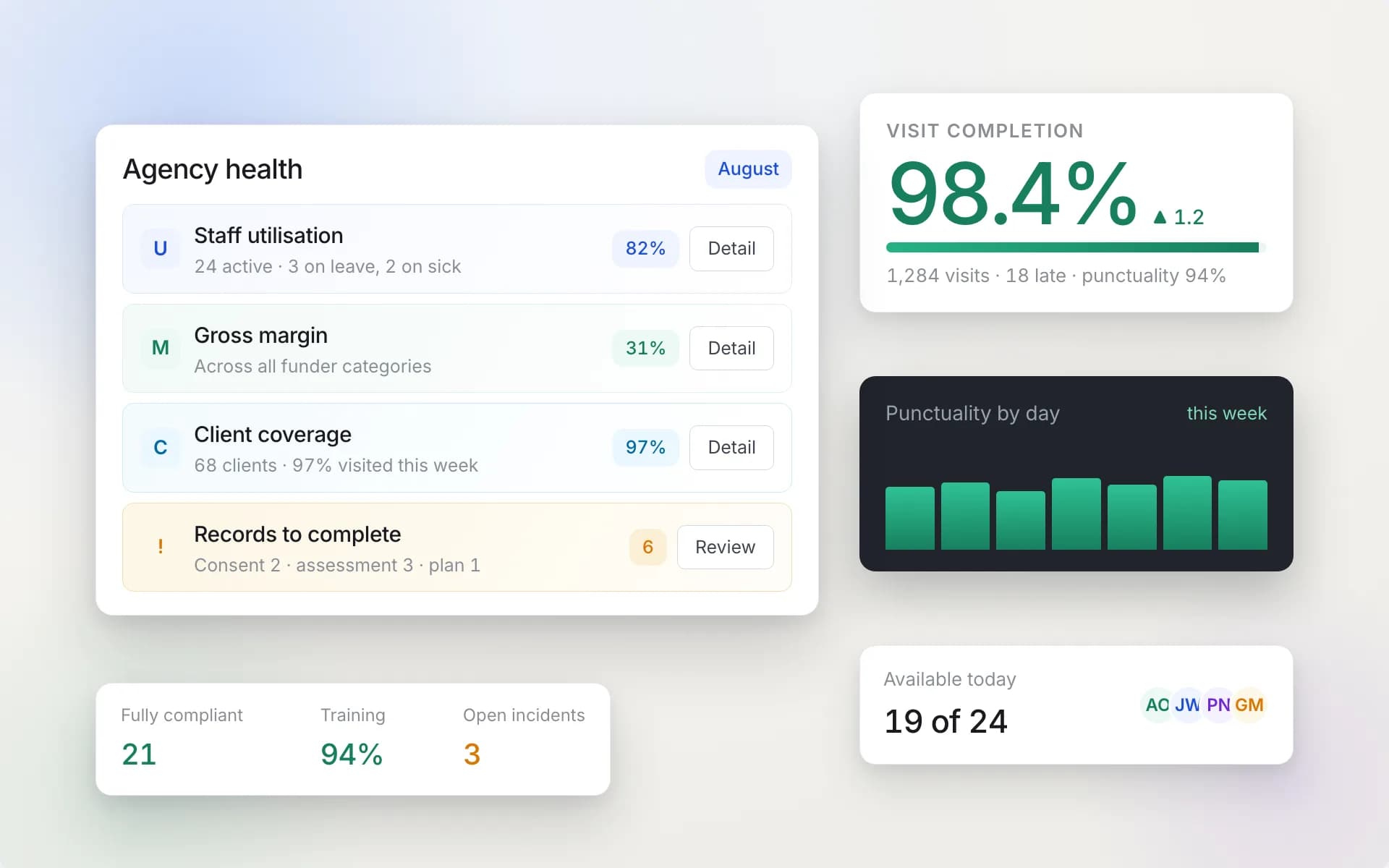
Reporting built on the same records the care team fills in, so the numbers and the notes cannot disagree.
What to ask any vendor
Take this to every demo, including ours. Ask them to show you, not tell you.
Ask them to remove a carer from Monday and rebuild the affected visits in front of you, and count the clicks.
Ask what happens when a dose is due and nobody is rostered to give it.
Ask them to show you a resident with nothing charted for two days, and see whether the system says "no data" or shows a comfortable green figure.
Ask where an AI-drafted care plan amendment goes, who approves it, and what the audit trail records.
Ask to see the AI call log, and ask where the off switch is.
Ask what the product does with AI disabled.
Ask how a carer's note is corrected, and whether the original survives.
Ask what they would hand an inspector, and let them open it.
Ask how you would get all of your data out if you left.
A vendor who welcomes those questions is telling you something. So is one who redirects to the roadmap.
Where CareOS fits
CareOS was built for UK care providers with the AI substrate underneath the product rather than beside it, which is why the capabilities above are described the way they are: every call audited, a per-organisation switch, deterministic numbers with generated explanations, and anything touching a clinical or regulatory record arriving as a draft for a named human to approve.
It covers domiciliary care, care homes, supported living, children's services and staffing, with care management across rostering, eMAR, care planning, compliance and finance in one system. If you would like to test any of the above against your own service, book a demo and bring the week that broke your current setup. Bring the checklist too.
Frequently asked questions
What does AI actually do in care management software?
In a well-built system it does four kinds of work: it drafts documents from records you already hold, such as care plans and risk assessments; it structures what carers record, including spoken notes; it reads across weeks of records to surface changes a person would miss; and it explains deterministic calculations, such as why a rota suggestion was made, in plain English. It should not be deciding staffing numbers or authoring clinical records unsupervised.
Is it safe to use AI in a CQC-regulated care service?
It can be, on conditions. Numbers that an inspector may question should be calculated deterministically rather than generated. Anything written to a clinical or regulatory record should arrive as a draft that a named person approves, with an audit trail. Every AI call should be logged, and you should be able to switch AI off for your organisation without the product breaking.
Can AI write a care plan?
It can draft one from an assessment or from documents such as a hospital discharge summary or a previous provider's plan, producing outcomes, risks and carer tasks linked back to the source. It should not publish one. The draft is a starting point that a manager reviews, edits and activates, which is both safer and usually faster than writing from a blank page.
Does AI in care software replace staff?
It removes administrative work rather than care work. The tasks it takes on are retyping documents into records, chasing expiring compliance, reading across a fortnight of notes to spot a change, and drafting paperwork nobody enjoys writing. Care delivery, clinical judgement and every decision that carries risk stay with people.
What is the difference between AI that is built in and AI that is bolted on?
A bolt-on sits beside the product, usually as a chat box or a summarise button, and reads only what you paste into it. A native implementation reads the records the rest of the system reads, writes proposals into those records with approval steps, and is governed by the same controls, including an off switch, an audit log and cost metering. The quickest test is to ask what the product does with AI disabled.
How do I evaluate AI features during a software demo?
Ask the vendor to demonstrate rather than describe. Have them rebuild Monday after a carer calls in sick and count the clicks. Ask what happens when a medication is due and nobody is rostered to give it. Ask to see a resident with no records for two days and check the system reports missing data rather than a green figure. Ask where an AI-drafted change goes for approval, and ask to see the AI call log and the off switch.
Does AI in care software work offline or without an AI provider configured?
The deterministic parts should. Alerting on missed doses, chasing expiring compliance, detecting absent records and calculating staffing requirements involve no model at all. Well-built systems degrade rather than break when AI is unavailable, returning the underlying facts without the generated narrative, which also matters on the days a provider has an outage.
Keep reading
- Care Management Software: What It Does and How to ChooseWhat the category actually covers, the six modules a complete system needs, why social care and healthcare are different markets, and how to compare vendors against your own worst week rather than their demo.
- Healthcare Management Software in the UK: Types, Features and How to ChooseThe phrase covers four different products bought by four different people. A map of the categories, why care providers get mis-sold the other three, and five questions that settle which one you are shopping in.
- National Living Wage Compliance in Home Care: The 2026 Guide for UK Domiciliary Care ProvidersPaying a carer £13 per contact hour does not mean they receive the National Living Wage. Which hours and payments count, how to calculate the effective hourly rate, and how to find shortfalls before payroll.
CareOS by care setting
The platform is one system with a workspace per setting. See what it looks like for yours:
See CareOS against your own worst-case Monday
CareOS is UK care management software: rostering, eMAR, care plans, compliance and finance in one system, with a workspace built for each care setting and designed around CQC, Ofsted and DSCR requirements.
Book a demo