
eMAR Software: Electronic Medication Records for UK Care Providers
Medication is where a care provider carries the most risk in the smallest amount of time. A carer has a few minutes in somebody's kitchen, a blister pack, a chart, and a list of things to do before the next call. Most of the time it goes exactly as it should. The problem is not the ninety-nine occasions it works; it is that on the hundredth, the paper chart records the failure so quietly that nobody finds out for a month.
eMAR software is the answer to that specific problem. This guide covers what it is, how paper MAR charts fail, what a good electronic system does at the point of care and back in the office, and how to judge one, because the demos all look similar and the differences only surface in use.
What is eMAR?
eMAR stands for electronic medication administration record. It replaces the paper MAR chart with a digital record that presents each due dose to the person administering it, captures what happened, and makes the result visible to the office immediately.
At the point of care the carer sees who the medicine is for, what it is, the dose, the route, the time it was due, and any instructions. They record one of a small set of outcomes: given, refused, withheld, not available, or self-administered, with a reason where anything other than given is recorded. The entry is attributed to them and timestamped by the system rather than written by hand.
Back in the office the same data is a live picture rather than a folder collected at the end of the month. That difference in timing is the entire point, and it is the thing to hold on to when you are comparing products.
eMAR is one module of a wider care management system, and it works best when it is part of one rather than a separate product with its own login, because the medication record needs to know who is scheduled to be with the person and when.
You will also see the same category sold as medication management software or a medication management system. The wider label usually signals that stock levels, ordering, controlled-drug registers and safety alerting are included alongside the administration record itself. Treat the labels as interchangeable when you are searching, and judge the product on the specifics below rather than on which name the vendor chose.
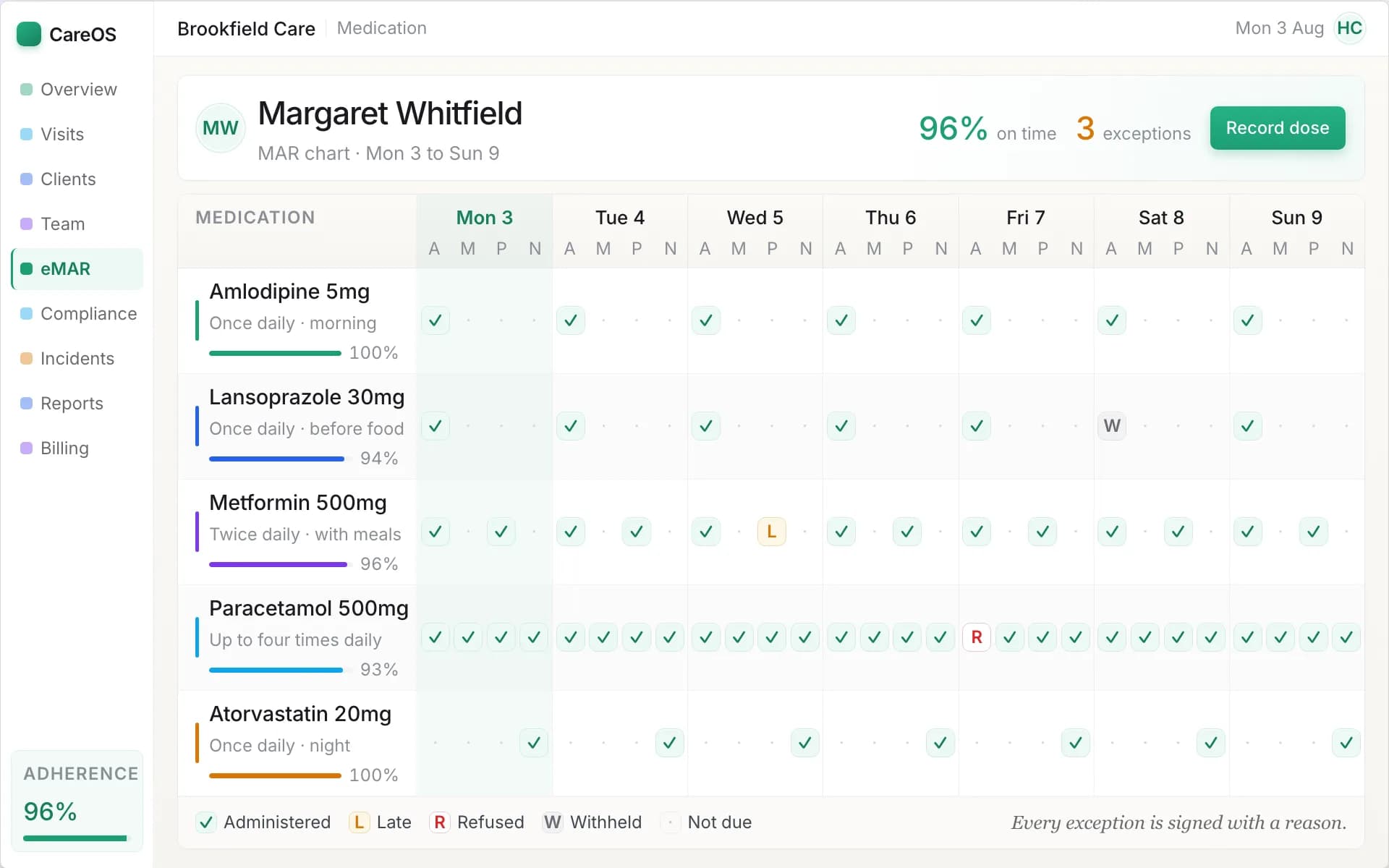
Each dose against the person and the time it was due, with the outcome recorded at the point of care.
How paper MAR charts fail
Paper MAR charts are lawful and have been used for decades. They fail in characteristic ways, and it is worth being precise about them, because a digital system that does not address these specific failures is just a screen.
The blank box. The single biggest problem in the category. A gap on a paper chart is ambiguous: it might mean the dose was missed, or given and not signed, or the person was in hospital. It is indistinguishable from every one of those. Weeks later, at audit, nobody can reconstruct which it was, so the honest answer to an inspector is that you do not know. That answer is expensive.
Discovery lag. The chart lives in the person's home or on the trolley. Nobody in the office sees it until it comes back. A missed dose on the 3rd is discovered on the 30th. Everything you might have done about it, phoning the carer, sending somebody back, contacting the GP, was only possible on the 3rd.
Transcription. Handwriting a chart from a pharmacy label or a prescription introduces an error rate that no amount of care eliminates. Transcription errors in medication records are a recurring theme in the sector, and they are structurally avoidable.
Legibility and attribution. Initials in a small box, weeks later, in a hurry. Who administered this? What does that annotation say? A record nobody can read is a record you cannot rely on.
No pattern visibility. A person refusing their evening medication three times in a fortnight is a clinical signal. On paper, spread across two charts, it is invisible until somebody happens to notice. Nobody has time to happen to notice.
What good eMAR does at the point of care
Shows only what is due, now. The carer should not be scrolling a full medication list looking for the right line. The system knows the round or the visit and presents the doses relevant to it.
Makes the outcome explicit. Given is one tap. Anything else requires a reason, because an unexplained non-administration is exactly what causes trouble later. The set of outcomes should reflect real practice: refused, withheld on clinical instruction, not available, hospital, self-administered, family administered.
Handles as-needed medication properly. PRN is different in kind, not degree. The carer needs to see what it is for, the maximum in twenty-four hours, and the minimum gap since the last dose, and after giving it they need to record whether it worked. A system that treats PRN as a scheduled dose with a flag will let somebody exceed a maximum, and the record will not tell you whether the paracetamol helped.
Supports controlled drugs. Where a witness is required, the system should require one, and record both people. This is one of the clearest cases where software should refuse rather than warn.
Works without signal. Care happens in lifts, rural homes and buildings with thick walls. If the app cannot record a dose offline and sync afterwards, it fails precisely where the paper chart used to work. Ask about this directly and ask what the carer sees when they are offline.
Is fast. A medication round has real time pressure. If recording takes noticeably longer than a signature, staff will do it afterwards from memory, which is worse than paper because it looks authoritative.
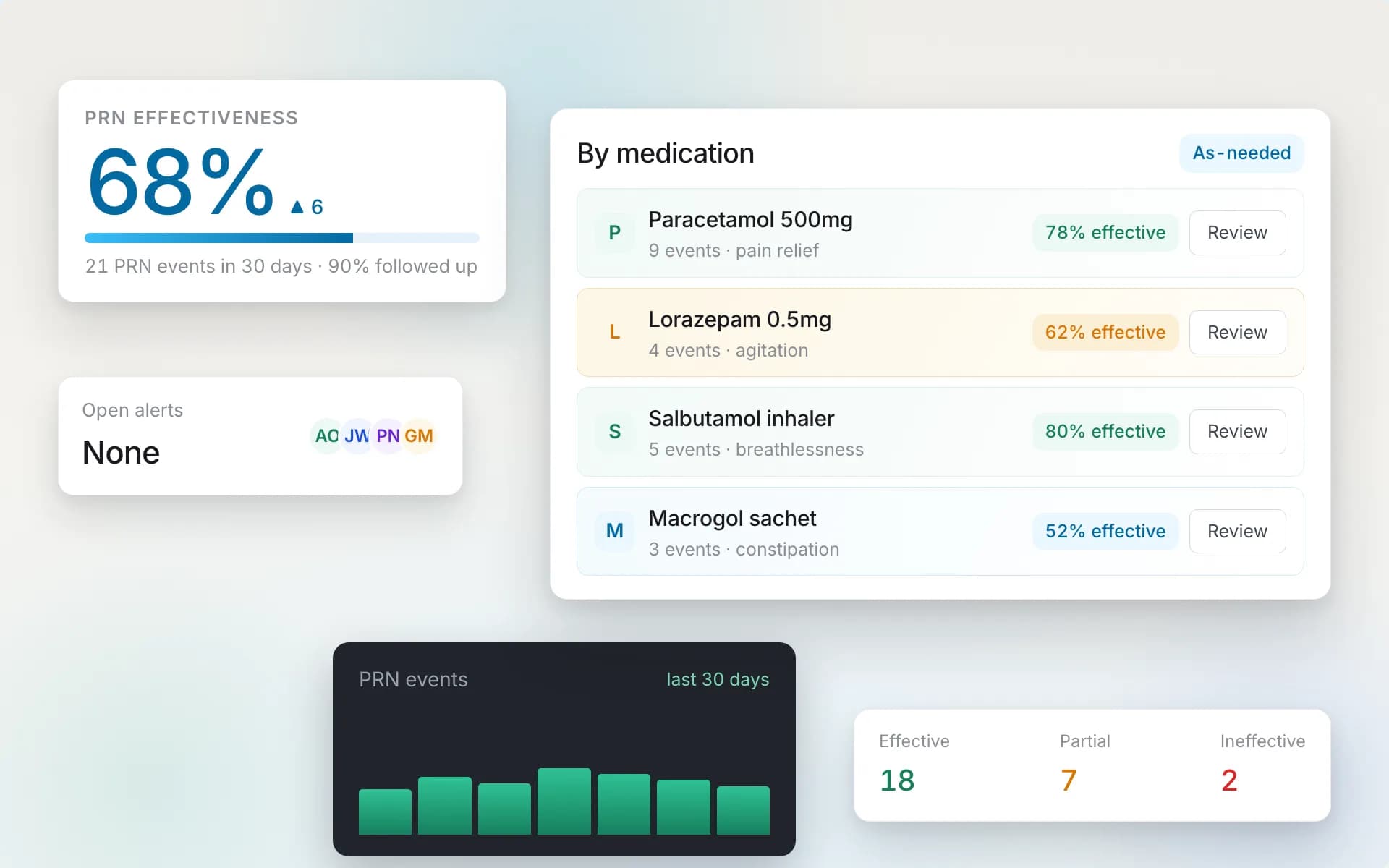
As-needed medication with maximum doses, gaps since the last dose, and whether it actually worked.
What good eMAR does in the office
This is where the products genuinely differ, and where a demo will not tell you unless you ask.
It alerts on a missed dose while it still matters. When a dose passes its window unrecorded, somebody should be told. Not tomorrow, not in a monthly report. That single behaviour is the largest safety gain of the whole category, and it is the question to lead with when you are comparing vendors. If the answer is "it appears in a report", you are buying a filing cabinet with a screen.
It shows the chart as a chart. Managers and inspectors read a MAR chart in a familiar grid: people down one side, doses across, outcomes in the cells. A system that can only show you an event log is technically complete and practically useless in a meeting.
It surfaces patterns. Repeated refusals, doses regularly given late, one person accounting for most of the missed doses in the service, a medicine that is frequently unavailable. These are clinical and operational signals and they should arrive without anybody running an analysis.
It links to the rest of the record. A refusal is often the first sign of something else. If the medication record sits beside the care notes, the incident log and the care plan, the picture assembles itself. If eMAR is a separate product, somebody has to assemble it, and they will not.
It gives you the audit trail. Who recorded what, when, from where, and whether anything was subsequently amended and by whom. An amendable record with no trail is worse than paper, because it looks stronger than it is.
The stronger systems go a step further and tell you at the start of a day that someone has medication due with nobody rostered to give it — the failure that produces a missed dose before anyone has had the chance to make a mistake. That class of check, and what else the AI layer is doing around medication, is covered in the guide to AI care management software.
Medication, regulation and evidence
Medicines management is one of the areas a CQC inspection examines most closely in adult social care, and NICE publishes guidance on managing medicines both in care homes and for adults receiving social care in the community. Neither is quoted here on purpose, because guidance is revised and a summary written today may not be accurate when you read it. Go to the source, and treat any vendor who paraphrases guidance at you with confidence as a sales risk.
What is stable is the shape of the evidence. An inspector asking about medication wants to know: is there a complete record of every dose due and what happened to it; where a dose was not given, is there a recorded reason; are as-needed medicines given within their limits and is the outcome recorded; are controlled drugs handled with the required witnessing; do staff administering medicines have current competence; and when something went wrong, was it noticed, recorded, and acted on.
A good eMAR answers the first four as a by-product of ordinary work. The fifth belongs to your training records, which is why medication and workforce compliance belong in the same system. The sixth is the one that separates services, and it comes down to whether anybody was told in time to act.
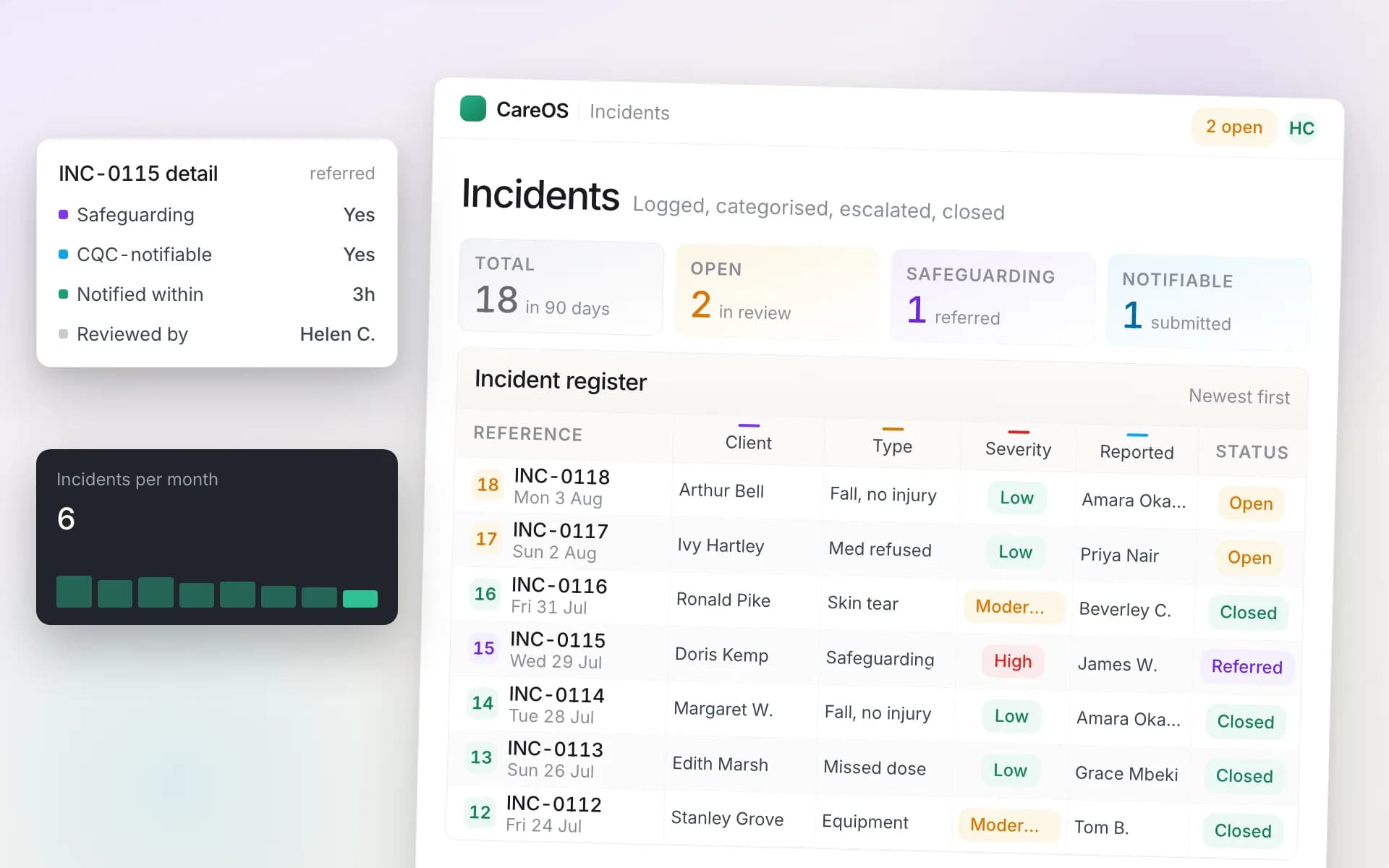
A medication error recorded as an incident, with the action taken tracked to a close rather than left open.
Home care and residential are different problems
In home care, medication is administered during a visit by a lone worker, often with no colleague to check with. The eMAR has to be tied to the visit: which doses are due during this call, at this address, for this person. A dose due at 13:00 when the lunch call runs 12:30 to 13:15 is this carer's responsibility; one due at 18:00 is not, and a system that shows the carer everything due that day invites doses being recorded by whoever is there rather than whoever gave them. See the domiciliary care software guide for how this fits the visit-based model.
In residential care, medication is administered in rounds by a senior or a nurse, to many residents in sequence, from a trolley. The system has to be fast enough to keep up with a round, handle the whole unit, and support the checks the round requires. See care home management software.
A product built for one and adapted to the other usually shows the strain in exactly these details, so ask which it was designed around.
Choosing an eMAR
| Requirement | What to check |
|---|---|
| Due-dose presentation | Only what is due now, tied to the visit or the round |
| Outcomes | Given, refused, withheld, unavailable, self or family administered, with reasons |
| PRN | Indication, maximum in 24 hours, minimum gap, outcome recorded after |
| Controlled drugs | Witnessing enforced, both parties recorded |
| Offline | Records without signal and syncs later, with clear carer feedback |
| Missed-dose alerting | Office notified while it can still be acted on, not in a report |
| Chart view | A readable MAR grid, not only an event log |
| Patterns | Repeated refusals and late doses surfaced automatically |
| Audit trail | Attributable, timestamped, amendments traceable |
| Setup | How medicines are loaded and kept current when a prescription changes |
| Integration | Sits beside care notes, incidents and compliance in one record |
Two questions to ask every vendor. First: a dose was due at 08:00 and it is now 10:00 with nothing recorded. Walk me through exactly what has happened in your system, and who knows. Second: show me the MAR chart you would put in front of an inspector, with a month of realistic data including some refusals.
A note on transition
Moving off paper is the point at which errors are most likely, so do it deliberately. Load the medication records from the current charts with two people checking, not one. Run parallel for a short period, with paper as the fallback and the system as the record, then stop the paper cleanly rather than letting both run indefinitely, because two records that disagree are worse than either alone. Train on a real round with somebody alongside. And decide in advance who watches the missed-dose alerts in the first fortnight, because that is when they will fire most and when the habit either forms or does not.
Where to go next
For the wider platform, start with care management software. For the inspection picture, CQC compliance software. For getting the right carer to the right person at the right time in the first place, care rostering software.
CareOS includes eMAR for home care visits and residential rounds: due doses at the point of care, PRN with limits and outcomes, controlled drug witnessing, offline recording, real-time missed-dose alerting to the office, and a MAR chart that reads like a MAR chart. If you want to see the missed-dose path specifically, book a demo and ask for it.
Frequently asked questions
What is eMAR?
eMAR stands for electronic medication administration record. It replaces the paper MAR chart with a digital record that presents each due dose to the person administering it, captures the outcome as given, refused, withheld, unavailable or self-administered with a reason, attributes and timestamps the entry automatically, and makes the result visible to the office immediately rather than at the end of the month.
Is eMAR better than a paper MAR chart?
For the specific ways paper fails, yes. A blank box on paper is indistinguishable from a missed dose, a dose given and unsigned, or a hospital stay, and nobody can tell which weeks later. Paper also has a discovery lag: a dose missed on the 3rd is found on the 30th, long after anything could be done. Electronic records remove the ambiguity and close the lag.
What should eMAR do about as-needed (PRN) medication?
Show the carer what it is for, the maximum permitted in twenty-four hours and the minimum gap since the last dose, prevent or warn on exceeding those, and prompt for whether the dose actually worked. A system that treats PRN as a scheduled dose with a flag will let somebody exceed a maximum and will leave you with no record of the outcome.
Does eMAR work when carers have no phone signal?
It has to, and this is worth testing rather than assuming. Care happens in lifts, rural homes and thick-walled buildings, so an app that cannot record offline and sync later fails exactly where paper used to work. Ask a vendor to show you what a carer sees when the device is offline, and what happens to the record when signal returns.
What does the CQC look for in medication records?
Broadly: a complete record of every dose due and what happened to it, a recorded reason wherever a dose was not given, as-needed medicines given within their limits with the outcome recorded, controlled drugs handled with the required witnessing, current competence for staff who administer, and evidence that when something went wrong it was noticed, recorded and acted on. NICE also publishes guidance on managing medicines in care homes and in the community, which is worth reading at source.
How do we move from paper MAR charts to eMAR safely?
Load the medication records with two people checking rather than one, run a short parallel period with paper as the fallback and the system as the record, then stop the paper cleanly, because two records that disagree are worse than either alone. Train on a real round with somebody alongside, and decide in advance who watches the missed-dose alerts in the first fortnight, when they fire most and the habit either forms or does not.
Keep reading
- Care Home Management Software: A Buyer's Guide for UK HomesWhy residential care needs different software from home care, the eight things a care home system has to get right, what the CQC will ask it to evidence, and how to move off paper without a bad fortnight.
- Domiciliary Care Software in 2026: The Complete Buyer's Guide for UK Home Care AgenciesWhat domiciliary care software actually does, the features that matter, how CQC, DSCR and DSPT should shape your shortlist, and a scoring method to compare vendors without being dazzled.
- National Living Wage Compliance in Home Care: The 2026 Guide for UK Domiciliary Care ProvidersPaying a carer £13 per contact hour does not mean they receive the National Living Wage. Which hours and payments count, how to calculate the effective hourly rate, and how to find shortfalls before payroll.
CareOS by care setting
The platform is one system with a workspace per setting. See what it looks like for yours:
See CareOS against your own worst-case Monday
CareOS is UK care management software: rostering, eMAR, care plans, compliance and finance in one system, with a workspace built for each care setting and designed around CQC, Ofsted and DSCR requirements.
Book a demo