
CQC Compliance Software: Turning Daily Work into Inspection Evidence
Most providers who get a disappointing CQC rating are not delivering bad care. They are delivering decent care they cannot prove. The medication was given, but the MAR chart has three unexplained gaps. The care plan was reviewed, but nobody wrote down when. The carer arrived, but there is no record of it beyond a timesheet somebody filled in on Friday for the whole week.
Inspection is an evidence exercise. That is not cynicism, it is the design: a regulator cannot follow you around, so it examines what your service can show. CQC compliance software is a category of tool built around that reality, generating the evidence as a by-product of ordinary work rather than leaving you to assemble it afterwards.
This guide covers what these systems actually do, where providers most often lose marks, the evidence worth having ready, and how to judge whether a system will help you or just add another place to type things.
What is CQC compliance software?
It is software that captures, timestamps, attributes and reports the daily activity a CQC inspector will want evidence of: medication administration, care planning and review, incidents and safeguarding, staff recruitment and training, and proof that care was delivered as planned.
Domiciliary providers often search for the same thing as home care compliance software; the requirements below apply equally, with visit verification standing in for shift records.
Two shapes exist, and the distinction matters when you are buying.
Standalone compliance tools sit alongside your operational systems and track things like policies, audits, action plans and staff certificates. They are useful, particularly for policy control and audit scheduling, but they only know what somebody types into them.
Compliance as a property of your care management system is the stronger model. Here the evidence is a side effect of doing the work: the carer records the medication on their phone, so the MAR chart exists; the rota assigns a shift, so the staffing record exists; the manager signs off a care plan review, so the review date is stamped. Nobody enters anything twice, and there is no gap between what happened and what the record says happened.
If you are choosing a whole platform rather than a bolt-on, the wider category is covered in care management software.
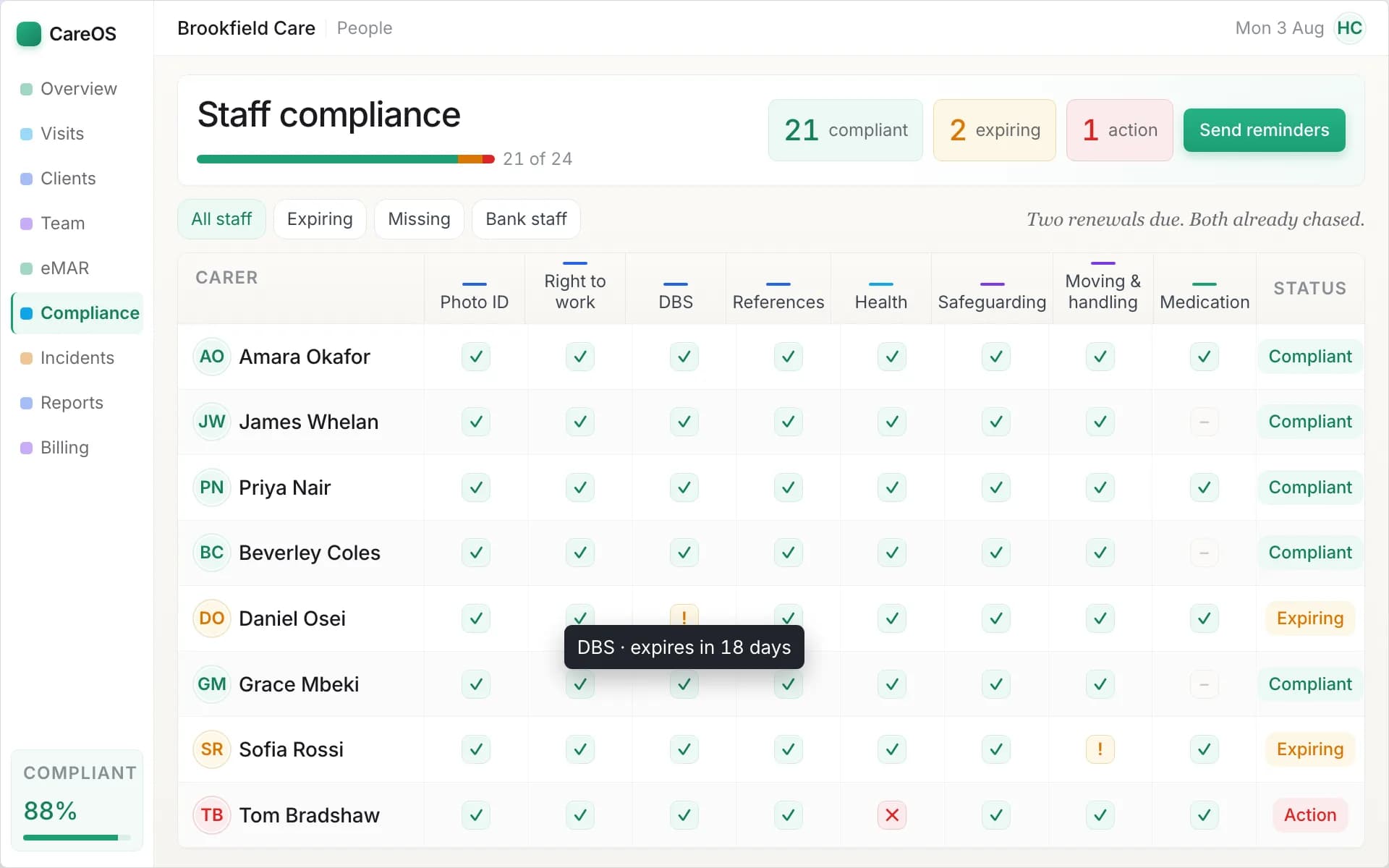
Workforce compliance as a live matrix rather than a spreadsheet somebody maintains when there is time.
What CQC actually assesses
The Care Quality Commission registers and assesses adult social care services in England. Its assessment is organised around five key questions that have been stable for many years: is the service safe, effective, caring, responsive and well-led. Beneath those sit quality statements and the categories of evidence CQC gathers against them.
That framework has been revised, and elements of it remain under review, so treat any vendor who speaks about it with absolute certainty as a sales risk rather than an expert. Check the current detail on CQC's own site before you build anything around a specific structure.
What has not moved, and is unlikely to, is the kind of evidence inspectors ask for. Mapped to the five questions, that is roughly:
- Safe. Medication records, risk assessments, incident and safeguarding records, recruitment checks including DBS and right to work, staffing levels, and infection control.
- Effective. Current and reviewed care plans, consent and mental capacity records, staff training and competence, and outcomes for the people you support.
- Caring. Evidence that care is person-centred, that people and families are involved, and that dignity and preferences are recorded and followed.
- Responsive. How you respond to changing needs, complaints handling, and accessible information.
- Well-led. Governance, audits, oversight, action plans, and an audit trail showing who did what and when.
Well-led is where software makes the most visible difference, and where providers most often underperform. It is difficult to demonstrate governance from a filing cabinet, and straightforward to demonstrate it from a system that logs everything.
Where providers lose marks
Patterns recur, and almost all of them are recording failures rather than care failures.
Gaps in the MAR chart with no explanation. A blank box is the worst possible record because it is indistinguishable from a missed dose. Paper MAR charts produce these constantly, and they are found weeks later at audit when nothing can be done. This alone accounts for a great deal of the difference between a good and a requires-improvement rating on safe.
Care plans that have lapsed. A plan that has not been reviewed since a person's needs changed is evidence that the service is not responsive, whatever the carers actually did. Review dates that live in a manager's head lapse; review dates the system tracks do not.
No proof of delivery. In home care especially, if there is no verified record that a carer attended, the visit is unevidenced. A timesheet completed in arrears is a claim, not evidence.
Staff compliance that expired quietly. Somebody's mandatory training lapsed in March and they have been working since. Nobody knew, because the spreadsheet is updated when there is time and there is never time.
Actions recorded but not closed. An incident logged with no recorded outcome reads to an inspector as a service that notices problems and does not act on them, which is worse than not noticing.
No audit trail. A record that can be edited without trace is weak evidence and a genuine liability. If your system permits silent edits, an inspector who notices will discount everything it produces.
Evidence as a by-product
The move worth making is from compliance as a project to compliance as a consequence.
A worked example. A carer arrives at a person's home, checks in on their phone with the time and location captured, sees the tasks and the care plan for that visit, records the medication given, notes that the person declined breakfast, and checks out. That is one carer doing their job. It has also produced: proof of attendance, evidence of person-centred care delivery, a MAR entry, a care record entry, and a data point about nutrition that will show up if it becomes a pattern. Nobody did any compliance work.
Now the office side. The missed dose that was not recorded triggers an alert to the coordinator while there is still time to phone the carer. The person declining meals three days running surfaces as a concern rather than sitting unread in free text. The care plan review falling due next month appears on a list before it lapses rather than after.
That is what to look for. The test of a compliance system is not whether it can store evidence. It is whether it notices.
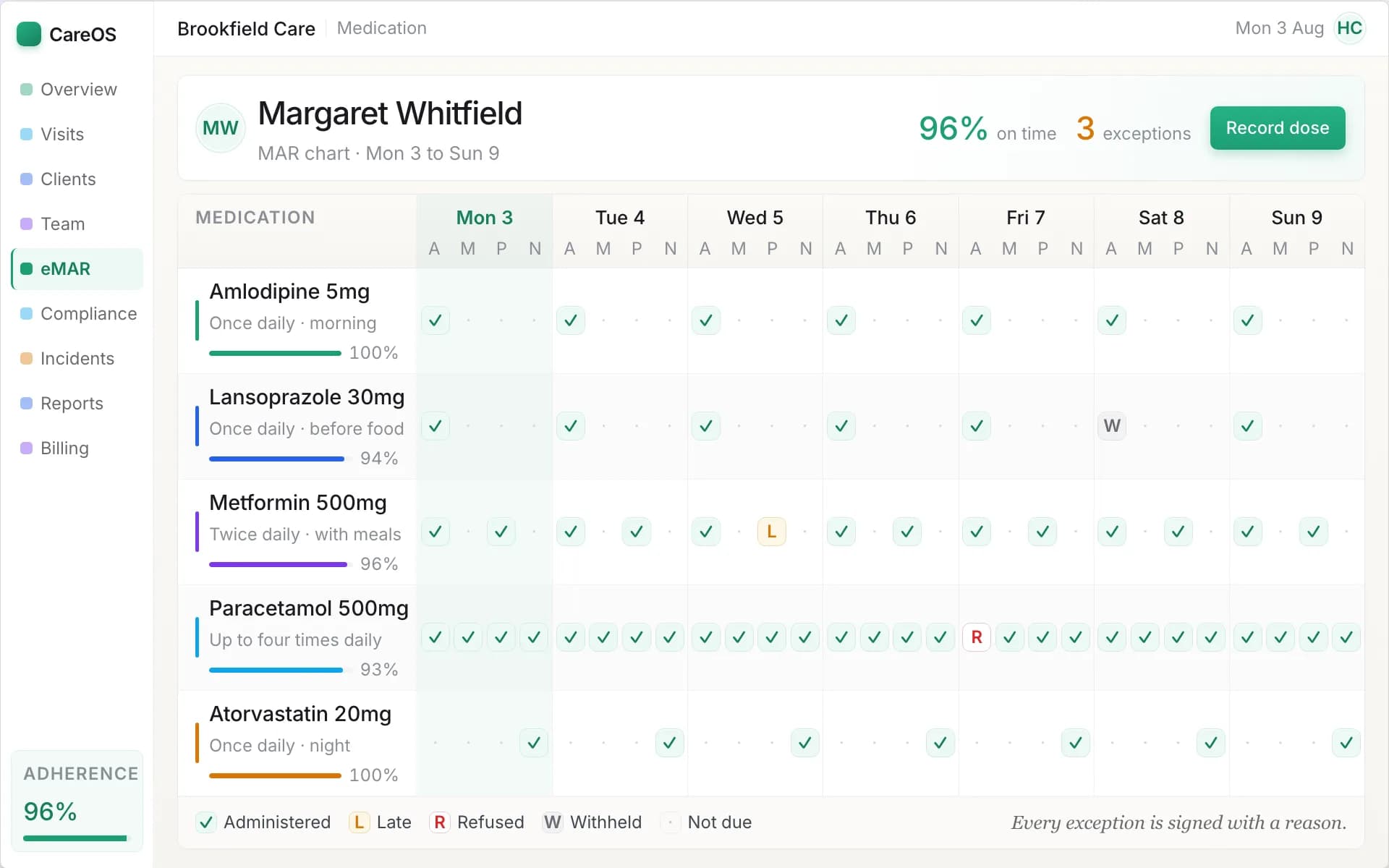
Medication recorded at the point of care, with anything missed surfaced while it can still be acted on.
Some of this is now drafted rather than typed — policies grounded in the regulations, notifications assembled from the incident record, expiring compliance chased rather than merely displayed. What that can and cannot safely do, and where a human must stay in the loop, is set out in the guide to AI care management software.
The features that produce inspection-ready records
Medication records with real-time alerting
Electronic MAR that shows each due dose, records given, refused or withheld with a reason, handles as-needed medication and controlled drug witnessing, and tells the office about a missed dose immediately. If medication is your main concern, this is the module to interrogate hardest.
Care planning with review tracking
Person-centred plans, linked risk assessments, and scheduled reviews that appear on somebody's list before they expire. Ask a vendor to show you the list of plans falling due, because it is the single most useful compliance screen in the product.
Visit or shift verification
Proof that care was delivered: geotagged check-in and check-out for home care, shift-based recording for residential. This is the foundation everything else rests on, because unevidenced delivery makes every other record hypothetical.
Incident, falls and safeguarding records
Reporting at the point it happens, categorisation so patterns are visible, and, crucially, actions and outcomes recorded against each one. An incident record without a closed action is worse than none.
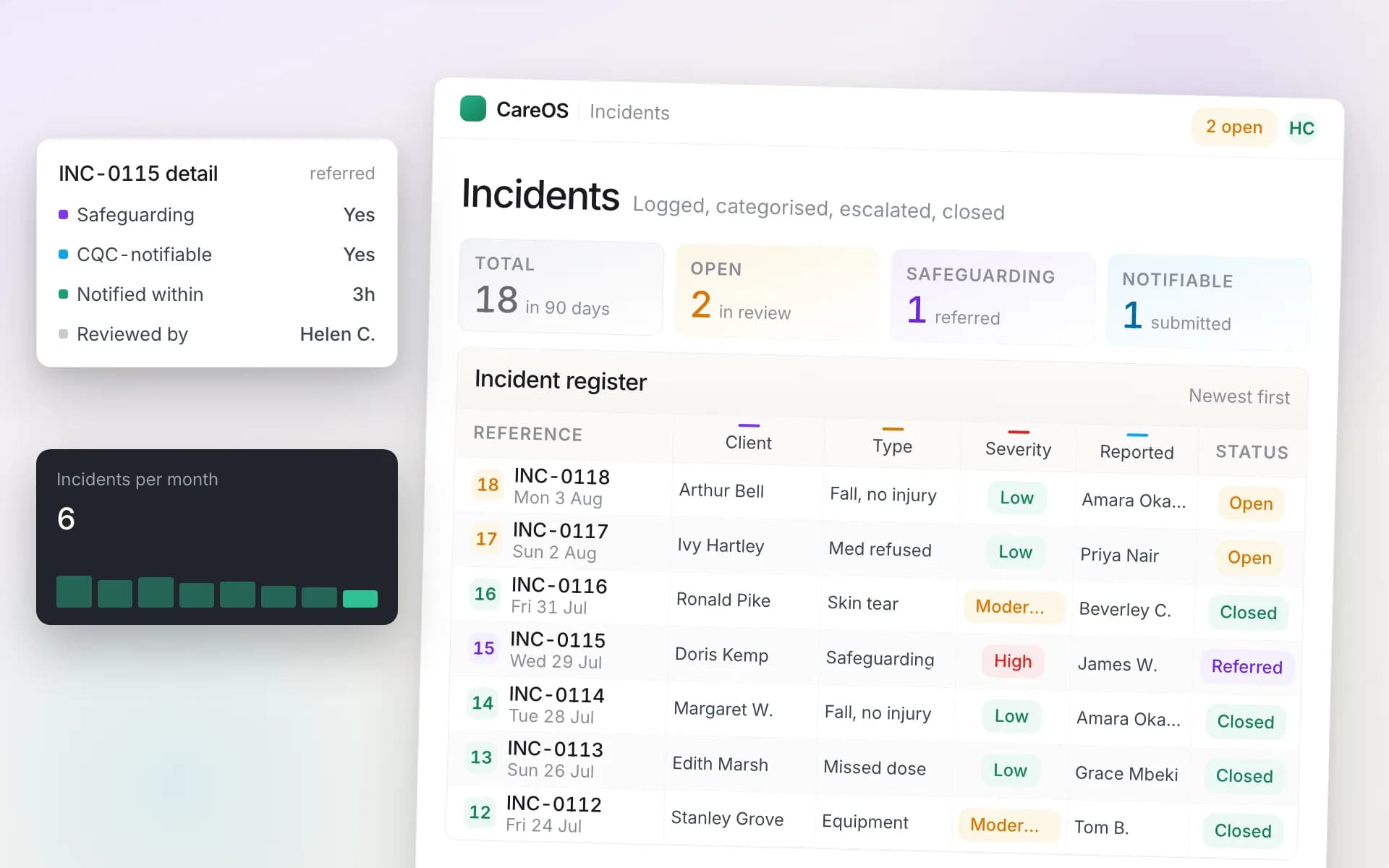
Incidents captured as they happen, with actions and outcomes tracked to closure rather than left open.
Workforce compliance with expiry alerting
DBS, right to work, references, mandatory training, supervisions and appraisals, tracked per person, with expiries flagged in advance. The strongest version blocks rostering somebody whose mandatory training has lapsed, which turns a reporting tool into a safety control.
Audit trails and reporting
Every record attributable and timestamped, edits traceable, and reports you can run on demand rather than build. Ask to see the audit trail on a record that has been amended, because that is what an inspector will ask for if anything looks unusual.
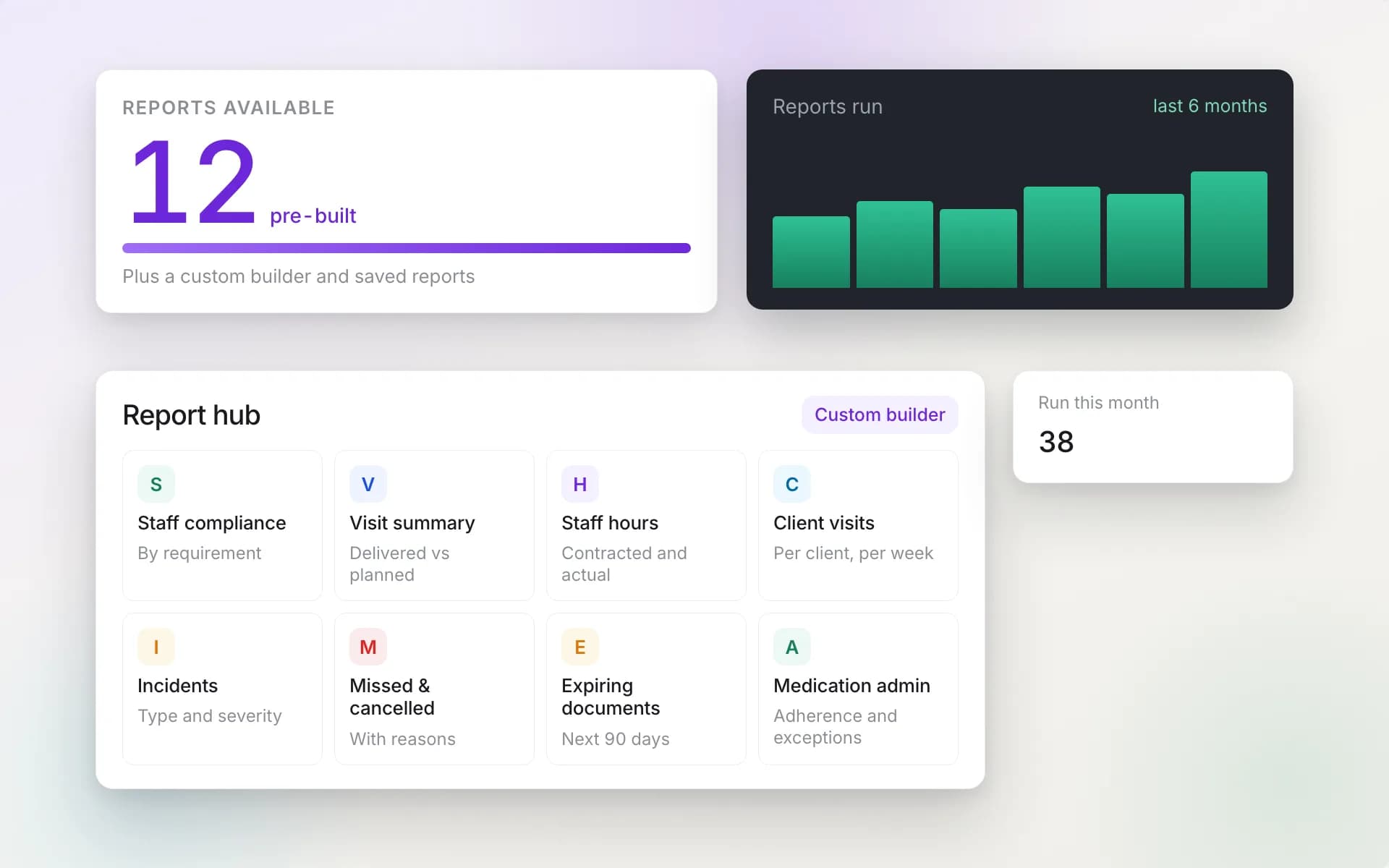
Reports run on demand rather than assembled: the practical difference between preparing for an inspection and being ready for one.
Two things beyond CQC
NHS DSPT. The Data Security and Protection Toolkit is the annual self-assessment showing you handle care data safely. Your software vendor holds your data, so their security posture directly affects your submission. Ask what standards they meet and whether they will support you through it.
DSCR. NHS England's Digital Social Care Records programme is moving the sector towards assured systems, and assurance affects access to associated funding. Ask a vendor whether they are assured or actively pursuing assurance, and take a vague answer as an answer.
If your service is a children's home, your regulator is Ofsted rather than CQC and the requirements differ enough to need their own treatment: see children's home software.
Judging whether a system will actually help
Ask what they would hand an inspector. Not a feature list. The actual reports, on screen, with realistic data. A vendor who has done this before will have a confident answer within seconds.
Ask what happens when a dose is missed. If the answer is that it shows up in a report, that is a record. If somebody in the office is told while it can still be fixed, that is a control. You want the control.
Ask to see an amended record's audit trail. If it does not have one, or the vendor is vague about it, stop.
Ask what the system refuses to let you do. Good compliance software prevents things: rostering unqualified staff, publishing a rota below safe staffing, closing an incident with no action. Software that only records is doing half the job.
Ask about your evidence at exit. Care records must be retained for years after a person leaves your service. If you move systems, you need your history in a usable form. Get the answer in writing.
Be sceptical of the phrase "CQC compliant". No software can make a service compliant, because compliance is a property of your practice, not your database. A vendor claiming otherwise is either careless with words or selling you a false sense of security. What a good system can be is CQC-ready: producing the evidence your compliance rests on.
A realistic sequence if you are starting from paper
Do not try to digitise everything at once. Order the work by risk.
Start with medication, because it carries the most risk and the failure is silent. Then proof of delivery, because everything else assumes it. Then care plans and reviews, because lapsed plans are the most common effective and responsive finding. Then workforce compliance, which is mostly a data-entry exercise once and a maintained system afterwards. Then incidents and audits, which benefit from the data the earlier steps generate.
Each step is useful on its own, which matters: it means an inspection landing mid-programme finds you better off than you were, not halfway through a change.
Where to go next
For the wider platform, start with care management software. Home care agencies should read the domiciliary care software buyer's guide; residential services, the care home management software guide.
CareOS is CQC-ready care management software for UK providers: eMAR with real-time missed-dose alerting, care plans with review tracking, verified delivery, incident and falls reporting, workforce compliance with expiry alerts, and an audit trail on everything. If you would like to see exactly what we would put in front of an inspector, book a demo and ask for that specifically.
Frequently asked questions
What is CQC compliance software?
Software that captures, timestamps and attributes the daily activity a CQC inspector asks for evidence of: medication administration, care planning and review, incidents and safeguarding, staff recruitment and training, and proof that care was delivered. The strongest versions are not separate tools but a property of the care management system, so the evidence is a by-product of doing the work.
Can software make my service CQC compliant?
No. Compliance is a property of your practice, not your database, and any vendor claiming their product makes you compliant is either careless with words or selling a false sense of security. What good software can be is CQC-ready: it produces the evidence your compliance rests on, and it notices problems while they can still be fixed.
What evidence does the CQC ask for?
Broadly: medication records, risk assessments, incident and safeguarding records with the actions taken, recruitment checks including DBS and right to work, staffing levels, current and reviewed care plans, consent and mental capacity records, staff training and competence, complaints handling, and governance with an audit trail. The framework detail has been revised more than once, so check CQC's own current guidance.
Why do good services still get poor ratings?
Almost always because of recording rather than care. The commonest patterns are unexplained gaps in MAR charts, care plans that have lapsed since a person's needs changed, no verified proof that a visit happened, staff training that expired without anyone noticing, and incidents logged with no recorded outcome. Each of those is an evidence failure, not a care failure, and each is what software addresses.
Do I need separate compliance software or is it part of a care system?
Standalone compliance tools are useful for policy control and audit scheduling, but they only know what somebody types into them. Compliance built into the care management system is stronger, because the record is generated by the work itself: the carer records medication, so the MAR chart exists. If you are choosing a whole platform, prefer the built-in model and use a standalone tool only for what it genuinely adds.
Where should a paper-based service start?
Order the work by risk. Medication first, because it carries the most risk and fails silently. Then proof of delivery, because every other record assumes it. Then care plans and review tracking, then workforce compliance, then incidents and audits. Each step is useful on its own, so an inspection landing mid-programme finds you better off rather than halfway through a change.
Keep reading
- Compliance Software for Healthcare and Care Providers in the UKClinical compliance and care compliance share a word and almost nothing else. A map of the UK regulatory landscape, what the software is for in each market, and four questions to work out which one you are shopping in.
- Care Management Software: What It Does and How to ChooseWhat the category actually covers, the six modules a complete system needs, why social care and healthcare are different markets, and how to compare vendors against your own worst week rather than their demo.
- Domiciliary Care Software in 2026: The Complete Buyer's Guide for UK Home Care AgenciesWhat domiciliary care software actually does, the features that matter, how CQC, DSCR and DSPT should shape your shortlist, and a scoring method to compare vendors without being dazzled.
CareOS by care setting
The platform is one system with a workspace per setting. See what it looks like for yours:
See CareOS against your own worst-case Monday
CareOS is UK care management software: rostering, eMAR, care plans, compliance and finance in one system, with a workspace built for each care setting and designed around CQC, Ofsted and DSCR requirements.
Book a demo