
Compliance Software for Healthcare and Care Providers in the UK
"Compliance software for healthcare" covers an enormous amount of ground, and the first useful thing to do is narrow it, because the product a hospital trust needs and the product a care agency needs share a word and almost nothing else.
This guide maps the UK regulatory landscape across health and social care, sets out what compliance software is actually for in each, and gives you a way to work out which category you are shopping in. It is written primarily for care providers, since that is the part of the market we know properly, but the map covers both so you can place yourself on it.
If you run a care service rather than an NHS organisation, the short version is that your regulator is the CQC or Ofsted, your compliance evidence is generated by daily care activity, and the specific guide for you is CQC compliance software. The rest of this post explains why the wider category is confusing and how to avoid buying the wrong end of it.
Two markets, one phrase
Clinical compliance concerns the safety and governance of healthcare delivery and the systems supporting it. In an NHS setting that includes clinical risk management for health IT, information governance, medical device regulation where software makes clinical claims, procurement assurance, and clinical audit. The buyers are trusts, integrated care boards, GP practices and private healthcare providers.
Care compliance concerns regulated social care: whether a service is safe, well-led and delivering the care it says it does, evidenced by medication records, care plans, incident records, staffing and workforce checks. The buyers are home care agencies, care homes, supported living services and children's homes.
Both are compliance. Both are healthcare in the loose sense that people say it. They demand entirely different software, and the overlap is thinner than the shared vocabulary suggests: an information governance platform will not evidence that a carer administered a medicine, and a care management system will not manage a clinical safety case.
The rest of this post takes them in turn, then gives you the decision.
The UK regulatory map
Worth having in one place, because vendors rarely draw it for you.
CQC (Care Quality Commission). Registers and inspects health and adult social care services in England, including NHS trusts, GP practices, independent hospitals, care homes and domiciliary care agencies. The assessment framework has been revised more than once and remains under review, so read the current version on CQC's own site rather than any vendor's summary.
Ofsted. Regulates children's homes and children's social care rather than CQC. The standards are different enough that adult social care software leaves gaps. See children's home software.
The devolved regulators. Care Inspectorate in Scotland, Care Inspectorate Wales, and RQIA in Northern Ireland. If you operate across borders, check any product supports the right one rather than assuming CQC coverage is sufficient.
NHS DSPT (Data Security and Protection Toolkit). The annual self-assessment showing an organisation handles health and care data safely. It applies to social care providers as well as NHS bodies, and your software vendor's own security posture affects your submission because they hold your data.
UK GDPR and the Data Protection Act. Lawful basis, special category data, retention, subject access, breach reporting. Care and health records are special category data, so the bar is higher than for ordinary business data.
DCB0129 and DCB0160. Clinical risk management standards for the manufacture and deployment of health IT systems. If a system makes clinical claims in an NHS context, these matter enormously; for a social care operational system, they are usually not the applicable frame, and a vendor waving them around as a general quality badge is a small signal about how they sell.
MHRA and software as a medical device. If software diagnoses, screens, or drives a treatment decision, it may be regulated as a medical device. Most care management software is deliberately outside this, because it records and organises care rather than making clinical determinations. Worth knowing so you can tell when a claim moves a product into that territory.
DTAC (Digital Technology Assessment Criteria). The baseline NHS organisations use when procuring digital tools, covering clinical safety, data protection, technical security, interoperability and usability. Relevant if you are selling into or buying within the NHS.
Employment and health and safety obligations. Right to work, DBS or equivalent barring checks, safe recruitment, HSE duties, RIDDOR reporting. These apply to every provider regardless of regulator and are, in practice, where a lot of day-to-day compliance work actually sits.
Compliance software in a care setting
For a regulated care provider, the useful distinction is between two things people call compliance software.
Service compliance is evidencing that the care you deliver is safe and as planned: medication records, care plans and reviews, incidents and safeguarding, proof of delivery, audits and action plans.
Workforce compliance is evidencing that the people delivering it are safe to do so: DBS, right to work, references, mandatory training, supervisions, appraisals and competencies.
Most standalone compliance products handle the second reasonably and the first hardly at all, because service compliance is generated by the operational system, not typed into a register. That is the crux of the buying decision and it is covered properly in CQC compliance software.
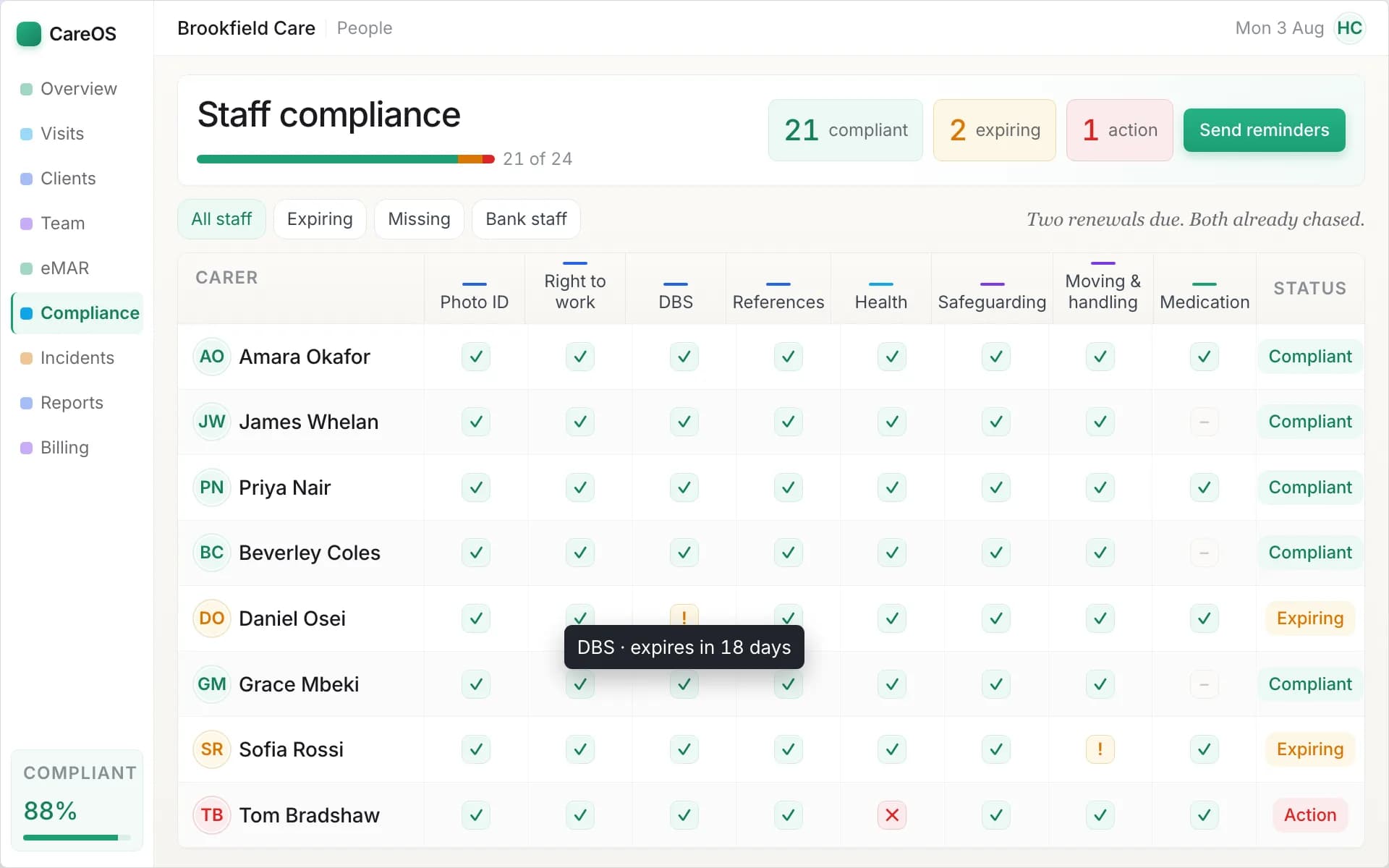
Workforce compliance as a live matrix, with expiries surfaced before they become gaps in the rota.
What good looks like
It is generated, not entered. The strongest compliance evidence is a side effect of doing the work. A carer records a medicine on their phone and the MAR chart exists. A manager signs off a care plan review and the review date is stamped. Nothing is typed twice and there is no gap between what happened and what the record says.
It notices. A register that stores certificates is a filing cabinet. A system that tells somebody a DBS expires in six weeks, that a dose passed its window unrecorded, or that an incident has been open for a month without an action, is a control. Ask every vendor what their system tells you without being asked.
It prevents. The strongest version blocks the unsafe thing: rostering a carer whose mandatory training lapsed, publishing a rota below safe staffing, closing an incident with no recorded outcome. Recording is half the job.
It is attributable and traceable. Every record tied to a person and a timestamp, every amendment traceable. A record that can be edited silently is weaker than paper, because it looks stronger than it is.
It reports on demand. The difference between preparing for an inspection and being ready for one is whether the evidence is a report you run or a folder you assemble.
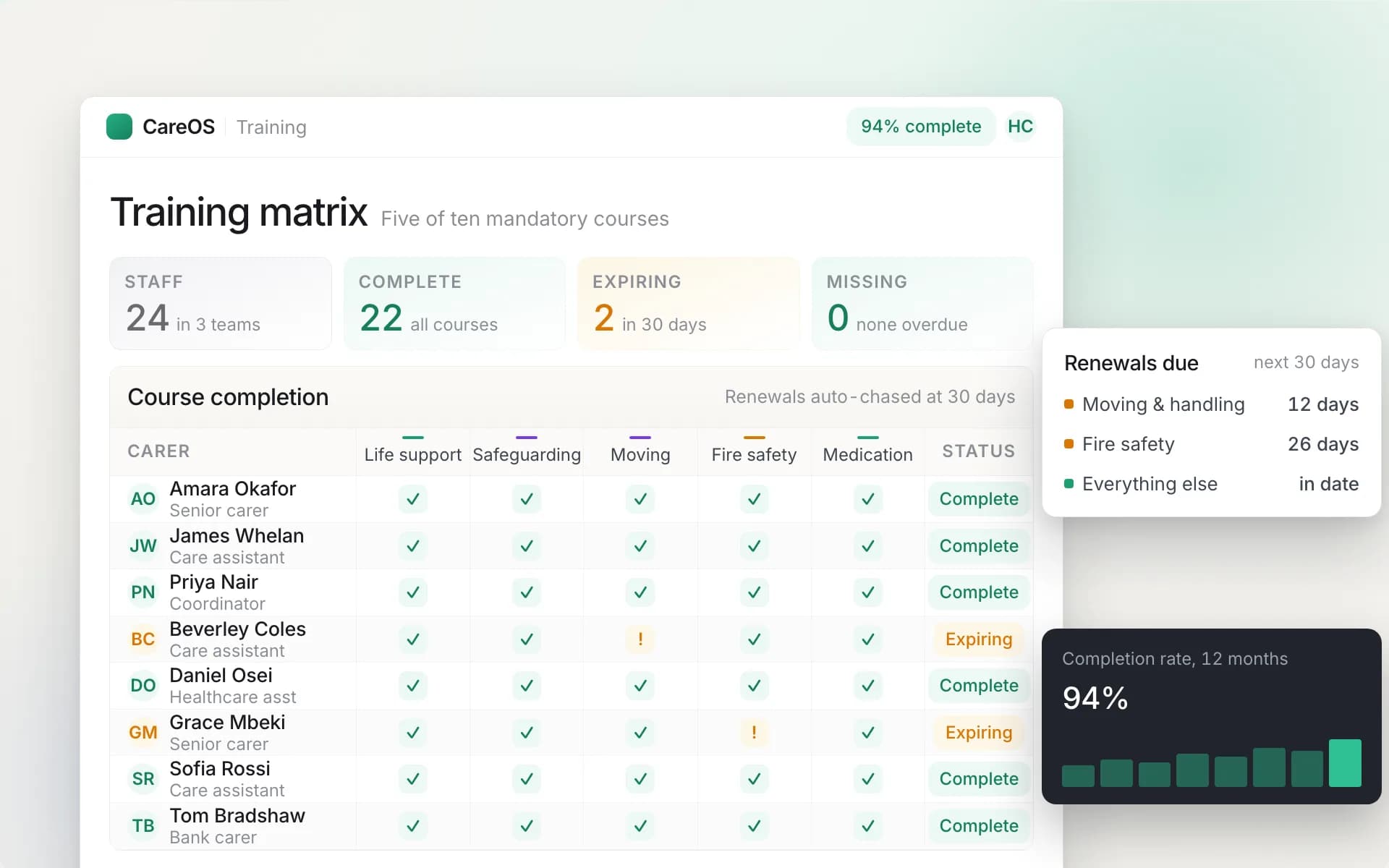
Mandatory training tracked per person, feeding the rota so a lapse blocks an assignment rather than surfacing at audit.
Compliance software in a clinical setting
Different shape entirely, and worth naming so you can recognise it in a search result.
Clinical settings buy information governance and risk platforms covering the DSPT and DTAC evidence base, clinical safety tooling supporting DCB0129 and DCB0160 hazard logs and safety cases, policy management with version control and attestation, clinical audit tooling, incident management aligned to national patient safety frameworks, and medical device or quality management systems where a product carries clinical claims.
If those are the words in your requirement, you are shopping in the clinical market and a social care operational system will not serve you, however good it is at what it does.
Which market are you in?
Four questions usually settle it.
- Who registers or inspects you? CQC as a social care provider, or Ofsted, points at care compliance. CQC as an NHS trust or independent hospital, alongside NHS procurement requirements, points at clinical.
- What is your primary record? A care plan and a daily care record means care compliance. A clinical record with diagnoses, prescribing and treatment decisions means clinical.
- Where does your evidence come from? If it is produced by carers delivering care, buy an operational system that generates it. If it is produced by governance processes, policies, audits and safety cases, buy a governance platform.
- Who is your workforce? Care workers, support workers and registered managers, or clinicians in registered professional roles. Both need compliance tracking, but the requirements and the training frameworks differ.
Most organisations reading this land squarely on the care side. If you did, the practical guides are CQC compliance software for the evidence picture and care management software for the platform it should be part of.
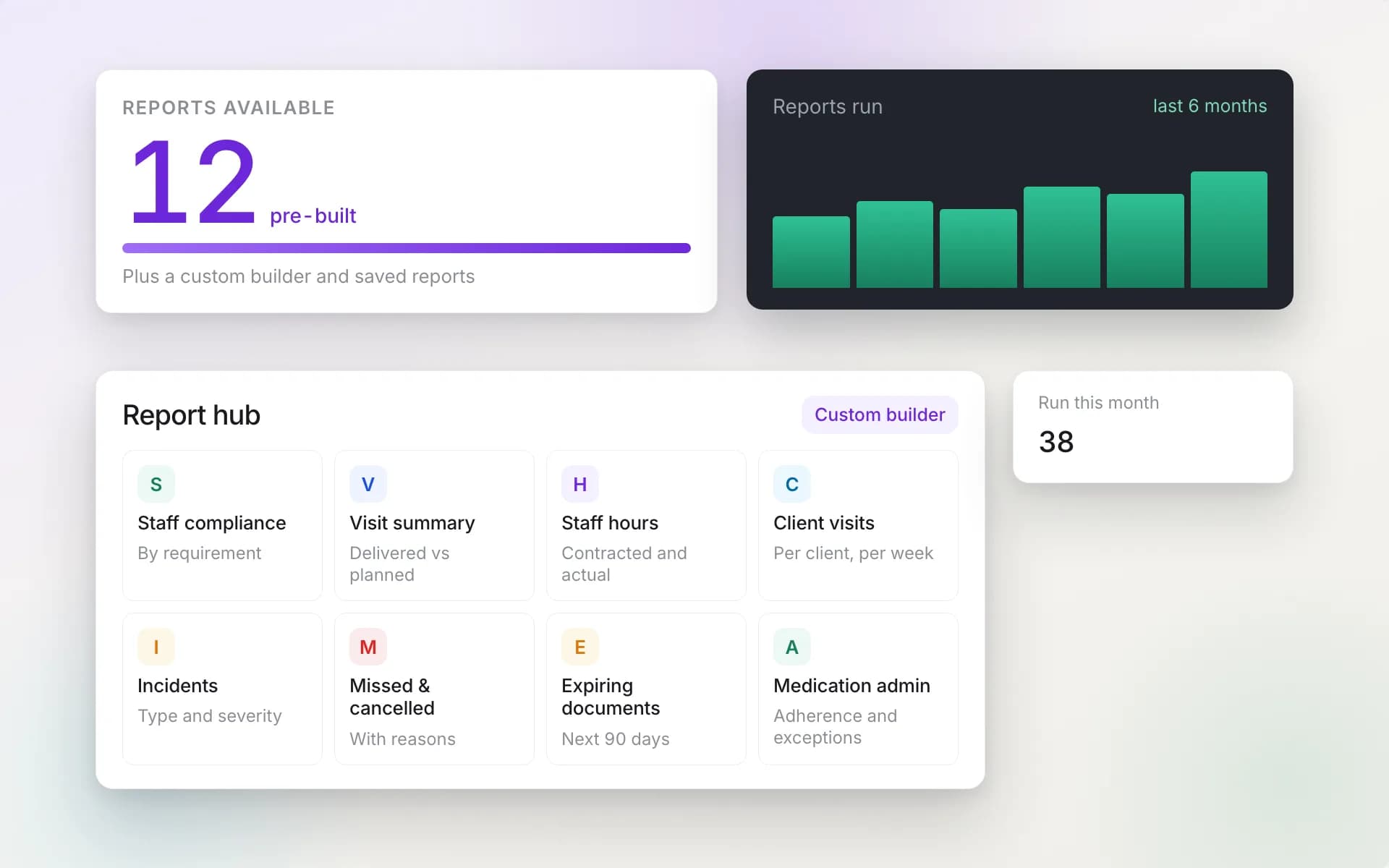
Evidence as a report rather than a project: the practical difference between preparing and being ready.
Buying: what to insist on
Show me the evidence pack. Not a feature list. The actual reports you would put in front of an inspector or an auditor, on screen, with realistic data.
Show me what happens automatically. What does the system tell somebody, without being asked, and how? An alert that only exists in a dashboard nobody opens is not an alert.
Show me an amended record's audit trail. If it does not have one, stop there.
Tell me what it refuses to allow. Prevention beats recording. A vendor with a confident answer here has thought about safety rather than storage.
Tell me about your own compliance. They hold your data. What security standards do they meet, will they support your DSPT submission, where is the data hosted, and who has access?
Tell me what happens at exit. Care records must be retained for years after a person leaves your service. If you change systems, you need your history in a usable form, and you want that answer in writing before you sign rather than after you give notice.
Be wary of "compliant" as a product claim. No software makes an organisation compliant, because compliance is a property of practice rather than of a database. A vendor who says otherwise is either careless with language or selling reassurance. What a system can honestly be is ready: producing the evidence, and noticing the gaps, while there is still time to act.
Where to go next
If you are a care provider: CQC compliance software for what inspectors actually ask to see, care management software for the platform, and the setting-specific guides for home care, care homes and supported living.
CareOS is CQC-ready care management software for UK social care providers, where compliance evidence is produced by the work rather than assembled afterwards: eMAR with missed-dose alerting, care plans with review tracking, incident and safeguarding records, workforce compliance with expiry alerts that feed the rota, and an audit trail on everything. It is not a clinical governance platform and does not pretend to be. If you are on the care side of the map, book a demo and ask us to show you the inspection evidence directly.
Frequently asked questions
What is compliance software for healthcare?
The phrase covers two different markets. In a clinical setting it means information governance, clinical risk and safety tooling, policy management and audit platforms used by NHS organisations and private healthcare providers. In social care it means systems that evidence safe care and a safe workforce: medication records, care plans and reviews, incidents, proof of delivery, and staff checks and training.
What is the difference between clinical compliance and care compliance software?
Clinical compliance is about the governance and safety of healthcare delivery and the IT supporting it, evidenced by policies, safety cases, audits and assurance processes. Care compliance is about whether a regulated care service is safe and delivering the care it says it does, evidenced by records generated when carers deliver care. An information governance platform cannot evidence that a carer gave a medicine, and a care system cannot manage a clinical safety case.
What UK regulations should compliance software help with?
For care providers: CQC in England or Ofsted for children's services, with the Care Inspectorate, Care Inspectorate Wales and RQIA in the devolved nations, plus NHS DSPT for data security, UK GDPR, and employment obligations such as right to work and DBS checks. In NHS and clinical settings, add DTAC for procurement, DCB0129 and DCB0160 for clinical risk in health IT, and MHRA regulation where software makes clinical claims.
Is the NHS DSPT relevant to social care providers?
Yes. The Data Security and Protection Toolkit applies to social care providers as well as NHS organisations, and it is an annual self-assessment rather than a one-off. Because your software vendor holds your data, their security posture directly affects your submission, so ask what standards they meet and whether they will actively support you through the toolkit.
Do I need standalone compliance software or is it part of a care system?
Standalone tools handle workforce compliance and policy management reasonably and service compliance hardly at all, because service evidence is generated by the operational system rather than typed into a register. For a care provider, compliance built into the care management platform is stronger, and a standalone tool is worth adding only for what it genuinely contributes on top.
Can software make my organisation compliant?
No, and treat the claim as a warning sign. Compliance is a property of your practice, not your database. What good software can honestly do is produce the evidence your compliance rests on, notice gaps while there is still time to act, and prevent specific unsafe actions such as rostering staff whose mandatory training has lapsed.
Keep reading
- CQC Compliance Software: Turning Daily Work into Inspection EvidenceMost providers who get a poor rating are delivering decent care they cannot prove. What CQC compliance software does, where evidence usually fails, and how to tell a system that notices from one that only records.
- Care Management Software: What It Does and How to ChooseWhat the category actually covers, the six modules a complete system needs, why social care and healthcare are different markets, and how to compare vendors against your own worst week rather than their demo.
- Domiciliary Care Software in 2026: The Complete Buyer's Guide for UK Home Care AgenciesWhat domiciliary care software actually does, the features that matter, how CQC, DSCR and DSPT should shape your shortlist, and a scoring method to compare vendors without being dazzled.
CareOS by care setting
The platform is one system with a workspace per setting. See what it looks like for yours:
See CareOS against your own worst-case Monday
CareOS is UK care management software: rostering, eMAR, care plans, compliance and finance in one system, with a workspace built for each care setting and designed around CQC, Ofsted and DSCR requirements.
Book a demo