
Supported Living Software: What Providers Need That Home Care Systems Miss
Supported living is the setting most often sold the wrong software. It is not home care, because staff are frequently rostered to a house rather than to a round of visits. It is not residential care, because each person has their own tenancy, their own front door in law, and rights that follow from that. It sits between the two, and most products are built for one or the other.
The result is a sector full of services running a domiciliary system with the visit logic switched off, or a care home system with the building relabelled as a property, and doing the parts that do not fit in a spreadsheet alongside. This guide covers what genuinely differs about supported living, what the software therefore has to do, and how to tell a product built for it from one adapted to it.
What makes supported living different
People have tenancies, not places. This is the legal foundation and it changes everything downstream. The person is a tenant in their own home who also receives care. Their housing and their support are separate arrangements, often with separate providers and separate funding. Software that models a person as occupying a bed in your building has the relationship wrong, and it shows up in awkward places: charging, notice, what happens when support ends but the tenancy does not.
Staff are rostered to a property, not to a person. In a shared house, two support workers cover four tenants across a shift. They are not delivering four separate visits; they are running a house. Any given hour of care might be spent with one tenant, with all four, or supporting someone at an appointment two miles away. A system built around discrete visits struggles to represent this honestly, and services end up recording fictional visit times to satisfy it.
Support is measured in outcomes as much as tasks. The purpose is greater independence and a life the person chooses. The record is not primarily a list of personal care tasks completed; it is progress against goals the person set, keyworker sessions, and what changed. A care record designed around task ticking captures almost none of that.
Funded hours and ratios are the commercial unit. A local authority commissions a number of support hours per tenant per week, often at different ratios: one to one, two to one for community access, shared support in the house. Reconciling delivered support against commissioned hours, per tenant, is the core financial question. It is not the same question as invoicing visits.
Capacity and rights sit at the centre. Most people in supported living have a learning disability, autism, a mental health condition or an acquired brain injury. Mental Capacity Act decision records, best interests processes and, where relevant, authorisations for restrictions on liberty are routine rather than exceptional, and they have to be findable.
Why home care and care home software both fit badly
If you have tried either, the failure modes will be familiar.
A home care system insists on visits. Every hour of support becomes a fabricated appointment with a start and an end, and a support worker on a twelve-hour shift checks in and out of a person's flat repeatedly to satisfy a scheduling model that thinks they have driven there. The travel-time engine, which is the most valuable thing in a domiciliary product, is dead weight. Whole-house working, where the same hour supports several tenants, cannot be represented at all. See the domiciliary care software guide for what that model is actually for.
A care home system assumes the building is yours and the people in it are residents. Occupancy, bed management and fee-per-bed have no clean equivalent when each person holds a tenancy. Consent, choice and the tenant's control over their own home are structurally understated, which is uncomfortable in a setting where that control is the point. See care home management software.
Neither is unusable. Both cost you something every day, and the cost is mostly paid by support workers doing double entry and managers reconciling by hand.
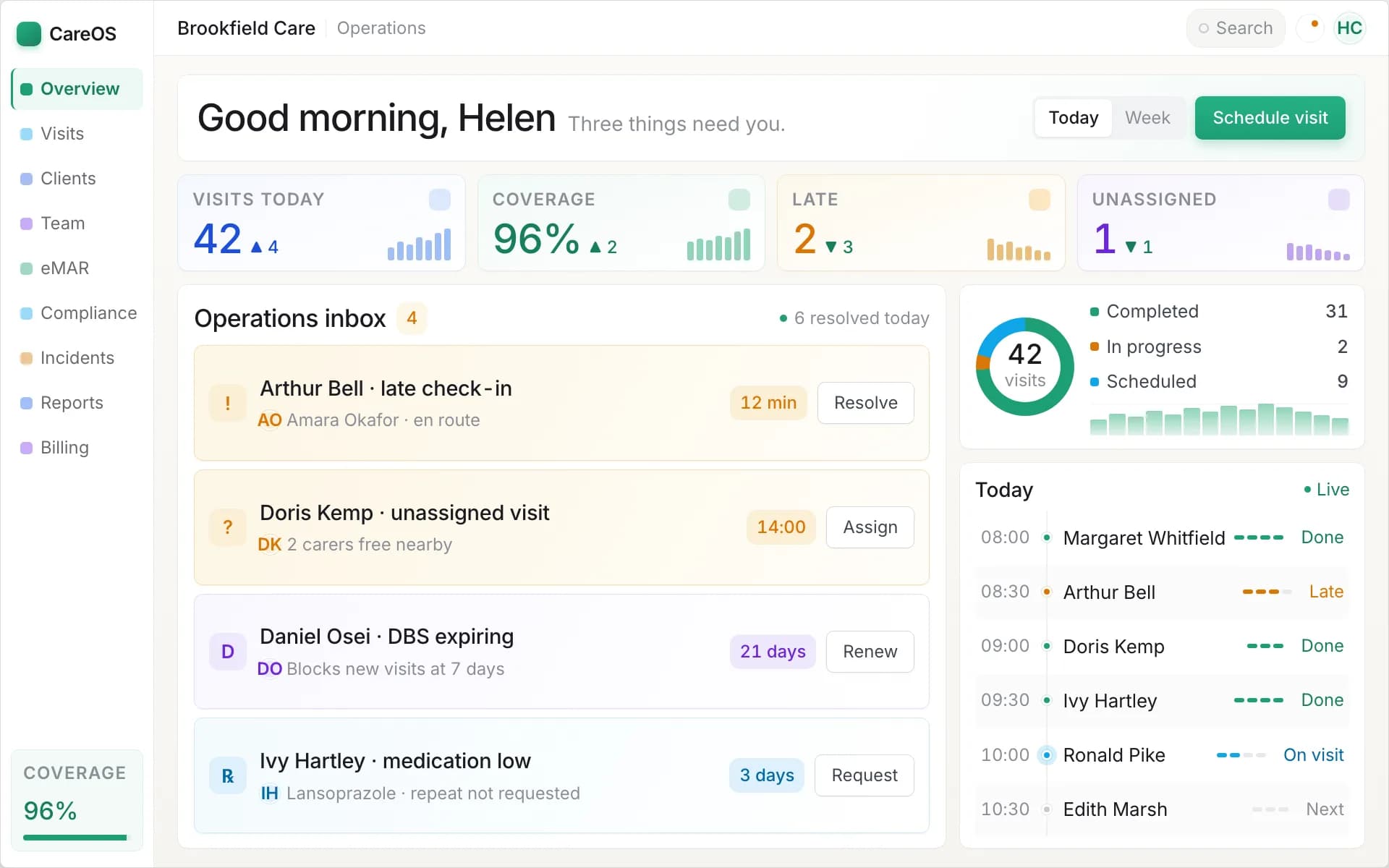
A day across properties rather than a round of visits: who is on shift, what is outstanding, what needs a decision.
What supported living software has to do
Roster by property, with the right people
Shift-based rostering against a property, with the skill mix and the ratios the commissioning requires, and the ability to represent one-to-one and two-to-one support alongside shared house hours. Sleep-ins and waking nights need to be distinct things, because they are paid differently and the distinction has been litigated.
It also needs to handle the case where a tenant's support crosses properties or goes into the community, without pretending that is a separate visit. The general principles are in care rostering software; what changes here is the unit.
Record support against the tenant and the shift
A support worker records what happened during a shift, attributed to the right tenants. Some entries belong to one person, some to the house. Getting this right is what removes the fictional visit records, and it is the single clearest sign a product was built for supported living rather than adapted to it.
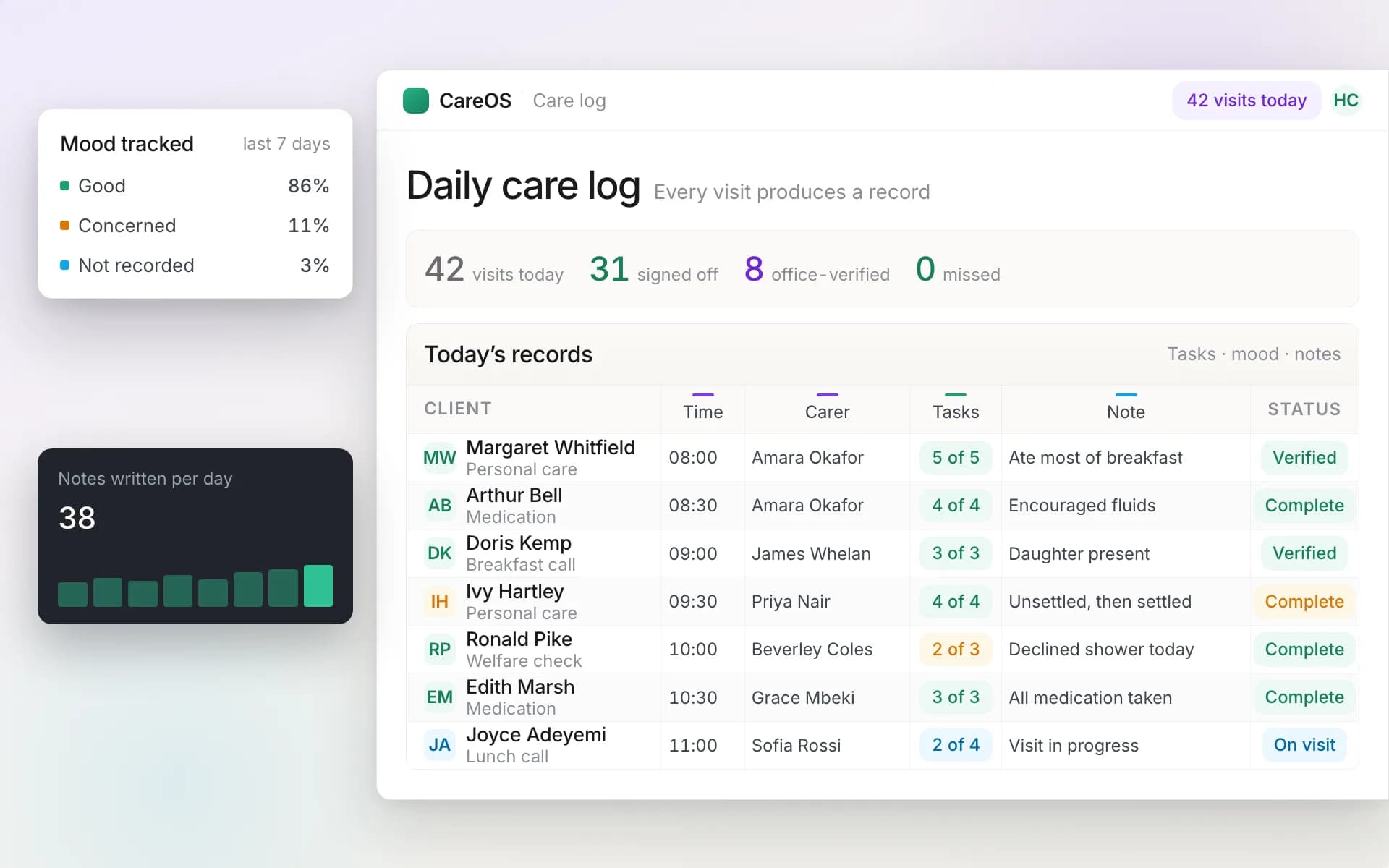
Support recorded against the tenant and the shift, including hours spent with the household rather than one person.
Support plans built around outcomes
Person-centred plans with goals the person has set, keyworker sessions recorded against those goals, and progress that is visible over months rather than buried in daily notes. If your software cannot answer "how is this person doing against what they wanted, over the last six months", it is recording activity rather than support.
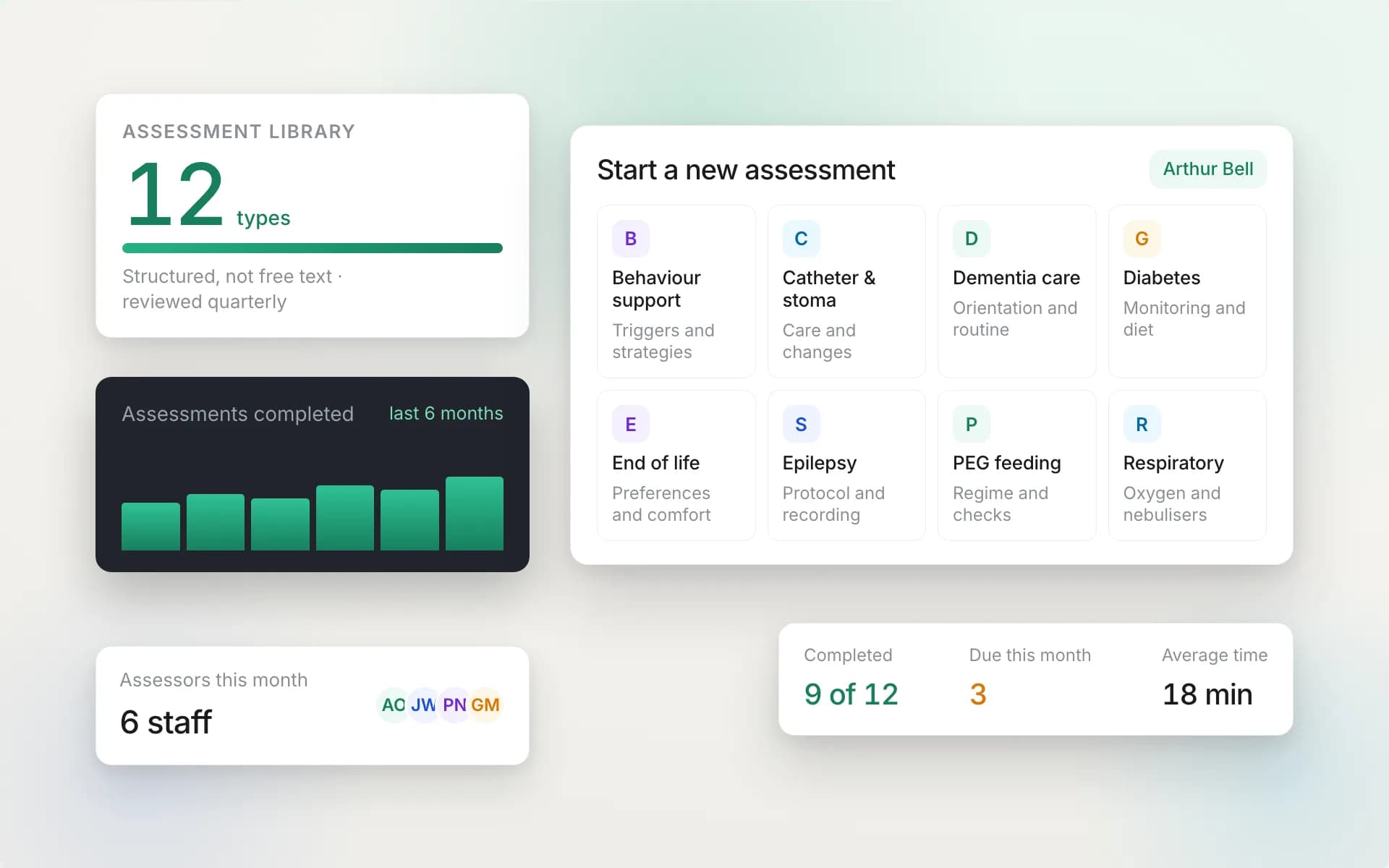
Support plans and risk assessments as live records, with reviews tracked before they lapse.
Mental capacity, best interests and restrictions
Capacity assessments are decision-specific, and the record should reflect that rather than carrying a single flag saying somebody "lacks capacity". Best interests decisions need the process recorded, not just the outcome. Any restrictive practice needs to be documented, reviewed and reduced over time, with the authorisation it rests on findable in seconds.
One point of law that catches out software built for other settings. The Deprivation of Liberty Safeguards do not apply in supported living. DoLS covers care homes and hospitals. Where the care and support arrangements in a person's own home amount to a deprivation of liberty, authorisation comes from the Court of Protection instead. The Liberty Protection Safeguards were legislated for as a replacement scheme and implementation has been postponed, so check the current position rather than relying on any vendor's summary, including this one. What matters when buying is simply that the system can hold a Court of Protection authorisation and its review dates as a first-class record, not squeeze it into a DoLS-shaped field.
Medication in a shared setting
Medication may be self-administered with prompting, administered by staff, or a mix that differs per tenant and per medicine. The system needs to represent the level of support each person has for each medicine, rather than assuming staff administer everything. The wider picture is in the eMAR guide.
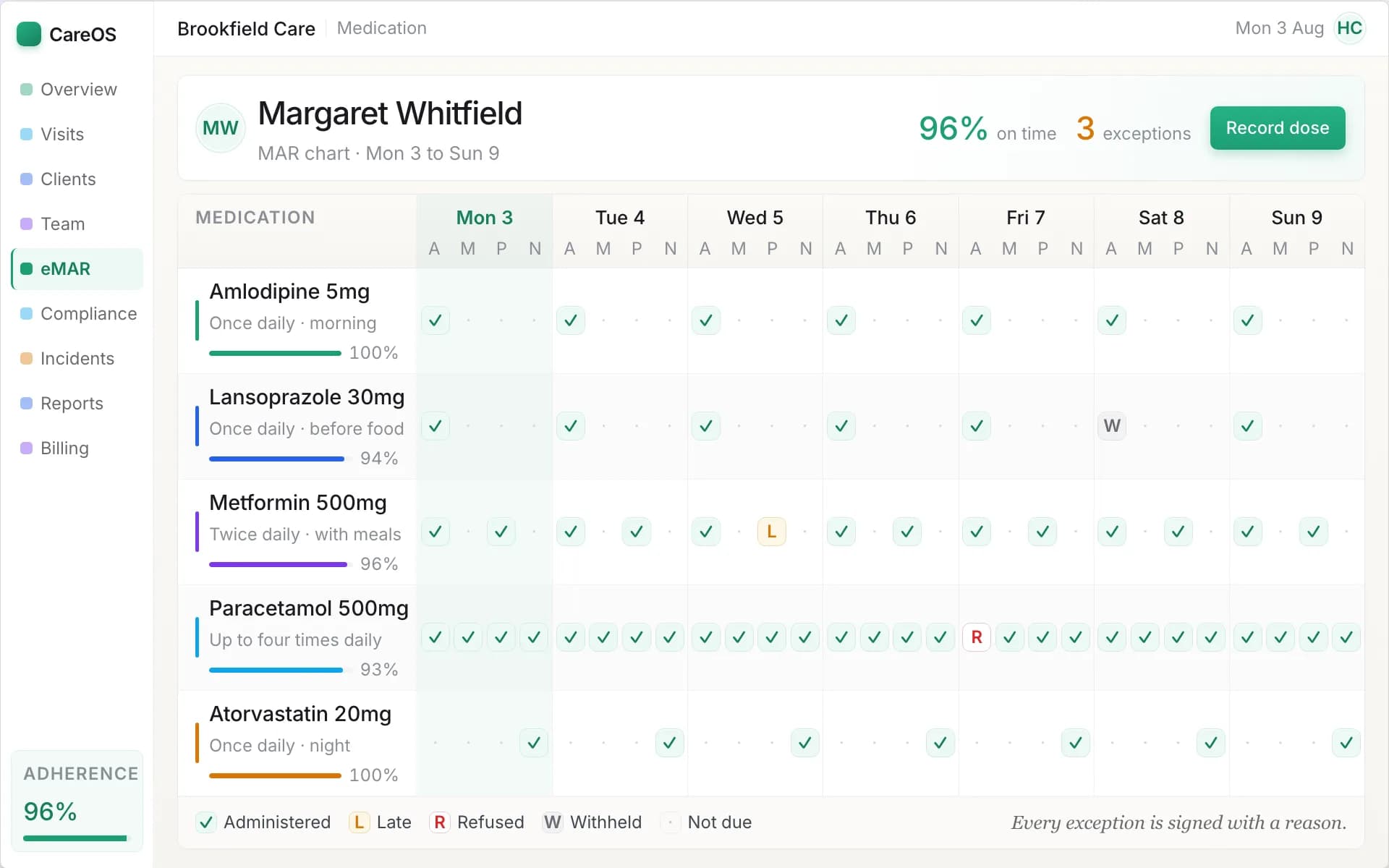
Medication recorded per tenant, including where the person self-administers with support.
Hours, ratios and reconciliation
The commercial core. Commissioned hours per tenant, at their ratios, against support actually delivered, with the variance visible before an invoice goes out rather than after a local authority queries it. Ask any vendor to show you this reconciliation on real-looking data, because it is the report supported living providers most often end up building in a spreadsheet regardless of what they bought.
Tenancy and property records
Tenancy start and end, rent and service charges where you are also the housing provider, void periods, and the paperwork attached to the property itself: gas safety, fire risk assessment, electrical checks. If you support people in a house you manage, these obligations sit alongside the care ones and belong in the same system rather than a separate folder.
Staff compliance
The same workforce requirements as anywhere else in care, with additions that matter here: positive behaviour support training, Mental Capacity Act training, and specific competencies for the people being supported. The rota should refuse to place somebody without them. See CQC compliance software.
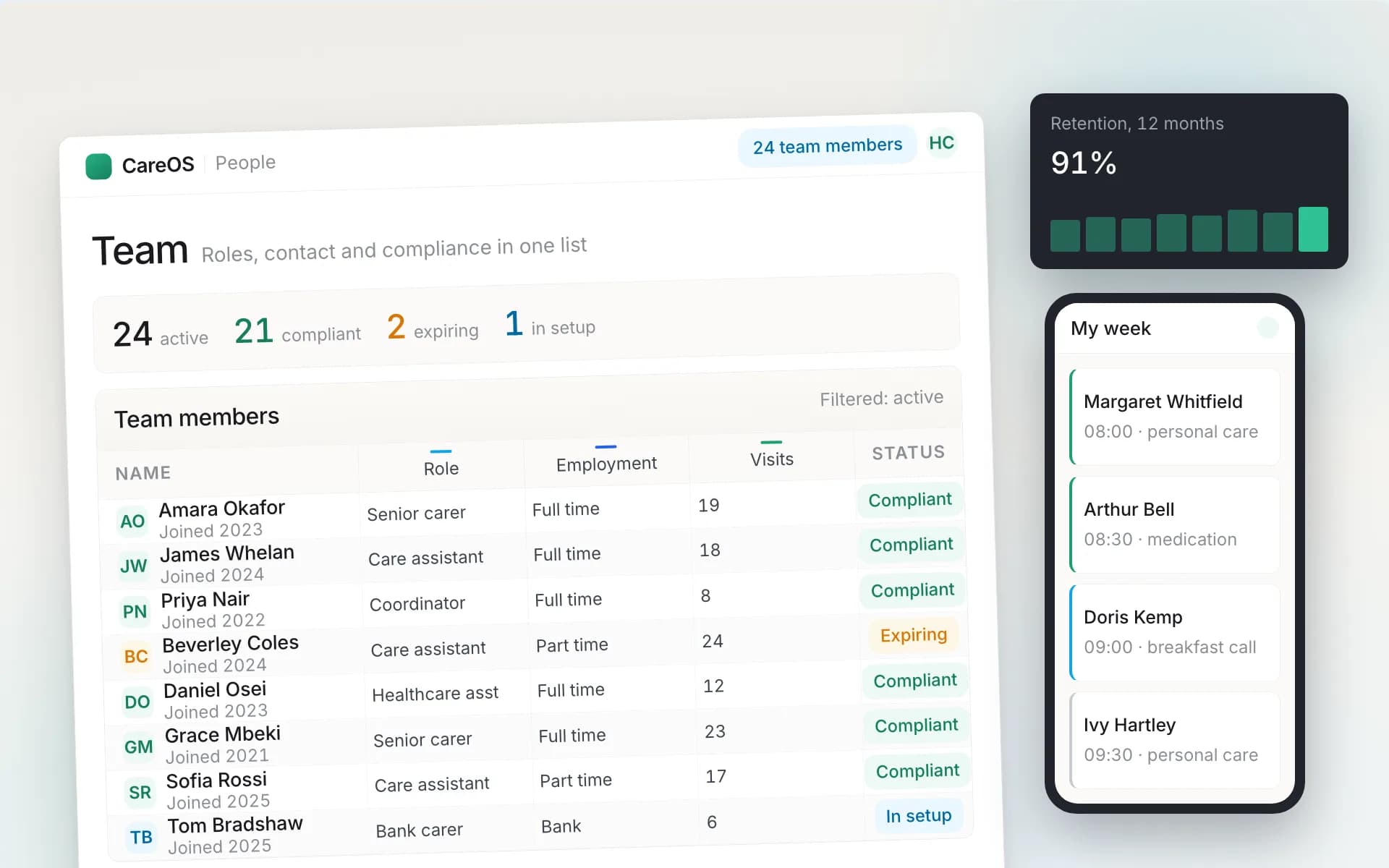
Availability, contracted hours and compliance in one place, so the rota can respect all three.
What to ask a vendor
The questions below separate products quickly, because a system built for another setting cannot answer them without visible strain.
- Whole-house support. A support worker spends an hour with all four tenants in the shared lounge. Show me how that is recorded and how it is attributed for the purposes of commissioned hours.
- Ratios. Show me a rota where one tenant has two-to-one support for a community activity on Thursday afternoons and shared support the rest of the week.
- Tenancy versus support. A person's support package ends but their tenancy continues, with a different provider taking over. What happens in your system?
- Outcomes over time. Show me a person's progress against their own goals across six months, not a list of daily notes.
- Capacity records. Show me a decision-specific capacity assessment and a best interests record, and tell me where a Court of Protection authorisation would live.
- Reconciliation. Show me commissioned hours against delivered support, per tenant, for last month, with the variance.
A vendor who answers all six comfortably has done this before. A vendor who answers by describing visits has not.
Choosing between systems
| Requirement | What to check |
|---|---|
| Model fit | Shift and property based, tenancy as a first-class concept |
| Whole-house recording | Support attributable to one tenant or the household, without fictional visits |
| Ratios | One to one, two to one and shared support represented in rota and reporting |
| Sleep-ins | Distinct from waking nights, paid and recorded differently |
| Outcomes | Goals the person set, keyworker sessions, progress over months |
| Capacity | Decision-specific assessments, best interests process, Court of Protection records |
| Restrictive practice | Documented, reviewed, and reducing over time |
| Medication | Level of support per medicine per person, including self-administration |
| Hours reconciliation | Commissioned against delivered, per tenant, variance visible before invoicing |
| Property | Tenancy records, and the safety obligations of a building you manage |
| Compliance | Positive behaviour support and Mental Capacity Act training enforced in rostering |
Where to go next
For the wider category and how the settings compare, start with care management software. If your organisation also delivers home care, the domiciliary care software guide covers the visit-based model, and care home management software covers residential.
CareOS supports supported living as its own model rather than an adapted one: property-based rostering with ratios and sleep-ins, whole-house recording attributable per tenant, outcome-led support plans and keyworker sessions, Mental Capacity Act records, eMAR with per-medicine support levels, and reconciliation of commissioned hours against delivered support. See the supported living overview, or book a demo and put the six questions above to us directly.
Frequently asked questions
What is supported living software?
Software built for services where people hold their own tenancy and receive support in their own home, usually with staff rostered to a property rather than to a round of visits. It has to handle shift-based rostering with support ratios, recording that can be attributed to one tenant or the whole household, outcome-led support plans, Mental Capacity Act records, and reconciliation of commissioned hours against support actually delivered.
Can I use home care software for supported living?
It fits badly. A home care system insists every hour of support is a visit, so a support worker on a twelve-hour shift ends up checking in and out of a flat repeatedly to satisfy a scheduling model that assumes they drove there, and whole-house support where one hour covers several tenants cannot be represented at all. The travel engine that makes a domiciliary product valuable is dead weight here.
How is supported living different from residential care?
In supported living each person holds their own tenancy and their housing and support are separate arrangements, often with different providers and different funding. In a care home the provider runs the building and the person is a resident. That difference drives everything downstream: charging, notice, what happens when support ends but the tenancy continues, and the degree of control the person has over their own home.
Does DoLS apply in supported living?
No. The Deprivation of Liberty Safeguards apply in care homes and hospitals. Where arrangements in a person's own home amount to a deprivation of liberty, authorisation comes from the Court of Protection instead. The Liberty Protection Safeguards were legislated for as a replacement and implementation has been postponed, so check the current position. For software, what matters is that a Court of Protection authorisation and its review dates can be held as a proper record rather than forced into a DoLS-shaped field.
How should software handle support ratios and commissioned hours?
It should let a rota express one-to-one, two-to-one and shared house support for the same tenant at different times, and then reconcile commissioned hours per tenant against support actually delivered, with the variance visible before an invoice goes out. This reconciliation is the report supported living providers most often end up rebuilding in a spreadsheet, so ask to see it on realistic data before you buy.
What should a supported living support plan record?
Goals the person has set for themselves, keyworker sessions recorded against those goals, and progress visible over months rather than buried in daily notes, alongside the usual risk assessments and reviews. If a system cannot answer how somebody is doing against what they wanted over the last six months, it is recording activity rather than support.
Keep reading
- National Living Wage Compliance in Home Care: The 2026 Guide for UK Domiciliary Care ProvidersPaying a carer £13 per contact hour does not mean they receive the National Living Wage. Which hours and payments count, how to calculate the effective hourly rate, and how to find shortfalls before payroll.
- Electronic Care Planning: What Makes a Care Plan Live Rather Than LaminatedA paper care plan is accurate on the day it is printed and quietly wrong thereafter. What separates electronic care planning from electronic paper: linked risks, tracked reviews, point-of-care access, and an audit trail that makes the record evidence.
- Nursing Home Management Software: What the Nursing Part ChangesMost care home software was built for the residential model and had the word nursing added to the brochure. What the nursing registration actually changes about the software you need, and five things to make a vendor show you live.
CareOS by care setting
The platform is one system with a workspace per setting. See what it looks like for yours:
See CareOS against your own worst-case Monday
CareOS is UK care management software: rostering, eMAR, care plans, compliance and finance in one system, with a workspace built for each care setting and designed around CQC, Ofsted and DSCR requirements.
Book a demo