
National Living Wage Compliance in Home Care: The 2026 Guide for UK Domiciliary Care Providers
Contents18 sections
Quick answer: National Living Wage (NLW) compliance in domiciliary care means making sure that every eligible worker's minimum-wage pay, divided by all of their hours that count for minimum-wage purposes in the pay reference period, is at least the statutory rate. For a home care agency those hours normally include care visits, travel between clients, required training and some waiting or availability time, not only the contact hours invoiced to clients.
Running a domiciliary care agency involves a payroll problem most other employers never meet. A care worker can complete six hours of client visits and spend another hour and a half travelling between those clients. They may attend mandatory training, wait because a visit cannot start on time, or work past the scheduled end of a call. If the agency pays only for contact time, the hourly rate on the contract or the job advert is not the worker's true hourly rate for National Minimum Wage purposes.
That gap is where the risk sits. An agency can advertise £13, £14 or more per care hour and still underpay a worker once all qualifying working time is counted, and it is rarely because anyone set out to pay too little. Far more often the rota lives in one system, visit times in another and payroll in a spreadsheet, so nobody ever sees the whole pay reference period in one place.
This guide explains the rules in practical language for owners, registered managers, payroll teams and finance staff in UK home care. It covers the operational realities of domiciliary care, including split shifts, short calls, rural rounds, late visits and gaps between appointments. Three calculators let you test your own figures as you read. It also explains how CareOS brings rota, actual visit, travel and pay information together so the check happens before payroll, not after a complaint.
This article is general information, not legal or payroll advice. Minimum-wage outcomes depend on contracts, working arrangements, the statutory type of work and the facts of each case. Take professional advice where your arrangements are complex or a historic shortfall may exist. Rates and guidance were checked on 5 September 2026 and are reviewed before 1 April each year.
What the National Living Wage is, and how it differs from the National Minimum Wage
The National Minimum Wage is the legal minimum hourly rate for eligible workers in the UK. Different statutory rates apply according to a worker's age and whether an eligible apprentice rate applies. The National Living Wage is the name given to the highest band, which applies to workers aged 21 and over.
From 1 April 2026 the statutory rates are:
| Worker category | Minimum hourly rate from 1 April 2026 |
|---|---|
| Aged 21 and over (National Living Wage) | £12.71 |
| Aged 18 to 20 | £10.85 |
| Aged 16 to 17 | £8.00 |
| Eligible apprentice rate | £8.00 |
The apprentice rate does not apply because an employer calls somebody an apprentice. The legal conditions must be met, and a 19-year-old or older apprentice moves off the rate after the first year. Record each worker's date of birth, apprenticeship status and the relevant dates, then apply the correct rate to each pay reference period. A worker moves to a higher age band from the first pay reference period that starts on or after their birthday, not from the birthday itself.
The statutory National Living Wage is not the voluntary "real Living Wage" promoted by the Living Wage Foundation. An agency may choose to pay the voluntary rate, but compliance is measured against the statutory rates set by government.
Rates normally change every April. Payroll and care-management systems should not rely on somebody remembering to replace a number in a spreadsheet. Effective-dated rates are safer: the system applies the statutory rate that matches the pay period and the worker's age or status.
The single most important rule for home care agencies
The most useful way to understand NLW compliance is one calculation:
Minimum-wage pay ÷ minimum-wage working hours = effective hourly rate
The result must be at least the rate that applies to the worker.
Both halves of that formula hide a trap. "Minimum-wage pay" is not always the gross figure on the payslip, because some payments do not count and some deductions or worker expenditure reduce it. And "minimum-wage working hours" are not the hours the agency invoices to commissioners or private clients.
Government guidance is clear that the minimum wage applies to eligible workers however they are paid. The employer must work out the equivalent hourly rate whether the worker receives a salary, a rate per visit, a shift payment or any other arrangement.
Compliance is assessed over a pay reference period. This is usually the period the worker is paid for, one week for weekly payroll or one month for monthly payroll, and it cannot be longer than a month. Each separate visit does not have to produce an hourly rate above NLW on its own. The employer must calculate the correct pay and hours for the whole pay reference period.
None of that makes individual shifts irrelevant. A badly designed round of many short visits and long journeys can pull the worker's rate below the minimum for the whole period, so watching each round is a useful early warning, even though the legal test is the pay-reference-period calculation.
Why contact-hour pay can create an NLW shortfall
Agencies often describe pay as an amount "per hour" when they mean an amount per hour spent with a service user. That is a commercial or payroll label. It does not decide which hours count under minimum-wage law.
Consider this morning round:
| Activity | Time | Normally counts for NLW? |
|---|---|---|
| Home to Client A | 20 minutes | Generally no |
| Visit with Client A | 60 minutes | Yes |
| Travel from A to B | 20 minutes | Yes |
| Visit with Client B | 30 minutes | Yes |
| Travel from B to C | 15 minutes | Yes |
| Visit with Client C | 45 minutes | Yes |
| Client C to home | 20 minutes | Generally no |
Client contact time is 135 minutes, or 2.25 hours. Qualifying time is 170 minutes, about 2.83 hours.
If the worker receives £13 for each contact hour, their pay is 2.25 × £13 = £29.25.
Their apparent rate is £13, because that is the contact-hour rate. Their effective minimum-wage rate, before any other adjustments, is £29.25 ÷ 2.83 hours = £10.32 per hour.
For a worker aged 21 or over in September 2026 that is below the £12.71 NLW. To reach £12.71 for 170 minutes, minimum-wage pay would need to be £36.02 (170 minutes at £12.71 is £36.0117, rounded up to the penny in the worker's favour). The shortfall for this round alone is £6.77.
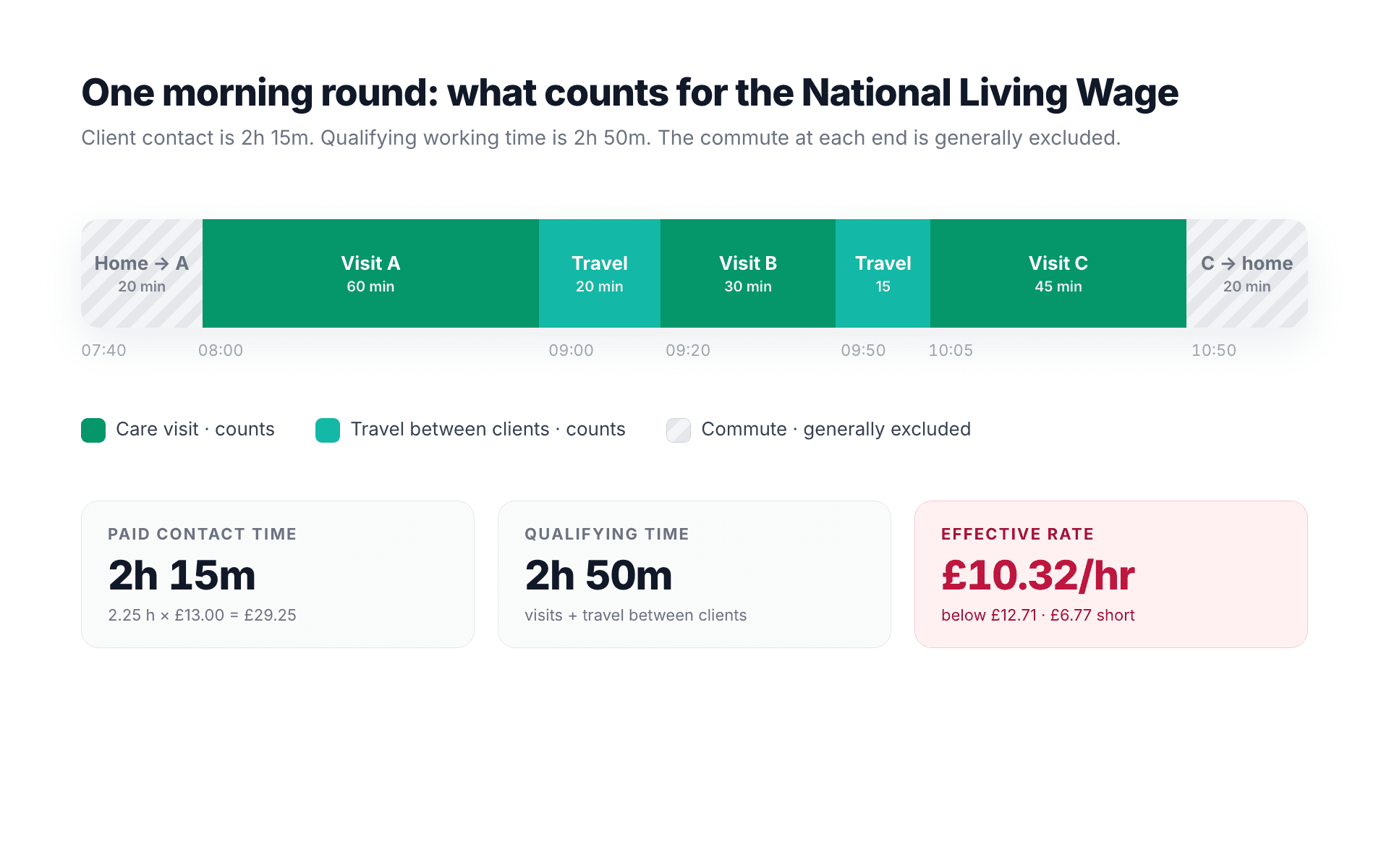 The same morning as a timeline. Contact time is 2h 15m; qualifying time is 2h 50m.
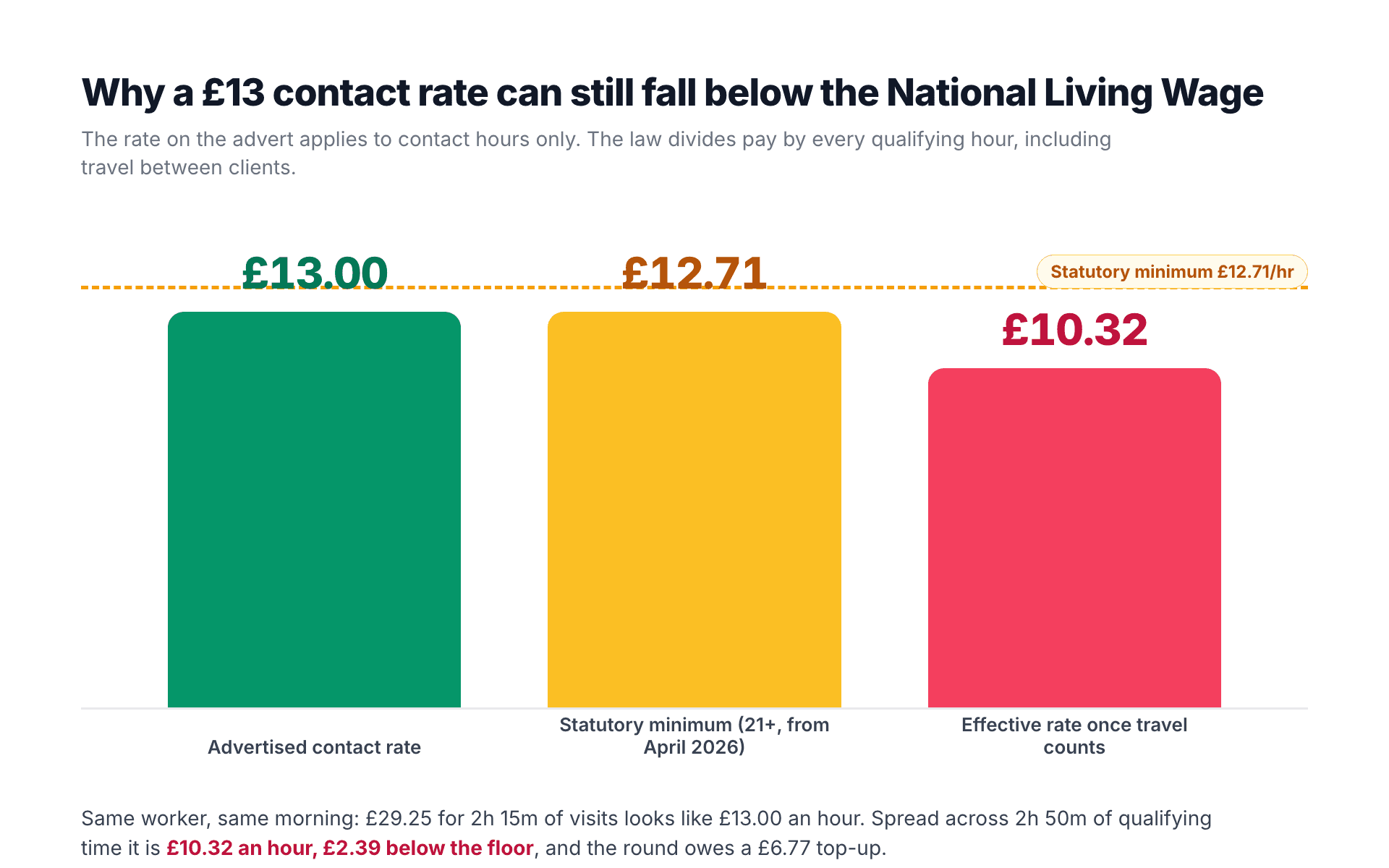 A £13 contact rate becomes £10.32 an hour once travel between clients is counted.
So a high contact rate is not, by itself, proof of compliance; the number, length and geography of the visits decide the real result. Try your own round below.
Round risk calculator
Project the effective rate a round will produce before anyone works it. Contact-only pay with lots of short calls is where shortfalls hide.
Between consecutive clients only; the commute is excluded.
Across the whole round.
Unpaid travel still counts as working time.
Statutory rates from 1 April 2026.
- Effective hourly rate
- £9.34/hr
- Required rate
- £12.71/hr
- Qualifying time
- 8h 21m (8.35h)
- Minimum pay for this time
- £106.13
Additional payment required: £28.13. £78.00 was paid; £106.13 is the statutory minimum for 8h 21m at £12.71/hr.
Contact 6h 00m + travel 2h 06m + other 0h 15m = 8h 21m · pay £78.00 = £78.00
General information, not legal or payroll advice. Uses the statutory rates from 1 April 2026. Enter minimum-wage pay and qualifying hours as this guide defines them; the result depends on the facts of each worker's arrangement.
Want this on your phone? Open the standalone calculator page and add it to your home screen.
CareOS runs this check for every worker and every pay reference period from the rota, visit and travel data it already holds. See how home care agencies use CareOS →
Which hours normally count in domiciliary care
The exact answer depends on the worker's contractual arrangement and the statutory type of work: time work, salaried hours work, output work or unmeasured work. Most frontline carers paid by the hour or by the visit perform time work, but do not assume every worker fits the same category. HMRC examines the facts and tests the work type when it investigates.
The following sections give the practical starting point for common home care arrangements.
1. Time spent delivering care
Time working during a client visit counts. Use reliable actual start and finish information, including additional time genuinely worked beyond the scheduled duration.
If a visit is scheduled for 30 minutes but the carer spends 38 minutes because it is unsafe to leave earlier, exporting the scheduled 30 minutes to payroll understates working time. A sound process records the exception, allows an authorised review and preserves both the original schedule and the approved actual time.
Care-related work also happens outside the client's home. Required record completion, handover, calls to the office, collecting equipment or medication-related tasks may be working time depending on the circumstances. Whether the time can be billed to a client has nothing to do with it; what matters is whether the worker is carrying out work, or is required to be available in a way that counts under the rules.
2. Travel between clients
Travel from one work assignment to the next counts for minimum-wage purposes. Government guidance uses the example of a care worker driving from one client to another between appointments.
This applies whether or not the agency pays "travel time" separately. A contract saying the visit rate includes travel does not remove the time from the denominator. The employer still has to show that total qualifying pay divided by total qualifying hours meets the legal minimum.
Travel records should reflect reality. In a rural area, an optimistic map estimate can be well below the journey actually needed on narrow roads or in school traffic. HMRC's own manual for its compliance officers says that travelling times based on optimal conditions, such as computer-calculated planned routes, are not persuasive where they do not represent the actual circumstances of the journey, and that an officer will not accept travel time adjusted as if the worker had taken a different route or mode of transport. Keep credible actual or reasonably verified travel information, investigate significant discrepancies and document the method.
Workers should never be encouraged to use a phone while driving. Mobile check-in data, route sequence, timestamps and exception reporting build an evidence trail without unsafe monitoring.
3. Home to the first client, and the last client home
For minimum-wage purposes, ordinary travel between home and work does not count. Government guidance also says that travel from home to a task or assignment will generally not be time for which the minimum wage must be paid. The home-to-first-client and last-client-to-home journeys are therefore normally excluded from the NMW calculation.
There is an important distinction. For workers without a fixed or habitual workplace, first and last journeys can count as working time under the Working Time Regulations following European case law. Working time rules address rest and maximum hours; the minimum wage rules determine minimum pay. The same minutes can be treated differently under the two regimes.
Do not turn "generally excluded" into an absolute rule in your software. If a worker performs duties while travelling, has to report to the office first, transports a colleague at the employer's direction or has an unusual arrangement, the facts can change the analysis. Such cases should be reviewable, not silently classified.
4. Waiting time and gaps between calls
Gaps are probably the most misunderstood area in home care pay. A blank space on a rota is not automatically travel, working time or a rest break; its treatment depends on what the worker is doing, where they are, how long the gap lasts and how much freedom they have during it.
Time spent at a workplace and required to be available for work counts even when no task is provided. HMRC's manual also says that periods of waiting while travelling, such as queuing traffic or waiting for a connection, are likely to be treated as time worked rather than assumed to be a break. A genuine rest break does not count for a time worker.
A ten-minute gap created by a tightly sequenced round is in reality time spent parking, walking to the property and waiting to start the next call. A 90-minute midday gap during which the worker is free to go home, shop or manage their own affairs is different. Labelling every gap "break" is unsafe if the worker is not genuinely free from duties.
Care software should therefore distinguish scheduled travel, actual travel, waiting, a genuine break and unexplained time, and give managers an exception workflow so that unusual gaps are reviewed and supported by notes rather than excluded by default.
5. Mandatory training
Employer-required training normally counts as working time for minimum-wage purposes: induction, refresher training, in-person courses, supervised learning and required online modules.
The risk is highest where new carers complete hours of e-learning before their first payroll run, or staff are told to complete modules at home "in their own time". If the training is required for the role, excluding it because it happens online or outside the office can lead to underpayment.
Training records should show the worker, the course, the requirement, start and completion information, duration, approval and the pay period in which the time and the payment were treated. Where a platform records only a completion date, use a defensible method for capturing the time actually required.
6. Team meetings, supervision and required administration
Required team meetings, supervision, appraisals and work-related administration are normally working time. So are required calls with coordinators, incident reporting and handovers outside a visit.
These small blocks are easily lost because they do not sit inside the rota. Ten minutes here and fifteen minutes there across a workforce becomes significant. Agencies need a simple way for workers to record non-visit work and for managers to approve it before payroll closes.
7. Sleep-in shifts and on-call arrangements
Sleep-in and on-call rules are fact-sensitive. Government guidance distinguishes between time when a worker is actually working and time when they are permitted to sleep with suitable facilities. In a qualifying sleep-in arrangement, not every hour of the shift necessarily counts; time when the worker is awake for the purpose of working generally does.
This area should never be reduced to a slogan such as "sleep-ins do not count". The contract, the location, the purpose of the arrangement, the duties performed, interruptions and facilities all matter. Supported living and complex care providers should configure sleep-in arrangements separately, record when the worker was awake for work and take specialist advice where necessary.
8. Rest breaks, holiday and sickness
For a time worker, genuine rest breaks and time away from work do not count as working time for minimum-wage purposes, even where other employment law requires the break or the employer chooses to pay for it. Holiday, sickness and family leave are treated under their own rules.
Salaried hours work has different mechanics, including how contractual basic hours and certain absences are treated. That is one more reason not to apply a contact-hours formula to every member of staff. A provider may employ hourly carers, salaried coordinators and managers under different arrangements, and each needs the right calculation.
What pay counts towards the National Living Wage
The top line on a payslip is not the same as minimum-wage pay. Basic pay counts, but the rules exclude or adjust elements such as certain premiums, tips, benefits in kind, loans, advances, expenses and deductions.
Classify pay items by their minimum-wage treatment rather than adding every gross-pay code together. The common questions are:
- Is a mileage payment reimbursing an expense rather than paying for working time?
- Is a bank-holiday or night payment a premium whose premium element does not count?
- Has the worker paid for a uniform, shoes, a DBS-related cost, training, equipment or travel connected with the job?
- Has the employer made a deduction for its own use or benefit?
- Is a payment a genuine loan, advance or repayment rather than pay for work?
Employer deductions connected with the employment, or for the employer's own use and benefit, reduce minimum-wage pay even if the worker agreed to them and even if the employer makes no profit. HMRC guidance lists exceptions, including deductions to repay a genuine loan or wage advance, but the precise rules matter.
Uniforms and work-related expenditure
Uniform costs are a well-known source of accidental underpayment. If a worker must buy particular clothing, shoes or equipment for the job, the expense may reduce their pay for minimum-wage purposes. The risk is not limited to a deduction visible on payroll; a payment the worker makes outside payroll can also be relevant.
Have a clear uniform policy, define what is compulsory, record what the employer provides and review any worker payments. Telling carers to buy "plain black trousers" or specific footwear can have minimum-wage implications even when the employer does not sell the items.
Mileage is not travel-time pay
Mileage and travel time solve different problems. Mileage payments address the cost of using a vehicle. Travel-time pay compensates time. Paying 30p or 45p per mile does not make the minutes spent travelling disappear from minimum-wage working hours.
Nor does paying travel time at a separate nominal rate prove compliance on its own. All relevant minimum-wage pay and hours must be brought into the calculation for the pay reference period.
How to calculate NLW compliance for a pay reference period
For a typical hourly-paid domiciliary care worker, a workable process has six steps. This is a simplified model; the statutory treatment depends on work type and individual facts.
Step 1: identify the pay reference period. Establish whether the worker is paid weekly, fortnightly, four-weekly or monthly and define the exact start and end dates. Do not blend hours from one period with pay from another. If late-approved time is paid later, it needs correct treatment rather than an informal adjustment that hides the original period.
Step 2: apply the correct statutory rate. Use the worker's age, apprenticeship status and effective dates. A birthday or status change can move the applicable rate. Rates change every April, so a period around the change needs the right treatment.
Step 3: total all qualifying hours. Bring together actual care time, qualifying inter-client travel, mandatory training, relevant waiting or availability, meetings and other required work. Exclude only time that can properly be excluded, such as a genuine rest break or ordinary commuting.
Step 4: calculate minimum-wage pay. Identify the payments that count, remove the elements that do not, and apply reductions for deductions or expenditure. Do not assume gross taxable pay is the answer.
Step 5: divide pay by hours and compare. Calculate the effective rate and compare it with the worker's statutory minimum.
Step 6: calculate and pay any adjustment. If the result is below the legal rate, calculate the amount needed to bring pay up to the minimum and correct payroll promptly. Preserve the original calculation, the reason for the adjustment, the approval and the payment evidence.
A full monthly example for a home care worker
Sarah is 34 and paid monthly. Her applicable rate from 1 April 2026 is £12.71. Her approved record for September shows:
| Category | Hours |
|---|---|
| Actual client visits | 120.0 |
| Travel between clients | 18.0 |
| Mandatory training | 3.0 |
| Qualifying waiting time | 2.0 |
| Total qualifying hours | 143.0 |
Suppose her minimum-wage pay for the period is £1,900.
£1,900 ÷ 143 = £13.29 per hour
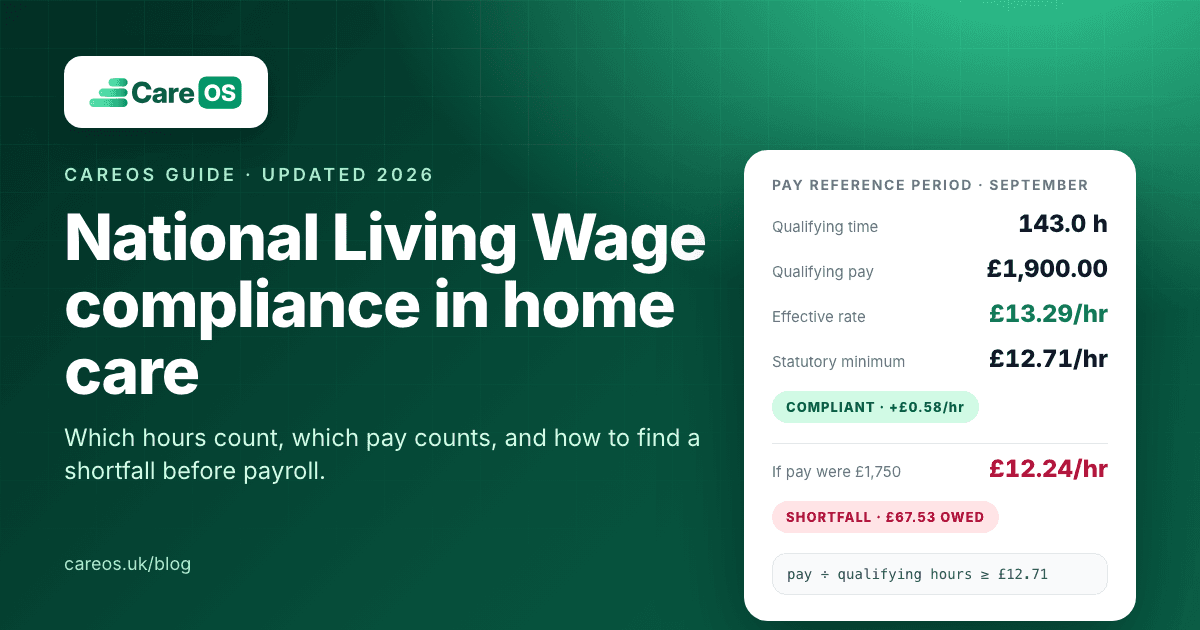
That is 58p above £12.71, so the period is compliant on these facts. A useful dashboard shows the margin as well as the verdict. A worker one or two pence above the minimum is at risk if unrecorded time is later approved.
Now suppose Sarah's qualifying pay is £1,750.
£1,750 ÷ 143 = £12.24 per hour
Minimum pay needed: 143 × £12.71 = £1,817.53
Shortfall: £1,817.53 − £1,750 = £67.53
The manager should see the effective rate, the legal rate, the required pay and the £67.53 adjustment. "Failed" with no explanation is not enough. Payroll staff need to understand the result to correct it.
Effective rate calculator
Enter one worker's qualifying time and minimum-wage pay for a single pay reference period.
Not the journey from home to the first call or from the last call home.
Pay that counts. Leave out mileage reimbursement and any premium element that does not count.
Statutory rates from 1 April 2026.
- Effective hourly rate
- £13.29/hr
- Required rate
- £12.71/hr
- Qualifying time
- 143h 00m (143.00h)
- Minimum pay for this time
- £1,817.53
Comfortably above the statutory minimum on these figures.
£1,900.00 ÷ 143.00h = £13.29/hr · minimum 143.00h × £12.71 = £1,817.53
General information, not legal or payroll advice. Uses the statutory rates from 1 April 2026. Enter minimum-wage pay and qualifying hours as this guide defines them; the result depends on the facts of each worker's arrangement.
Want this on your phone? Open the standalone calculator page and add it to your home screen.
CareOS runs this check for every worker and every pay reference period from the rota, visit and travel data it already holds. See how home care agencies use CareOS →
What contact rate do you actually need?
Once you accept that travel and other non-contact time count, the question flips: given the shape of a typical week, what contact-hour rate keeps a worker at or above the floor? The answer depends on how much of the worker's qualifying time is contact time. A carer with compact rounds and 90% contact time needs a small uplift. A rural carer with 70% contact time and unpaid travel needs a large one. Paying travel time separately, even at the statutory rate, brings the required contact rate down sharply.
Required contact rate calculator
Work backwards: given the travel and other qualifying time a typical week carries, what contact-hour rate keeps the worker at or above the floor?
Statutory rates from 1 April 2026.
- Contact rate needed
- £15.26/hr
- Statutory floor
- £12.71/hr
- Uplift over the floor
- £2.55/hr
Contact time is 83% of this worker's qualifying time, and travel is unpaid. Every contact hour must therefore carry £2.55 of pay for the time it does not cover. A round with more travel needs more; a compact round needs less.
(£12.71 × 36.00h) ÷ 30.00h = £15.26/hr, rounded up to the penny
General information, not legal or payroll advice. Uses the statutory rates from 1 April 2026. Enter minimum-wage pay and qualifying hours as this guide defines them; the result depends on the facts of each worker's arrangement.
Want this on your phone? Open the standalone calculator page and add it to your home screen.
CareOS runs this check for every worker and every pay reference period from the rota, visit and travel data it already holds. See how home care agencies use CareOS →
Keep these calculators: on your phone, or on your own website
On your phone. The three calculators also live on their own page at careos.uk/tools/nlw-calculator, without the article around them. Open that page on your phone and add it to your home screen: in Safari on an iPhone, tap Share and then Add to Home Screen; in Chrome on Android, tap the three-dot menu and then Add to Home screen or Install app. It then opens like an app, full-screen, with an NLW Calculator icon, so a coordinator can check a round in the car park before it is confirmed. There is a QR code on that page for anyone reading this on a desktop.
On your website. All three calculators are free to embed on any care agency, payroll bureau, HR or training website. Under each one, choose Embed this calculator on your website, copy the code and paste it into your page. The calculator loads in a frame, sizes itself to its content, needs no account or setup, and never asks your visitors for personal data.
The embed code ends with a one-line credit that links back to this guide. Please keep it: it is how your readers reach the full explanation of what they have just calculated, and it is the only thing we ask in return. The statutory rates inside the calculators are maintained by CareOS, so when they change each April your embedded copy, and your home-screen copy, update with them.
The seven most common NLW mistakes in home care
1. Checking the advertised rate instead of the effective rate. "We pay £13.50 an hour" is not a compliance calculation if £13.50 applies only to client-contact time.
2. Excluding all travel. Inter-client travel normally counts. Mileage reimbursement does not replace the need to account for the time.
3. Treating every rota gap as a break. A gap may contain travel, parking, waiting or required availability. Classify it according to the facts.
4. Relying only on scheduled visit duration. Actual work can run beyond the rota. Systems need late and early visit exceptions and a fair approval process.
5. Forgetting training and non-visit tasks. Required e-learning, meetings, supervision and administration add qualifying hours outside the visit schedule.
6. Using gross pay without reviewing pay items and deductions. Some premiums do not count in full, and employment-related costs or deductions reduce minimum-wage pay.
7. Performing the check only after a complaint. A retrospective spreadsheet can measure the damage but cannot prevent it. Checking at the rota stage and again before payroll closes lets the agency act while there is still time to.
Why travel-time estimates need proper governance
No system has a field called "legally correct travel". What an agency needs is a documented, consistent method that reflects how it actually operates.
A defensible approach draws on actual visit timestamps, the ordered sequence of calls, staff-reported exceptions and route estimates as a reasonableness check, while accepting that each has limits: timestamps can include time writing notes or parking, GPS data can be patchy or raise privacy concerns, and map estimates know nothing about congestion, diversions, rural access or the walk from a parking space.
Nobody's travel data is perfect, and pretending otherwise is the real mistake. Make the method transparent and review the exceptions:
- retain scheduled and actual visit times;
- calculate the interval between consecutive assignments;
- capture actual or evidenced travel where available;
- distinguish travel, waiting and a genuine break;
- flag impossible, negative or unusually long intervals;
- let the worker explain discrepancies;
- record manager amendments with the reason and a timestamp; and
- freeze the approved position when payroll is finalised.
That is a more credible audit trail than silently replacing real events with an ideal route time.
What evidence should a home care agency keep?
Employers must keep records sufficient to prove that each worker received at least the minimum wage for every pay reference period. HMRC says the information about a worker and a pay reference period must be producible in a single document. For records covered by the rules in force since April 2021, the minimum retention period is six years, running from the end of the pay reference period after the one the records cover.
HMRC's guidance lists payroll and PAYE information, contracts, timesheets, clocking systems, rotas, appointment diaries, training records, expense claims and bank statements. For a care agency, a useful NLW evidence pack includes:
- worker identity, date of birth and apprenticeship status;
- contract and work-type assessment;
- pay frequency and pay-reference-period dates;
- planned rota and actual visit start and end information;
- inter-client journey sequence and travel evidence;
- waiting, breaks and the reason for material gaps;
- training, supervision, meetings and other work;
- pay items included in and excluded from minimum-wage pay;
- deductions, worker payments and expense treatment;
- the applicable statutory rate;
- the calculation, the result and the safety margin;
- corrections or top-up payments and their approvals; and
- an audit history of manual changes.
The agency should be able to reproduce the result after the manager who ran that payroll has left. A spreadsheet on one person's laptop, linked to changing rota data, is not a resilient compliance record.
Workers who reasonably believe they have been underpaid can also ask to see their records. Under section 10 of the National Minimum Wage Act 1998 a worker can serve a written production notice, and the employer must produce the relevant records within 14 days of receiving it unless a later date is agreed during that period. Accessible, worker-level reporting is operationally useful as well as good governance.
What happens if an agency gets NLW wrong
HMRC can investigate after a worker complaint or through a targeted investigation. Compliance officers can require employers and staff to produce and explain records, inspect premises and request further information. The employer bears the burden of proving compliance.
Where HMRC identifies underpayment, a notice can require the employer to pay arrears and a financial penalty. Government guidance states the penalty can be up to 200% of the arrears, capped at £20,000 per worker, with a 50% reduction if the notice is fully complied with within 14 days. Deliberate non-payment and record offences can carry criminal consequences. Employers also face public naming, employee-relations damage, management time and reputational harm with commissioners and partners.
Arrears are not limited to the cash difference originally missed. The statutory formula can use current minimum-wage rates where these are higher. A small recurring error across many workers and pay periods becomes a significant liability.
The right response to a suspected historic problem is not to delete or rewrite records. Preserve the evidence, stop the issue continuing, take professional advice, calculate the affected periods carefully and consider HMRC's voluntary-declaration route where appropriate.
Building NLW compliance into everyday operations
Compliance holds up best when it is treated as a cycle that runs with every payroll rather than an audit that happens once a year.
At recruitment and onboarding. Record accurate age and apprenticeship information. Make sure the contract reflects the real pay arrangement and work type. Explain how contact time, travel, waiting, training, mileage and non-visit work are recorded and paid. Review required worker expenditure, including uniforms and equipment.
While building the rota. Home care rostering software that projects pay at the planning stage makes this routine. Assess the combination of paid visits, journey time and gaps. A round of many 15-minute calls may be financially and legally riskier than a compact block of longer visits. Flag projected effective rates before shifts are assigned. Consider geographic clustering and continuity of care, not only whether every visit has a worker.
During service delivery. Capture reliable actual visit times and let workers report travel, waiting, delayed calls and additional work. Do not create incentives to endanger service users or falsify timestamps. Review exceptions promptly.
Before payroll closes. Reconcile missing visits, overlaps, training, expenses, deductions and manual pay items. Run the worker-level calculation for the complete pay reference period. Investigate red and near-threshold results. Approve necessary top-ups before final submission.
After payroll. Freeze a reproducible compliance report and retain it with the underlying evidence. Watch the patterns: workers regularly near the threshold, rounds causing excessive travel, branches with repeated manual adjustments, managers approving unexplained exclusions.
How CareOS supports NLW compliance in domiciliary care
CareOS home care management software is built around the same operational chain this guide describes: rota, actual visits, travel between clients, training and other qualifying time, worker-specific statutory rates, qualifying pay, shortfall calculation and audit reporting. Because the rota, the visit record, the travel record and payroll are one system, the check runs on the same data the agency already holds rather than on a spreadsheet somebody joins together afterwards.
The right rate for each worker. CareOS applies the statutory rate for the worker's age band as at the start of the pay reference period, moves a worker up a band from the first period after their birthday, applies the apprentice rate where it is recorded as applicable, and holds the rate schedule by effective date so an April change is picked up without anyone editing a number.
Every qualifying minute, on a worked basis. The calculation counts actual visit time, travel between clients at its worked duration (not the capped or rounded figure the agency chooses to pay), paid training, meetings and other work blocks. The commute is excluded. Mileage is excluded from pay, because it reimburses an expense rather than paying for time. Scheduled and actual time stay separate so a manager can see why a figure changed.
Effective rate, margin and the exact top-up. For every worker and every pay reference period CareOS shows qualifying pay ÷ qualifying hours, the statutory rate that applied, the margin above or below it, and, where there is a shortfall, the additional payment required, rounded up to the penny in the worker's favour. A shortfall blocks the payroll run from being finalised until it is resolved, and the resolution is recorded.
Green, amber, red. Compliant workers show green. A worker inside the agency's headroom margin shows amber, so a late visit or an extra journey cannot tip them below the floor unnoticed. A shortfall shows red with the adjustment. Amber is an operational warning, not a legal category.
A view of the whole agency, and of one worker. The payroll view lists every worker checked, how many are compliant, how many are at risk and the total adjustment required for the period. "View calculation" opens one worker's result in plain English: hours by category, pay, rate, the division and the outcome.
Travel and gap controls. CareOS distinguishes the estimated journey, the actual interval between visits and the classification of any gap, so travel, waiting and a genuine break are not silently treated as the same thing. Discrepancies are reviewed with a reason and the history is kept.
Warnings before the shift happens. Because CareOS knows the rota before payroll, it projects the effective rate a round is likely to produce while the round is being built, and warns where short calls and long journeys point to a shortfall. The manager can redesign the round, change the pay arrangement or budget for the adjustment before the worker is underpaid.
A resolution path that holds. A top-up entered on a worker's pay line survives recalculation, so "pay the shortfall, then recalculate" clears the exception rather than reviving it. A resolved exception keeps its link to the adjustment that settled it, so the audit trail shows what was found, what was paid and who approved it. Sleep-in shifts are checked separately, against the scheduled hours plus any logged disturbances.
An audit record that outlives the payroll run. When a run is finalised, the worker-and-period calculation is frozen with the rate, hours, pay and any adjustments, and can be exported as a compliance report for HMRC, an auditor or the worker.
No software can take on an employer's legal responsibility or decide every fact-sensitive case. Agencies must configure pay rules accurately, capture truthful information, review exceptions and take advice when they need it. What CareOS provides is the data, the calculation, the warnings and the evidence that make that responsibility manageable.
A practical NLW compliance checklist for domiciliary care agencies
Ask these questions before each payroll is finalised:
- Have we applied the correct statutory rate for every worker's age and status?
- Is the pay reference period correctly defined?
- Have we captured actual visit time, not only scheduled or commissioned time?
- Have we included travel between consecutive clients?
- Have we separated ordinary commuting from qualifying travel?
- Have we reviewed gaps and distinguished travel, waiting and genuine breaks?
- Have we included required training, meetings, supervision and administration?
- Have sleep-in or on-call arrangements been configured and reviewed separately?
- Have we classified pay elements according to the minimum-wage rules?
- Have we reviewed uniforms, equipment, travel costs and other worker expenditure?
- Have deductions and payments been treated in the correct pay reference period?
- Can each worker see how their qualifying hours and pay were calculated?
- Have red and near-threshold results been investigated before payroll closes?
- Has any required top-up been approved and paid?
- Can we reproduce the complete worker-level calculation in one report?
- Are the report and the supporting records retained for the required period?
If the honest answer to any of these is "we assume so", that is the place to start.
In short
National Living Wage compliance in home care comes down to a joined-up calculation rather than the number printed beside "hourly rate": the right worker rate, the correct pay reference period, every qualifying minute, the pay elements that legally count, and any deductions or expenditure that reduce them.
For domiciliary care providers, travel between clients is usually the difference between apparent compliance and actual underpayment, with training, waiting, meetings, overrunning visits and worker costs close behind. When those records live in separate rotas, apps, timesheets and payroll spreadsheets, errors are easy to miss and hard to explain two years later.
If you are choosing a system with this in mind, our domiciliary care software buyer's guide covers what to check on travel, payroll and the evidence an inspector will ask for.
Want to see how CareOS handles rota, travel, payroll and NLW compliance in one place for a home care agency? Book a CareOS demonstration.
Sources and further reading
- GOV.UK, Calculating the minimum wage
- GOV.UK, Working hours for which the minimum wage must be paid
- GOV.UK, Calculating the minimum wage: pay reference periods and the calculation
- GOV.UK, Enforcing the minimum wage
- GOV.UK, National Minimum Wage and National Living Wage rates
- GOV.UK, Employers and the minimum wage
- HMRC National Minimum Wage Manual, NMWM08300: travelling time for time work
- HMRC National Minimum Wage Manual, NMWM09010: pay reference periods
- HMRC National Minimum Wage Manual, NMWM11020: deductions and payments
- HMRC National Minimum Wage Manual, NMWM12020: records
- HMRC National Minimum Wage Manual, NMWM12040: record retention
- National Minimum Wage Act 1998, section 10: worker's right of access to records
This article is reviewed whenever statutory rates or government guidance change, and in any event before 1 April each year.
Frequently asked questions
Do care workers have to be paid for travel time between clients?
Travel between work assignments counts as working time for minimum-wage purposes, so it must be included when checking whether a worker's qualifying pay reaches the legal minimum. The contract may provide a separate travel-time rate, an inclusive arrangement or another lawful pay structure, but the overall statutory calculation for the pay reference period must still pass. Contractual rights may go beyond the minimum-wage requirement.
Does mileage count as payment for travel time?
No. Mileage reimbursement and pay for time are different things. A mileage payment covers vehicle costs. It does not remove the travel minutes from minimum-wage working hours, and its treatment as minimum-wage pay depends on the rules and the facts.
Must home-to-first-client travel be paid at the National Living Wage?
Ordinary home-to-work travel, including home to the first assignment and the last assignment to home, generally does not count for minimum-wage purposes. It may count as working time under the separate Working Time Regulations for some mobile workers, and unusual facts can change the answer.
Can an agency pay only for contact time?
An agency can structure pay in different lawful ways, but whatever label is used, the worker must receive at least the applicable minimum wage when minimum-wage pay is divided by all qualifying hours in the pay reference period. Contact-only pay creates a particular risk where travel and other work are substantial.
Is NLW checked per visit, per shift or per month?
The statutory comparison is made over the worker's pay reference period, usually a week or a month and never longer than a month. Shift-level or rota-level checks are useful warnings but do not replace the pay-reference-period calculation.
Does mandatory online training count?
Employer-required training normally counts as working time, including required learning completed online or at home. Agencies need reliable records of the time and of the pay period in which it was treated.
Does waiting between visits count?
It can. The answer depends on whether the worker is travelling, required to be available, waiting in connection with work, or genuinely free on a rest break. Automatically marking every gap as an unpaid break is risky.
Do sleep-in shifts count in full?
Not necessarily. Where a worker is permitted to sleep and suitable sleeping facilities are provided, the rules can treat that period differently from time when the worker is awake for the purpose of working. Sleep-in arrangements need fact-specific review.
How long should NLW records be kept?
For records covered by the rules in force from 1 April 2021, employers must keep them for at least six years, measured from the end of the pay reference period following the one the records cover. The agency must be able to produce sufficient worker-and-period evidence in a single document.
Can care software guarantee legal compliance?
No system can guarantee the outcome if configuration is wrong, data is missing or a fact-sensitive arrangement has not been reviewed. Good software automates the calculation, exposes missing information, warns before payroll, preserves evidence and makes compliance far more controllable. The employer remains legally responsible.
Keep reading
- Domiciliary Care Software in 2026: The Complete Buyer's Guide for UK Home Care AgenciesWhat domiciliary care software actually does, the features that matter, how CQC, DSCR and DSPT should shape your shortlist, and a scoring method to compare vendors without being dazzled.
- Electronic Care Planning: What Makes a Care Plan Live Rather Than LaminatedA paper care plan is accurate on the day it is printed and quietly wrong thereafter. What separates electronic care planning from electronic paper: linked risks, tracked reviews, point-of-care access, and an audit trail that makes the record evidence.
- Nursing Home Management Software: What the Nursing Part ChangesMost care home software was built for the residential model and had the word nursing added to the brochure. What the nursing registration actually changes about the software you need, and five things to make a vendor show you live.
CareOS by care setting
The platform is one system with a workspace per setting. See what it looks like for yours:
See CareOS against your own worst-case Monday
CareOS is UK care management software: rostering, eMAR, care plans, compliance and finance in one system, with a workspace built for each care setting and designed around CQC, Ofsted and DSCR requirements.
Book a demo