
Healthcare Management Software in the UK: Types, Features and How to Choose
Healthcare management software is one of those phrases that means whatever the person saying it needs it to mean. A hospital director hears patient administration. A practice manager hears appointments and billing. A care home manager hears rotas and medication. All three are searching the same words and looking for entirely different products.
This guide separates them. It sets out the four categories the phrase covers, what each is actually for, where social care sits, and how to work out which one you are shopping in before you sit through three demos of the wrong thing.
If you run a care service, a home care agency, care home, supported living service or children's home, your category is care management rather than clinical, and the guide written for you is care management software. The map below explains why the search term is misleading and what changes.
What healthcare management software means
At its broadest, it is any system that manages the operational side of delivering health or care: the people receiving it, the people delivering it, the schedule, the record of what happened, and the money.
Note the word management: this is the operational and administrative layer, so it excludes the diagnostic and clinical-decision tools, and the governance and assurance platforms, that sit in the wider healthcare software market. The reason the phrase is unhelpful is that "healthcare" in the UK spans two regulated worlds with different records, different regulators and different daily jobs. Clinical services diagnose and treat. Care services support people with daily living. A system built for one does the other badly, and the phrase does not distinguish them.
Below is the map. Find yourself on it first, then look at products.
The four categories
1. Clinical record systems
Electronic patient records in hospitals, and the clinical systems GP practices run on. The record is clinical: diagnoses, prescribing, results, referrals, correspondence. Interoperability requirements are heavy, integration with national infrastructure is expected, and procurement is long and formal.
Buyers: NHS trusts, GP practices, independent hospitals, private clinics.
2. Practice and clinic management
The commercial and administrative layer of a clinical service: appointments, patient communications, billing and insurance, capacity and room management, and reporting. Sometimes bundled with the clinical record, sometimes separate. Common in dentistry, physiotherapy, private GP and allied health.
Buyers: private practices and clinics of every size.
3. Care management
The operational system a regulated social care provider runs on: care records and plans, rostering, mobile recording by carers at the point of care, electronic medication records, workforce compliance, and invoicing and payroll. The record is a care record, not a clinical one. The regulator is CQC or Ofsted rather than an NHS procurement framework.
Buyers: home care agencies, care homes, supported living services, children's homes, care staffing agencies.
4. Workforce and back-office systems
Rostering, HR, payroll, training and finance products that are not health-specific but are sold into health and care. They handle staff well and know nothing about care delivery, which is fine if that is all you need and a problem if you assumed they covered the rest.
Buyers: anybody, which is the point and also the risk.
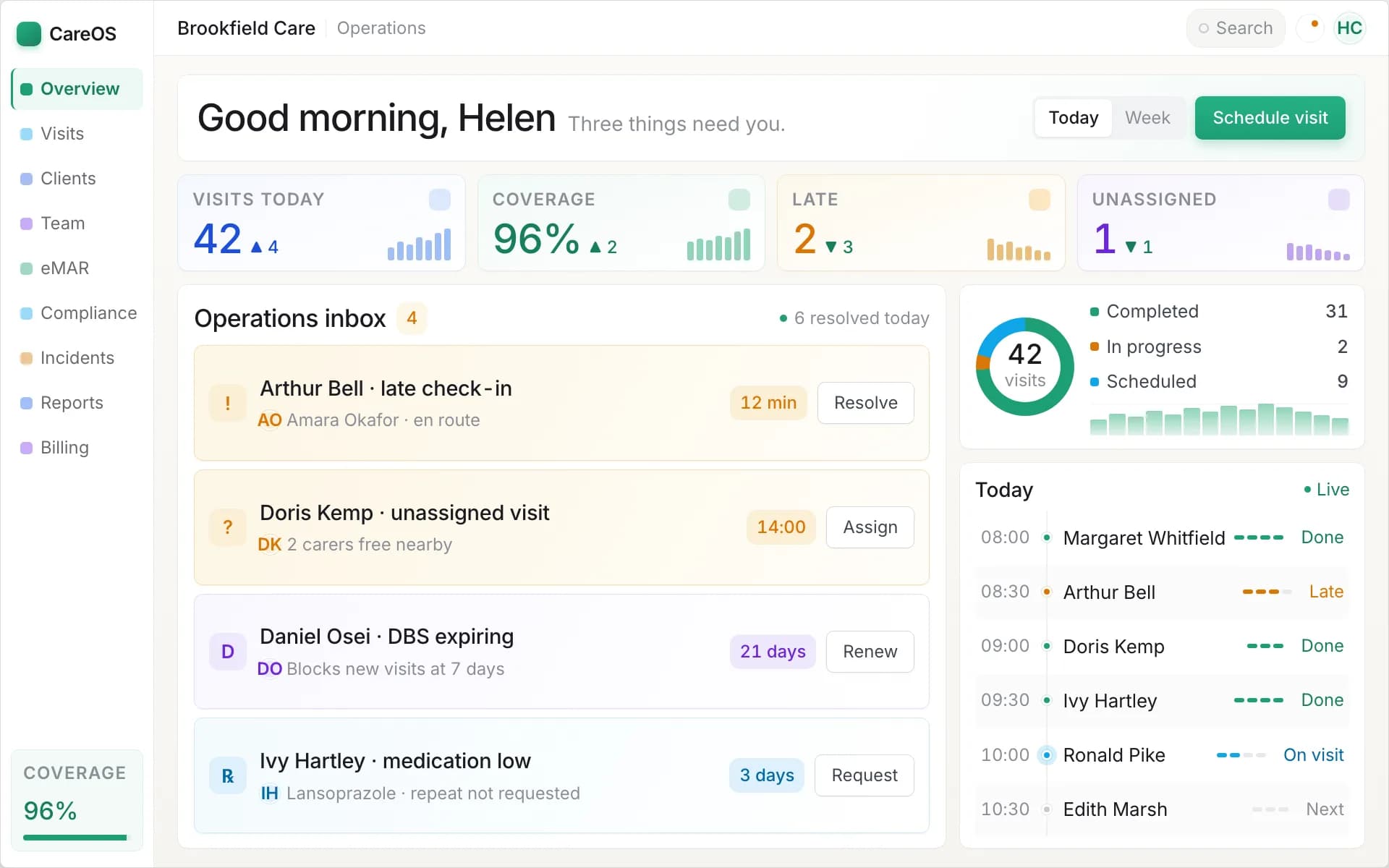
Category three in practice: an operational view of care delivery, not a clinical record.
"Software for healthcare management": the same thing, said differently
The phrase gets typed both ways round and there is no distinction worth drawing between them. If you searched for software for healthcare management, you are looking for the same four categories above.
What does sometimes differ is the intent behind the wording. People typing the phrase in that order are more often at the start of the process, looking for the shape of the market rather than a shortlist, which is what this post is for. Once you know your category, the specific guides are more useful than anything written at this level.
Where social care sits, and why it gets mis-sold
Social care is category three, and it is the category most often served badly, for a reason worth understanding.
Clinical systems are bought through structured procurement with defined assurance requirements. Care providers, especially small and mid-sized ones, buy in a much less structured market. The result is that care providers get sold products from the other three categories with some care-shaped language applied.
The three mismatches that recur:
A clinical system in a care setting. The record is organised around diagnosis and treatment, so care planning and daily support recording are bolted on. Rostering is usually absent or thin. Nothing knows what a domiciliary visit is.
A generic workforce system in a care setting. The rota is genuinely good. There is no care plan, no medication record, no proof of delivery, no compliance link, and nothing an inspector will accept as evidence of care. Providers end up running it alongside paper, which is the worst of both.
A care system built for the wrong setting. The subtlest and most common: home care software in a care home, or either in supported living. Covered in detail in care home management software and supported living software.
What a care management system has to do
If you have placed yourself in category three, this is the requirement list. It is set out fully in the care management software guide; the summary is:
Care records and planning. Person-centred plans with linked risk assessments and tracked reviews, visible to staff at the point of care rather than filed in the office.
Scheduling. Visits for home care, shifts for residential and supported living, with conflict detection and fast cover for absence. See care rostering software.
Recording. A mobile app carers actually use, working offline, producing verified evidence that care was delivered.
Medication. Electronic MAR with real-time alerting when a dose is missed. See eMAR software.
Workforce compliance. DBS, right to work, training and supervisions tracked with expiry alerts, ideally blocking unsafe rostering.
Finance. Invoices and payroll produced from actual delivery data, handling split funding between local authority and private payers.
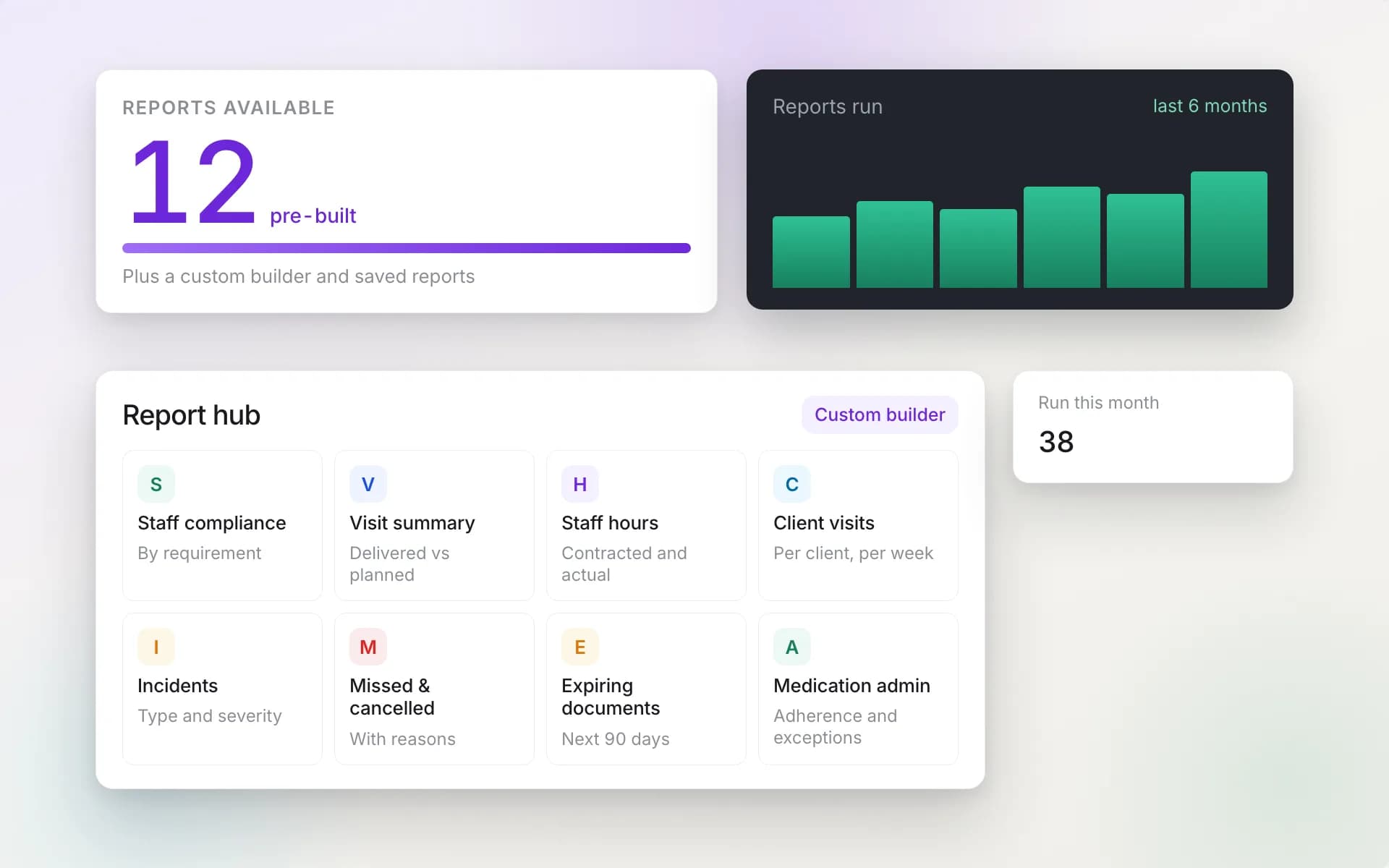
Operational and regulatory reporting from the same data the daily work produces.
Data, interoperability and security
Whichever category you land in, three things are worth raising with any vendor in the UK.
NHS DSPT. The Data Security and Protection Toolkit is the annual self-assessment covering how health and care data is handled. It applies to social care providers as well as NHS organisations. Your vendor holds your data, so their posture affects your submission directly: ask what standards they meet and whether they will support you through it.
DSCR. NHS England's Digital Social Care Records programme is moving social care towards assured digital record systems, and assurance affects access to associated funding. If you are in category three, ask whether a vendor is assured or actively pursuing assurance.
Interoperability. In clinical settings this is a hard requirement with national standards attached. In social care it is a growing expectation rather than a universal one, most visible in sharing information with NHS services around a person. Ask what a vendor can export, what it can receive, and whether that is a product feature or a professional services project. The honest answer is often the second, and it is better to know.
UK GDPR. Care and health records are special category data. Ask where data is hosted, who has access, how long it is retained, and what happens to it if you leave.
Working out your category
Five questions, in order. The first two usually settle it.
- What is the primary record you keep? A clinical record with diagnoses, prescribing and treatment decisions puts you in category one or two. A care plan and a daily record of support delivered puts you in category three.
- Who regulates you? CQC as a social care provider, or Ofsted, means category three. NHS procurement frameworks and clinical assurance requirements mean one or two.
- Who delivers the work? Registered clinicians on a clinical pathway, or care and support workers on a rota.
- What is the unit of work? An appointment or an episode of care, or a visit, a shift, or a package of support hours.
- What would an inspector or auditor ask you to produce? Clinical audit and safety cases, or medication records, care plans, staffing and evidence of delivery.
If your answers point at category three, everything else on this blog is written for you. If they point at one or two, this is not our market and we would rather say so than sell you something that fits badly.
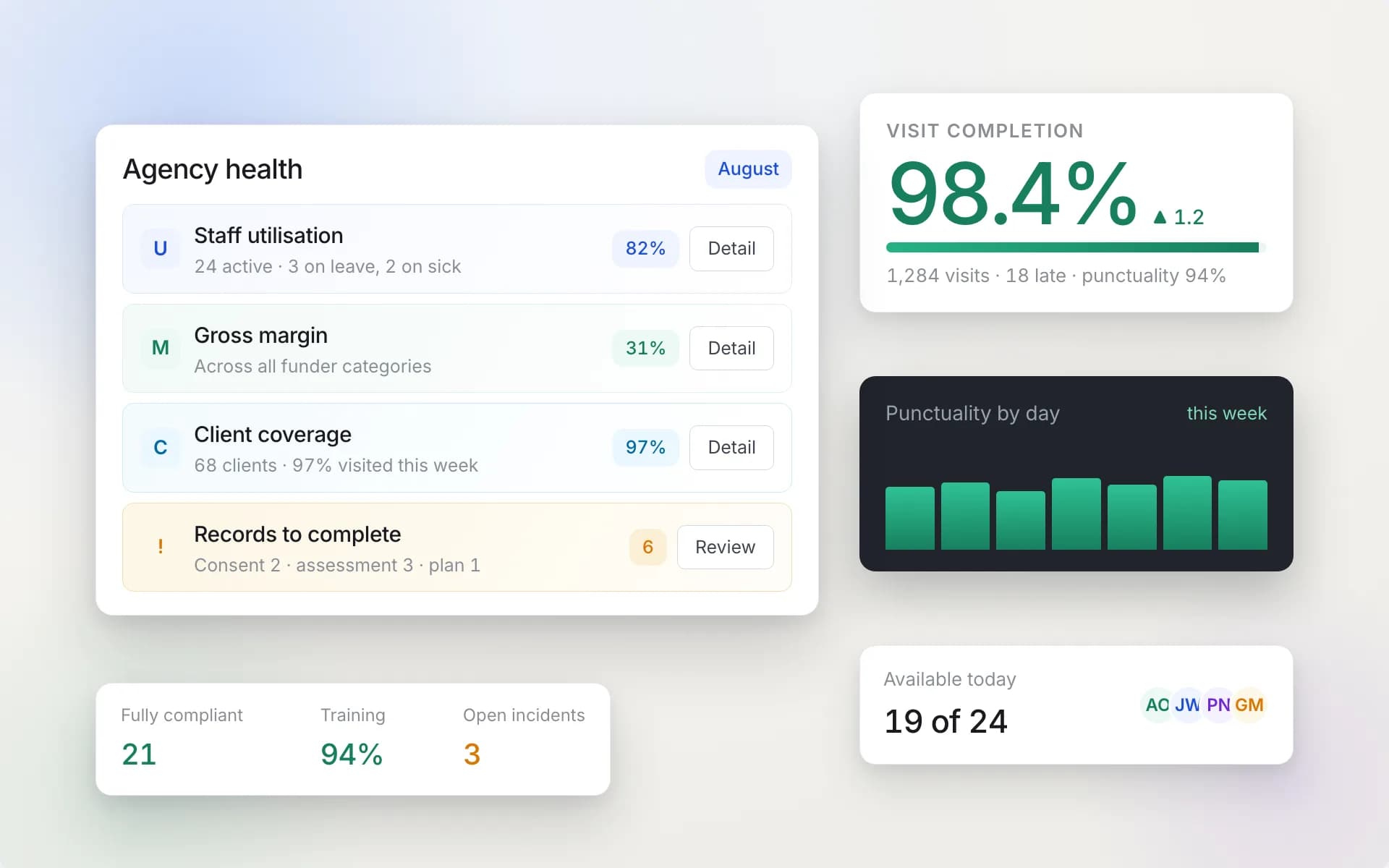
Trends across a service: the management layer that makes the operational record worth having.
Buying: a short checklist
- Category fit first, features second. A product from the wrong category cannot be fixed by a good feature list.
- Ask what it was built for. There is nearly always a specific answer, and it tells you where the sharp edges are.
- Bring your own worst week to the demo. Not the rehearsed scenario. The Sunday two people called in sick.
- Get total cost at your size and at double it, including setup, migration and any per-user charges.
- Interrogate migration. Who moves your existing records, and what does the process look like.
- Test support. Care runs at seven on a Sunday morning. Ask who answers.
- Read the exit terms. Full data export, reasonable notice, records retained in a usable form.
- Speak to a reference customer in your setting, at your size, who moved in the last year.
Where to go next
If your category turns out to be social care, the guide to AI care management software sets out what the AI in those systems does for a manager, and the four tests to hold any vendor to.
If you are in social care, start with care management software, then the guide for your setting: home care, care homes, or supported living. For the regulatory picture, CQC compliance software and compliance software for healthcare.
CareOS is care management software for UK social care providers across home care, care homes, supported living, children's services and care staffing. It is not a clinical record system and does not compete with one. If that is the category you are in, book a demo and bring the week that breaks your current setup.
Frequently asked questions
What is healthcare management software?
Broadly, any system managing the operational side of delivering health or care: the people receiving it, the people delivering it, the schedule, the record of what happened, and the money. In practice the phrase covers four distinct categories: clinical record systems, practice and clinic management, care management for social care providers, and generic workforce and back-office systems sold into health and care.
Is there a difference between healthcare management software and software for healthcare management?
No, they are the same phrase in a different order and cover the same four categories. The only pattern worth noting is that people typing the second version are more often at the start of the process, mapping the market rather than building a shortlist. Once you know which category you are in, a guide specific to that category is far more useful than either search term.
Is care management software the same as healthcare software?
No. Healthcare software usually means clinical systems: hospital patient records, GP practice systems, prescribing and diagnostics, bought by NHS organisations and private clinics. Care management software serves social care providers, where the record is a care record rather than a clinical one and the regulator is CQC or Ofsted. They overlap at the edges but are built around different daily work.
Why do care providers end up with the wrong software?
Because clinical systems are bought through structured procurement with defined assurance requirements, while care providers buy in a much less structured market. The three recurring mismatches are a clinical system used in a care setting, a generic workforce system with no care record or medication module, and a care system built for a different setting, such as home care software used in a care home.
What should I ask about data and security?
Ask what security standards the vendor meets and whether they will support your NHS DSPT submission, since they hold your data. Ask where data is hosted, who has access, how long it is retained, and what happens to it if you leave. In social care, also ask whether they are assured under NHS England's Digital Social Care Records programme or actively pursuing it.
How do I work out which category I need?
Two questions usually settle it. What is the primary record you keep: a clinical record with diagnoses and prescribing, or a care plan and a daily record of support delivered? And who regulates you: NHS procurement and clinical assurance, or CQC as a social care provider or Ofsted for children's services? The answers point at clinical systems or care management respectively.
Keep reading
- AI Care Management Software in 2026: Every Native Capability, and What It Does for a Care ManagerA working guide to AI in care management software: what it genuinely does across rostering, assessment, care recording, early warning, medication and compliance, the four tests to hold any vendor to, and the questions to ask in a demo.
- Care Management Software: What It Does and How to ChooseWhat the category actually covers, the six modules a complete system needs, why social care and healthcare are different markets, and how to compare vendors against your own worst week rather than their demo.
- Compliance Software for Healthcare and Care Providers in the UKClinical compliance and care compliance share a word and almost nothing else. A map of the UK regulatory landscape, what the software is for in each market, and four questions to work out which one you are shopping in.
CareOS by care setting
The platform is one system with a workspace per setting. See what it looks like for yours:
See CareOS against your own worst-case Monday
CareOS is UK care management software: rostering, eMAR, care plans, compliance and finance in one system, with a workspace built for each care setting and designed around CQC, Ofsted and DSCR requirements.
Book a demo