
CRM for Healthcare: What It Does, and What Care Providers Actually Need
Buying a CRM is an easy decision for a care provider to reach and an awkward one to live with. Not because CRM is a bad idea, but because the thing they needed was usually a different thing with an overlapping description, and by the time that is clear there is a second system holding half the information about the people you support.
This guide is about the boundary. What a CRM does in a health or care setting, what it is genuinely good at, where it stops, and how to tell whether your problem is a relationship problem or an operational one. If you get that distinction right the buying decision usually makes itself.
If you run a care service, the short version is that a CRM manages people who are not yet your clients, and a care management system manages people who are. Most providers need the second far more urgently than the first, and many need the first only as a module of the second.
What is a CRM, in this context?
Customer relationship management software tracks relationships and the interactions that make them up: contacts, organisations, conversations, enquiries, opportunities, and the pipeline from first contact to agreement. It is fundamentally a sales and communications tool, and it is very good at that job.
Applied to health and care, "CRM for healthcare" is used for a few distinguishable things:
Patient relationship management in clinical settings: appointment reminders, recalls and screening invitations, patient communications and satisfaction. Often built into practice management systems rather than bought separately.
Referral and enquiry management across both health and care: who has approached you, from where, what they need, what stage the conversation has reached, and whether anybody has followed up.
Commissioner and partner relationships, particularly for providers whose revenue comes from local authorities, integrated care boards or case managers. Contacts, contracts, tenders and the conversations around them.
Marketing operations: campaigns, enquiry sources, conversion, and where new business actually comes from as opposed to where you assume it comes from.
"CRM and healthcare": the relationship layer and the care record
People search this phrase both ways round, and the more useful way to think about it is as two layers that touch but should not merge.
The relationship layer is everything before and around care: an enquiry from a daughter about her father, a hospital discharge team asking whether you have capacity, a local authority framework conversation, a family's questions during the first fortnight. It is conversational, it is about people who may or may not become clients, and it is where a CRM lives.
The care record is everything from the point care begins: assessment, care plan, risk, medication, delivery, review. It is regulated, it is evidence, it is subject to retention rules, and it belongs in a care management system.
The mistake providers make is letting the first swallow parts of the second. A CRM will happily store a note about somebody's medication because a CRM will store anything. Six months later you have clinically relevant information in a marketing tool: outside your care record, not visible to carers, not part of your inspection evidence, and probably not retained or secured to the standard care data requires.
The rule worth adopting: the CRM holds the conversation, the care system holds the care. Anything an inspector might ask about belongs in the care record.
Where a CRM genuinely helps a care provider
Four places, and they are real.
Enquiries and the path to care
The commonest and best use. Someone gets in touch, usually at a stressful moment, often having called three other agencies the same morning. Speed and follow-through decide whether they become a client. A CRM, or an enquiry module, gives you the enquiry recorded, the source, an owner, a next action with a date, and visibility of everything in progress.
Two things matter more than the software. First, response time: a same-day call back beats a better-written brochure every time. Second, capacity honesty. The most useful question at enquiry stage is not "would you like a brochure" but "can we actually deliver care at that postcode, at those times, with the staff we have". A system that can answer that in the first conversation, rather than after three days of checking, converts better and avoids taking on packages you cannot staff.
That is where an enquiry capability inside the care system beats a standalone CRM outright, because only the care system knows your rota.
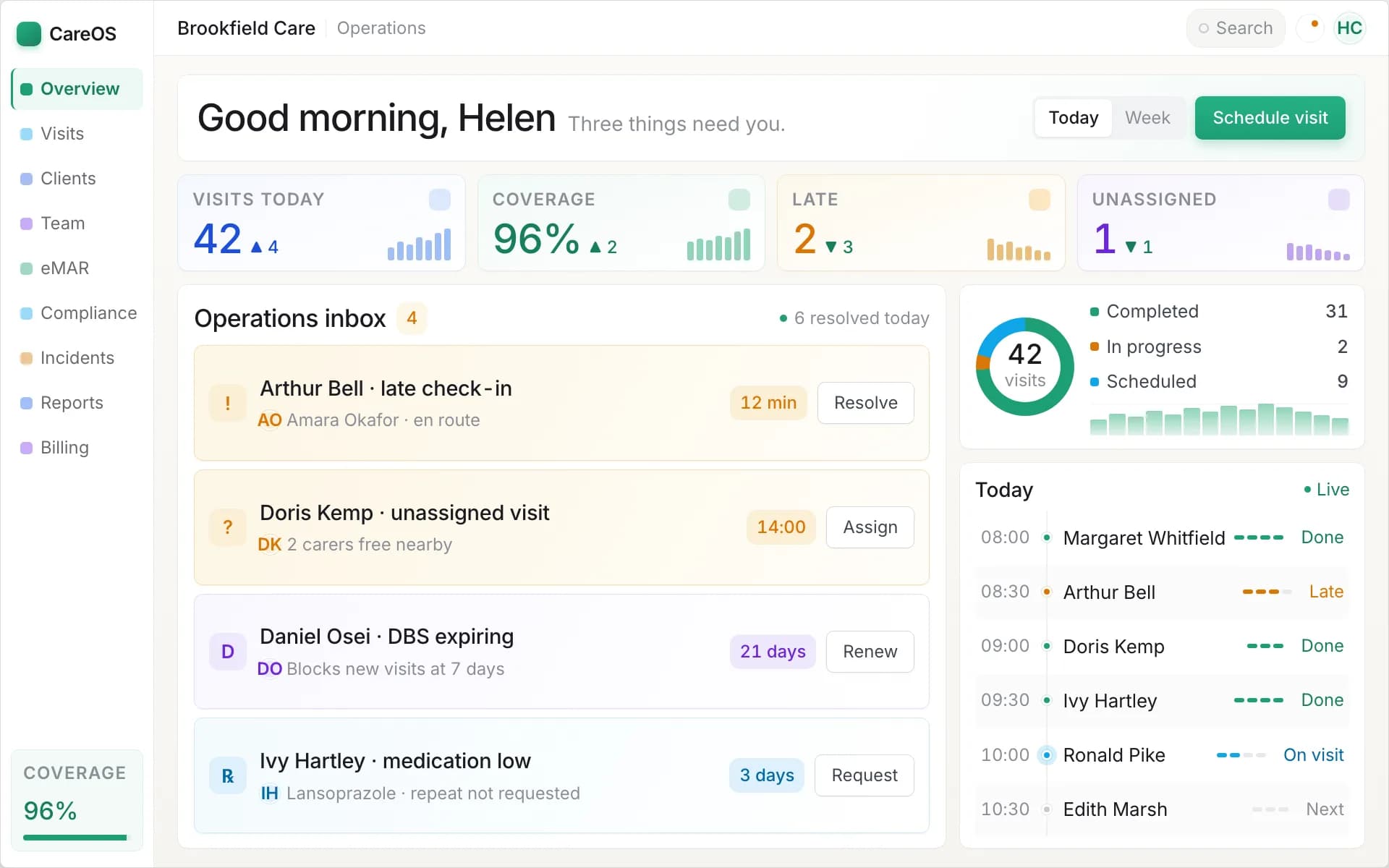
Capacity answered from the live rota, which is the one question at enquiry stage that a standalone CRM structurally cannot answer.
Commissioner and referrer relationships
If your work comes from local authorities, hospital discharge teams, case managers or brokerage, those relationships are your pipeline and they benefit from being tracked properly: who you spoke to, what was agreed, when the framework is up for renewal, which referrers send you work and which have stopped.
This is the clearest genuine CRM use case in care, and it is the one most often kept in somebody's inbox instead.
Family communication
Families want reassurance and, if they do not get it, they telephone. That inbound load is real and mostly avoidable. Some of it is CRM-shaped, tracking the relationship and the conversations, but most is better served by a family portal in the care system that simply shows relatives what care was delivered, because the underlying want is visibility rather than a conversation.
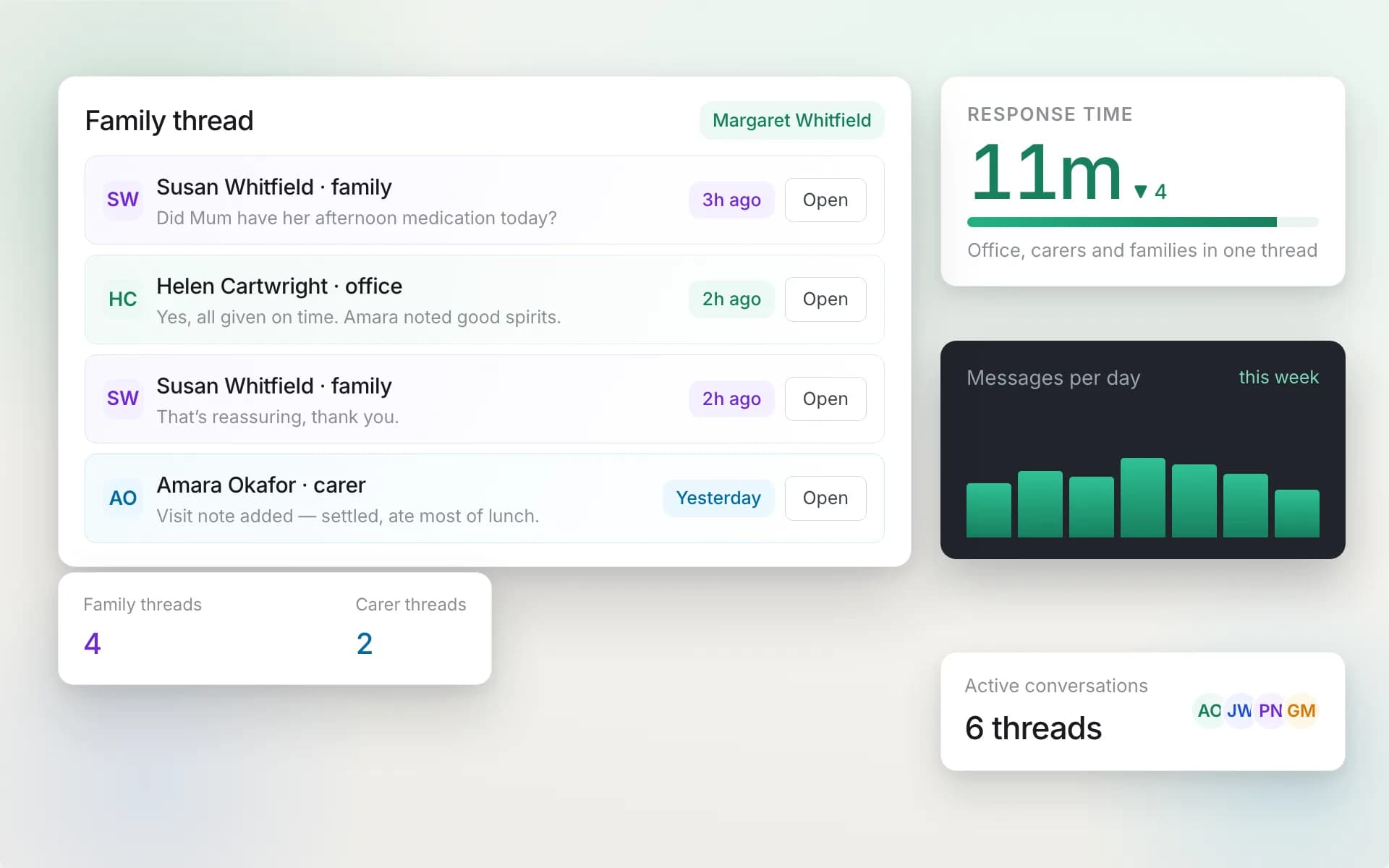
Communication attached to the person and the care record, rather than to a separate contact database.
Marketing and source tracking
Knowing where enquiries come from, which sources convert, and what a client is worth over their time with you. Useful, and mostly a reporting question. Worth having, rarely worth a separate platform on its own.
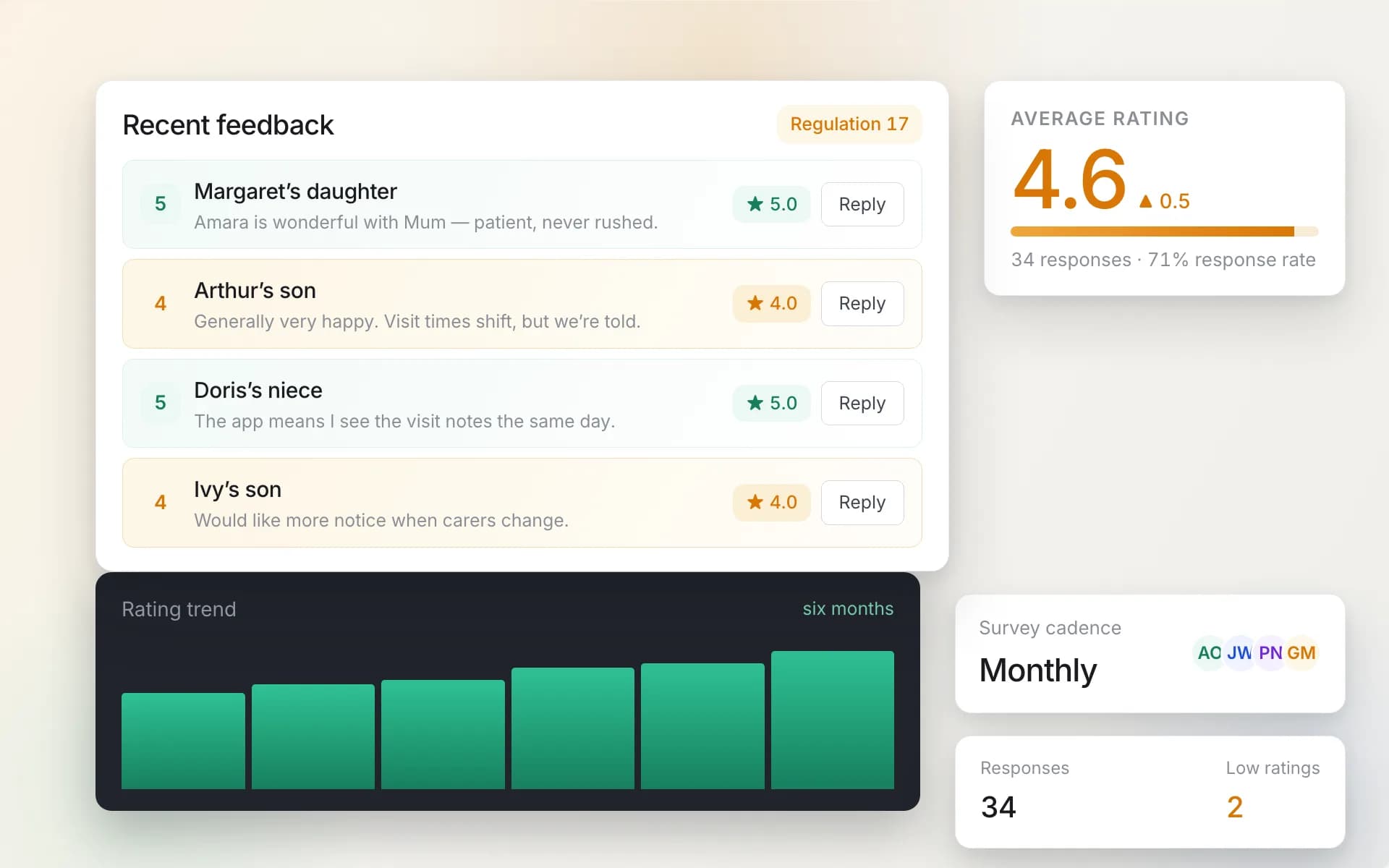
Feedback and satisfaction tracked alongside delivery rather than in a separate marketing tool.
Where a CRM stops
Be clear about what it will not do, because this is where the disappointment comes from.
It has no care record. No care plan, no risk assessment, no consent, no review cycle. You can approximate them with custom fields, and you will regret it.
It cannot roster. It does not know who is working, where they are, or whether a package is deliverable. See care rostering software.
It has no medication record. Nothing in the CRM world approaches an eMAR, and a workaround here is a safety issue rather than an inconvenience. See eMAR software.
It produces no inspection evidence. A CQC inspector will not ask about your pipeline. See CQC compliance software.
It has no concept of compliance. DBS expiry, mandatory training, right to work: absent, and not something a pipeline tool should be asked to hold.
Its data handling is built for marketing. Care records are special category data with retention obligations and access expectations that a general-purpose CRM is not designed around. Putting care information in one is a data protection question, not just an untidy one.
Do you need both?
Usually not two separate systems, and this is the practical conclusion.
A care management system with enquiry handling built in covers what most providers actually need: enquiries with owners and next actions, referral sources, conversion reporting, and a capacity check that can answer honestly in the first conversation because it reads the real rota. One system, one record, no gap between the enquiry and the care.
A separate CRM earns its place when your relationship management is genuinely complex in its own right: a large commissioner and tender operation, multi-brand marketing, a business development team with its own pipeline, or a group where sales and operations are properly separate functions.
If you do run both, agree the boundary before you start rather than after. The CRM holds contacts, conversations and the pipeline up to the point care is agreed. The care system holds everything from assessment onwards. Anything clinical or care-related lives in the care record, always, even when the CRM would let you put it somewhere else.
Buying: what to ask
If you are considering a CRM alongside a care system:
- What breaks if this lives in the care system instead? Often nothing, and you have saved a subscription and a synchronisation problem.
- Where does the boundary sit, exactly? Write it down. Which system owns a person between enquiry and first visit?
- What happens at conversion? When an enquiry becomes a client, does the information move automatically or does somebody retype it? Retyping is where errors and omissions enter the care record.
- What care data will end up in here anyway? Be honest, then check that is acceptable under your data protection obligations.
If you are choosing a care system and enquiries matter to you:
- Show me an enquiry from first call to first visit, live, including the capacity check.
- Show me where enquiries come from and which convert, as a report rather than a promise.
- Show me what happens when we cannot take the package. Recording a declined enquiry and why is how you find out what you are turning away.
Where to go next
If you came here for the boundary question, the practical next step is the platform side: care management software for the category, then your setting: home care, care homes, or supported living.
CareOS includes enquiry handling inside the care management system: enquiries with owners, sources and next actions, a capacity check that reads your live rota so you can answer honestly on the first call, and a clean path from enquiry to assessment to care with nothing retyped. It is not a general-purpose CRM and would be a poor substitute for one if relationship management is genuinely your problem. If enquiries and capacity are the bottleneck, book a demo and ask to see the enquiry-to-first-visit path specifically.
Frequently asked questions
What is a CRM for healthcare?
Customer relationship management software applied to health and care settings. In practice it covers patient communications and recalls in clinical services, referral and enquiry management, commissioner and partner relationships for providers funded by local authorities or integrated care boards, and marketing operations such as enquiry sources and conversion.
Is a CRM the same as a care management system?
No, and the distinction is the whole buying decision. A CRM manages relationships with people who are not yet your clients: enquiries, conversations, pipeline. A care management system manages people who are: assessment, care plan, risk, medication, delivery and review. The CRM holds the conversation, the care system holds the care.
Do care providers need a CRM as well as care software?
Usually not two separate systems. A care management system with enquiry handling built in covers what most providers need, with the significant advantage that it can answer a capacity question from the live rota during the first phone call. A separate CRM earns its place when relationship management is genuinely complex in its own right, such as a large commissioner and tender operation or a dedicated business development team.
Can I keep client care information in a CRM?
You can, and you should not. Care records are special category data with retention obligations and access expectations that a general-purpose CRM is not designed around, and information stored there is invisible to carers, absent from your inspection evidence and outside your care record. The workable rule is that anything an inspector might ask about belongs in the care system.
What is the most useful thing a CRM can do for a home care agency?
Handle enquiries well: recorded with a source, an owner and a dated next action, with everything in progress visible. Two things matter more than the software, though. Responding the same day beats a better brochure, and being able to answer honestly whether you can actually deliver at that postcode and those times, with the staff you have, on the first call rather than after three days of checking.
If we run both, where should the boundary sit?
Agree it before you start. The CRM owns contacts, conversations and the pipeline up to the point care is agreed. The care system owns everything from assessment onwards. Decide explicitly who owns a person between enquiry and first visit, and check what happens at conversion: if somebody has to retype the information, that is where errors and omissions enter the care record.
Keep reading
- National Living Wage Compliance in Home Care: The 2026 Guide for UK Domiciliary Care ProvidersPaying a carer £13 per contact hour does not mean they receive the National Living Wage. Which hours and payments count, how to calculate the effective hourly rate, and how to find shortfalls before payroll.
- Electronic Care Planning: What Makes a Care Plan Live Rather Than LaminatedA paper care plan is accurate on the day it is printed and quietly wrong thereafter. What separates electronic care planning from electronic paper: linked risks, tracked reviews, point-of-care access, and an audit trail that makes the record evidence.
- Nursing Home Management Software: What the Nursing Part ChangesMost care home software was built for the residential model and had the word nursing added to the brochure. What the nursing registration actually changes about the software you need, and five things to make a vendor show you live.
CareOS by care setting
The platform is one system with a workspace per setting. See what it looks like for yours:
See CareOS against your own worst-case Monday
CareOS is UK care management software: rostering, eMAR, care plans, compliance and finance in one system, with a workspace built for each care setting and designed around CQC, Ofsted and DSCR requirements.
Book a demo