
CQC Changes: What Is Coming for Care Providers, and How to Get Ready
Contents7 sections
Quick answer: CQC is changing how it inspects. Instead of one rulebook for every type of service, there will be a separate one for adult social care, with a set of plain questions for inspectors to ask and no more points scores. It is still being tested: CQC piloted the new approach from June to October 2026 and will review the pilots in November, and no start date has been fixed. Around it, CQC is rebuilding its online provider portal, checking some long-standing "good" services mainly through their records, tightening registration and writing dementia guidance every provider will have to follow. The law on deprivation of liberty changed in June 2026, and the first Fair Pay Agreement for care workers is due in April 2028.
On 23 October 2026 the Care Quality Commission published State of Care 2025/26, its yearly report on health and adult social care in England. CQC says it now has a clearer and more up-to-date picture than in recent years, because it has stepped up its inspections. Its August 2026 update said it had completed more than 9,600 assessments, ahead of a target of 9,000 by the end of September.
The report describes a sector changing shape quickly. Homecare is splitting into thousands of small agencies, while care homes are merging into fewer, larger ones. CQC says this is happening "largely by accident rather than by design". At the same time, the regulator is changing how it inspects and rates services.
This guide pulls that together in plain English for owners, registered managers and quality leads in home care, supported living and care homes. It covers what the report found, what is changing and when, what to do now, and how CareOS lines up with each change. We update this same page every year when the next State of Care comes out.
This is general information, not legal or regulatory advice. We checked the dates and figures against CQC and GOV.UK publications on 23 October 2026. Where CQC has not confirmed something yet, we say so.
What State of Care 2025/26 found
In short, most adult social care is rated good, but the market behind it is under strain and changing fast. Four themes matter most to providers.
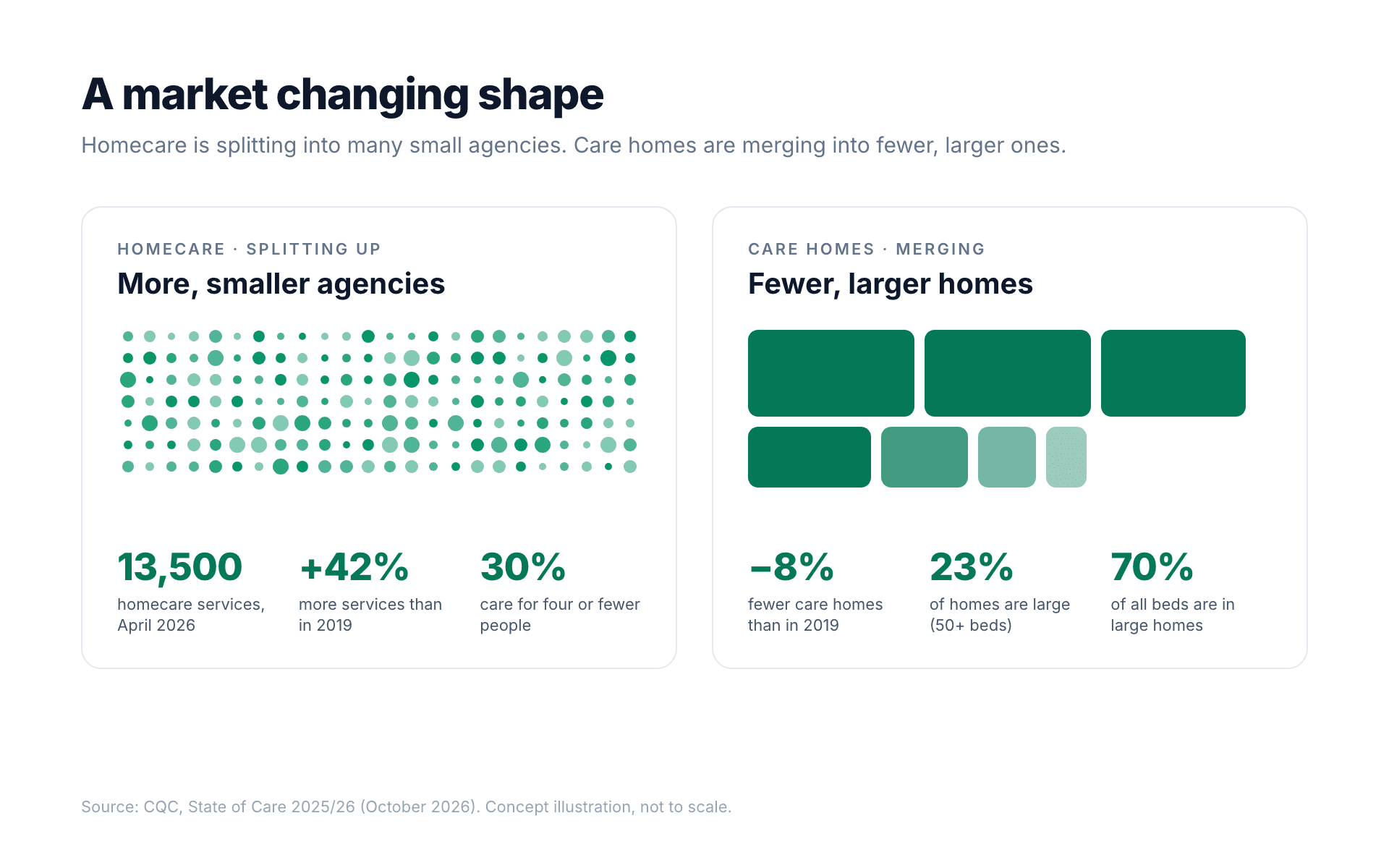 Homecare is splitting into many small agencies while care homes merge into fewer, larger ones. Figures: CQC State of Care 2025/26.
Ratings: most services are good, but leadership is the weak spot
CQC has rated 6,294 adult social care services under its current approach (figures as at August 2026):
| Service type | Rated | Good or outstanding | Requires improvement or inadequate |
|---|---|---|---|
| Homecare | 2,121 | 80% (76% good, 4% outstanding) | 20% (18% requires improvement, 2% inadequate) |
| Supported living | 390 | 78% (74%, 4%) | 21% (19%, 2%) |
| Care homes | 3,783 | 70% (67%, 3%) | 30% (27%, 3%) |
The weakest area is well-led: how well a service is run and managed. In care homes, about a third were rated requires improvement or inadequate for well-led (31% and 3%). Where inspectors looked at governance, management and sustainability, they found problems in 55% of the care home assessments they carried out. Kindness is not the issue: 89% of care homes were rated good or outstanding for caring.
CQC points out that these ratings are not a fair sample of every service. Many inspections happen because there was a concern, so the figures lean towards services where something may have gone wrong.
Homecare is splitting into small agencies
In April 2026 there were just over 13,500 homecare services, 42% more than in 2019 and about 700 more than a year earlier. Agencies looking after four or fewer people now make up 30% of the market.
Two other shifts matter for how agencies are run:
- 27% of homecare services also provide supported living, 6 percentage points more than two years ago.
- Supported living keeps growing quickly: up a further 20% in 2025/26, to more than 4,500 services.
Councils are also buying very little care. The Homecare Association found that most councils in England bought an average of 500 hours of homecare or fewer in a sample week. Its pricing model assumes a mainly council-funded service needs about 1,500 hours a week to stay financially viable.
Care homes are merging into fewer, larger homes
There are 8% fewer care homes than in April 2019, but about the same number of beds. Large homes, with 50 or more beds, went from 13% of homes in 2012 to 23% in 2026, and now have 70% of all beds. There are more than 1,500 fewer small homes. In January 2026 the Competition and Markets Authority looked into a large takeover of care homes by a US property investment trust, and has since accepted changes covering a small number of homes.
Staffing: fewer overseas recruits, gaps in training
- Almost 1 in 10 homecare jobs (9%) are vacant, the same as last year. In care homes the figure is 4.6%.
- International recruitment has fallen sharply: from 105,000 people in 2023/24, to 50,000 in 2024/25, to around 30,000 in 2025/26.
- CQC was told about 787 services losing their licence to sponsor overseas workers in 2025/26, up from 313 the year before. Most were in adult social care.
- Training is patchy. Among care staff, 56% have started or finished the Care Certificate, 54% of those giving direct care have no relevant qualification, and 38% have had dementia training.
In services rated inadequate, CQC found staff without DBS checks, rotas that did not match who was actually working, people given the wrong medicines, and a new carer giving medicine before anyone had checked they could do it safely. In one homecare agency rated outstanding, by contrast, the rostering system worked as a "digital safeguard": nobody could be booked to support a person until they had the training that person's needs called for.
Deprivation of liberty: long waits and a new legal test
Deprivation of Liberty Safeguards (DoLS) are the legal sign-off needed when someone who cannot consent is kept in a care home or hospital for their own safety. In 2024/25 councils received 364,900 applications, 10% more than the year before. Only 1 in 5 was dealt with inside the 21-day legal limit, and the average took 126 days. On 21 March 2026, 96,780 people were still waiting, almost half of them (47%) for six months or more.
On 2 June 2026 the Supreme Court changed the test for when someone counts as deprived of their liberty, with immediate effect. The planned replacement for DoLS, the Liberty Protection Safeguards, still has no start date.
What is changing at CQC, and when
Here is where things stand. We say where a date is confirmed and where it is not.
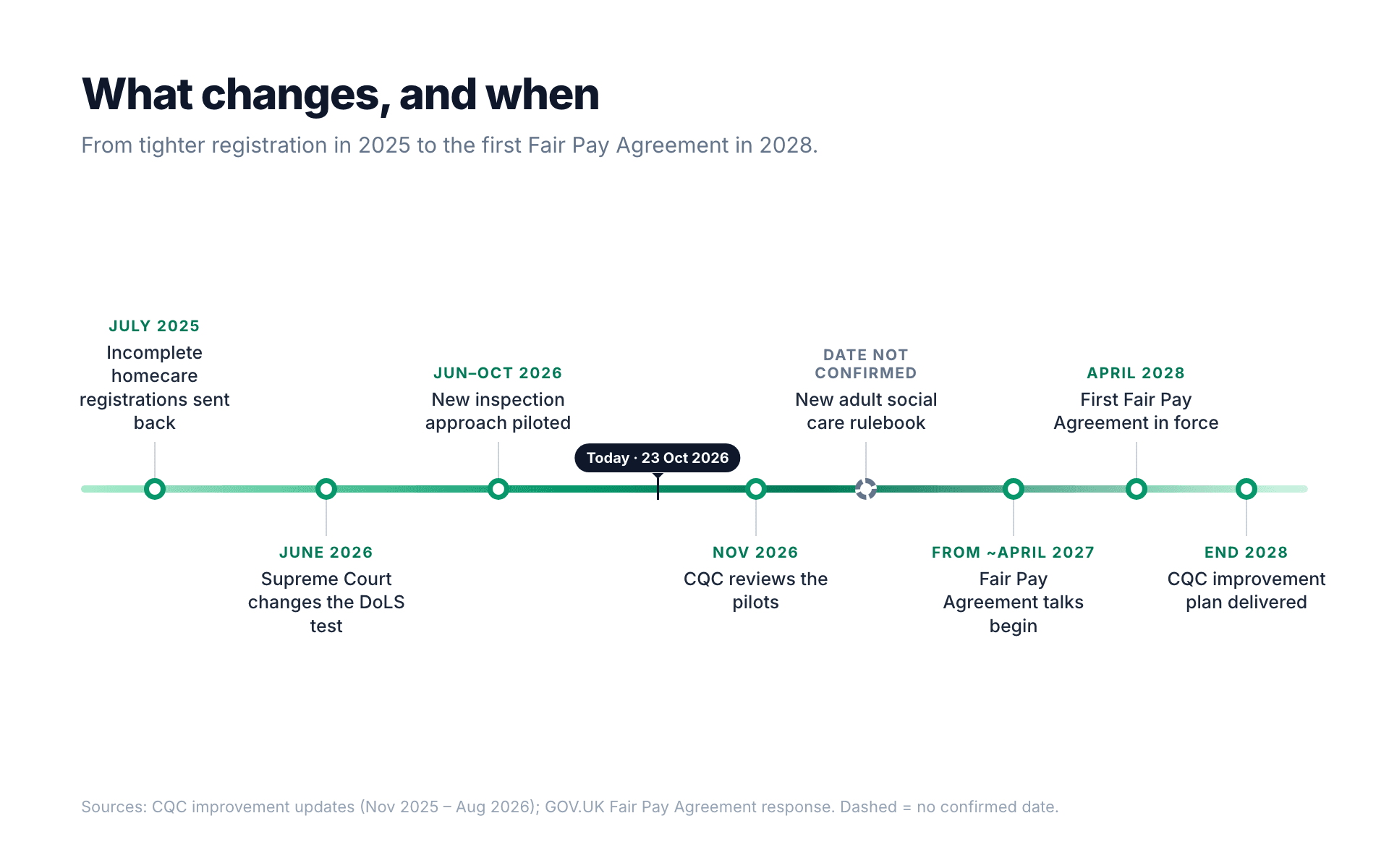 The main dates, from tighter registration in 2025 to the first Fair Pay Agreement in 2028. Dates for the new framework are not yet confirmed.
| When | What | Status |
|---|---|---|
| 1 July 2025 | CQC sends back homecare registration applications that are incomplete or inaccurate | In force; being extended to other services |
| March to June 2026 | Draft rulebooks for four types of service published for comment | Comments closed 12 June 2026 |
| May 2026 | Next round of council (local authority) assessments starts | Under way |
| 2 June 2026 | Supreme Court changes the test for deprivation of liberty | In force; government guidance published 15 June 2026 |
| June to October 2026 | Voluntary pilots of the new inspection approach | Due to end October 2026 |
| November 2026 | CQC reviews the pilots | Planned |
| From the end of 2026 | New adult social care framework comes in | CQC's plan; final framework not yet published, no start date confirmed |
| No date given | New online provider portal | Approved by CQC's board in August 2026 |
| From about April 2027 | Fair Pay Agreement talks begin | Government timetable |
| April 2028 | First Fair Pay Agreement takes effect | Government timetable |
| End of 2028 | CQC's longer-term improvement plan completed | CQC plan |
| No date yet | Liberty Protection Safeguards (the planned replacement for DoLS) | Consultation promised, not yet launched |
| No date yet | Dementia guidance all registered providers must follow | Promised in State of Care |
A new rulebook for adult social care
Since 2024, CQC has used one rulebook for every kind of service, the single assessment framework, built around 34 "we statements" (CQC calls them quality statements). It is replacing that with four separate rulebooks: adult social care, primary and community care, mental health, and hospitals.
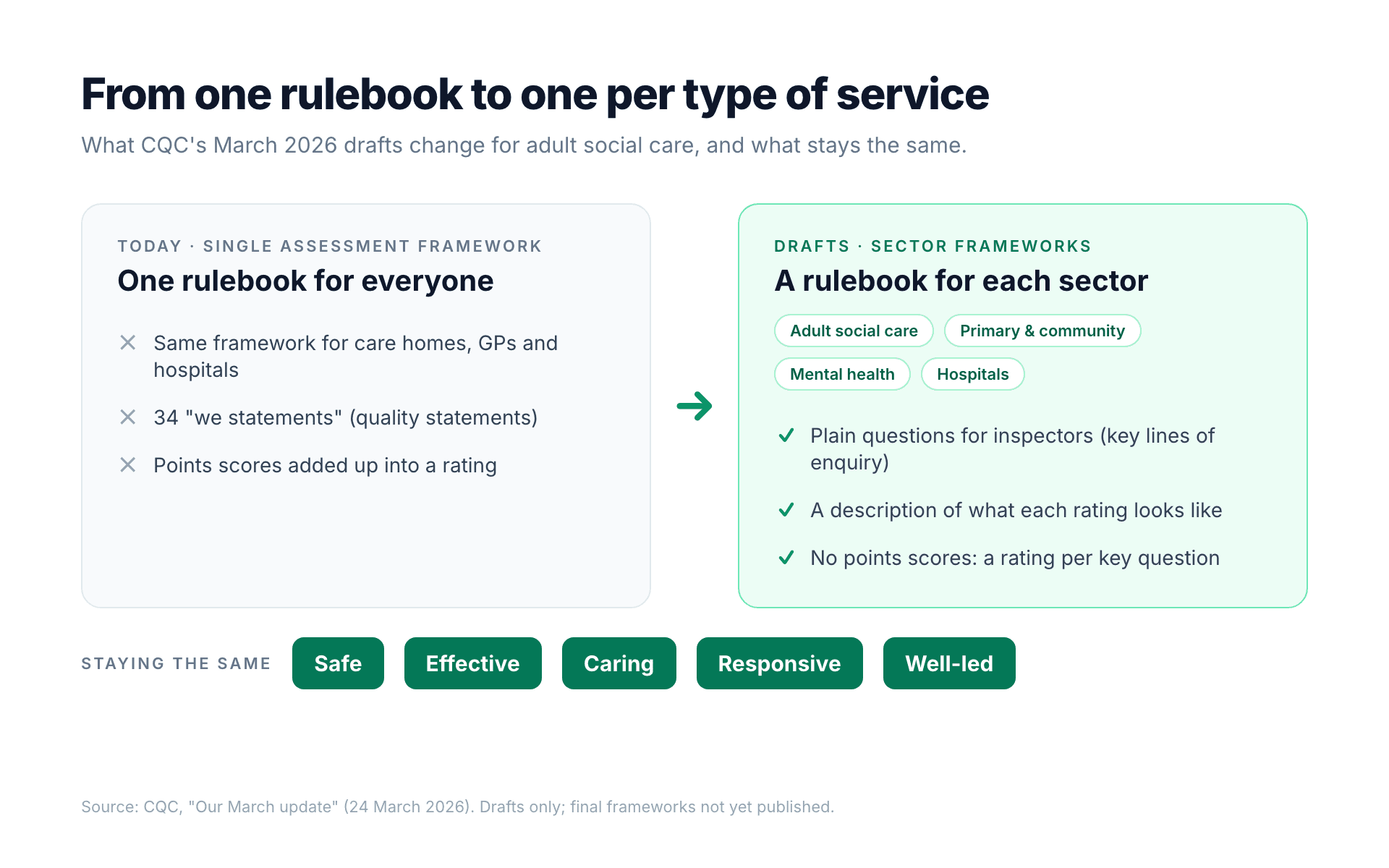 The five key questions stay. Under the drafts, the 34 statements and the points scores go. Based on CQC's draft frameworks, March 2026.
Under the drafts published in March 2026, for adult social care:
- The five key questions stay: is the service safe, effective, caring, responsive and well-led?
- The 34 statements are replaced by a shorter set of plain questions for inspectors to ask (CQC calls them key lines of enquiry), which will feel familiar to anyone who remembers inspections before 2024.
- Each rating comes with a description of what good, outstanding and so on look like.
- The points scores go. Inspectors give a rating for each of the five questions instead.
These are drafts. CQC's November 2025 plan aimed to publish the final rulebooks in summer 2026 and start using them at the end of the year. By its August 2026 update the final versions had not been published, and more talks with the sector were planned for the autumn. Until CQC publishes them, keep working to the current framework.
Checks based more on records for long-standing good services
CQC's priorities include services that have never been rated and ratings more than six years old. For some services rated good across all five questions, with a rating more than six years old, CQC plans a different kind of assessment. It would focus on people's experiences and outcomes, backed up by observation and "targeted, risk-based review of records". The service also needs a registered manager in place, no serious risks showing in CQC's data and no enforcement action under way.
In practice, your records will carry more of the weight. Care plans, medicine charts, rotas, training and audits need to be complete, current and quick to share.
A new provider portal, and CQC using AI itself
CQC's board has approved rebuilding its main online systems, including the provider portal, and CQC is looking at using AI to cut its own delays. In May 2026 CQC also set out what it expects from providers using AI. It does not check or approve individual products, and it says that "the absence or presence of AI does not predict a specific rating". What it wants to see is AI used in a way that is safe, effective and fair.
In practice, that means a person checks the AI's work, you have done a data protection impact assessment (a written check of the privacy risks), and staff are trained to use it. CQC ties all of this to its existing rules on person-centred care, dignity, consent, safe care and good governance.
Registration is getting stricter
Since 1 July 2025, CQC sends back homecare registration applications that are incomplete or inaccurate straight away, instead of chasing the missing details. It is extending this to other types of service and moving registration online. There are about 700 more homecare services than a year ago, so getting the application right first time matters.
Dementia guidance every provider must follow
CQC has promised to work with people and providers on dementia guidance that every CQC-registered provider will have to follow. It has not given a date. With only 38% of care staff trained in dementia, expect inspectors to look closely at training records once it arrives.
Deprivation of liberty after the Supreme Court ruling
The June 2026 ruling narrowed who counts as deprived of their liberty, with immediate effect, so fewer care arrangements will need authorising than before. The government published guidance on 15 June 2026 and has promised more. The consultation on the Liberty Protection Safeguards was promised for the first half of 2026 but had not started by October.
In the meantime, CQC wants providers to notify it properly, track each authorisation so none lapse, and follow any conditions attached. DoLS covers people aged 18 and over in care homes and hospitals; in other settings, such as supported living or someone's own home, the Court of Protection has to authorise it instead. In both cases the council or NHS body that arranges the care makes the application, not the provider.
Fair Pay Agreement
The government plans to set the rules in 2026, form the body that will negotiate pay in 2026 to 2027, start talks around April 2027 and bring in the first agreement from April 2028, backed by £500 million in its first year. In the consultation, a minimum pay rate was the most popular priority (73%), and just over half of people who replied wanted travel time included. For homecare, that means pay and travel records will matter even more than they already do under the National Living Wage rules for home care.
The Casey Commission
The independent commission on adult social care, led by Baroness Casey, will make recommendations on the long-term future of care, and CQC says it will contribute. We have not been able to confirm its current reporting date from a primary source, so treat any date you read as provisional.
What it means for your service
Home care and domiciliary care
Homecare is growing fast and splitting into small agencies, and councils often buy too few hours for an agency to stay viable. From CQC's findings, four things stand out for homecare agencies:
- Continuity. People and families notice when they do not know who is coming. One family described the agency they left this way: "you never knew who was coming". Good services had small, steady teams and made sure new staff were introduced to people.
- Rotas that match reality. Plan enough travel time between visits, and make sure your records show who actually turned up, and when.
- Training before booking. The outstanding agency checked staff had the right training before booking them with a person, not afterwards.
- Medicines. Inspectors found wrong medicines given, and staff giving medicine before their competence had been checked.
If you are reviewing your systems, our domiciliary care software buyer's guide covers what to check, and our comparison of the best domiciliary care software in the UK sets the main options side by side.
Supported living
Supported living keeps growing, and more than a quarter of homecare services now provide it too. That brings two challenges. You have to plan, and prove, shared and one-to-one hours against what was commissioned. And across adult social care, CQC raised concerns about "when needed" (PRN) medicines being used to calm or control people's behaviour, and about unclear processes for hiding medicine in food or drink (covert medication). Supported living is not covered by DoLS, so any deprivation of liberty has to go through the Court of Protection, which makes tracking each case even more important. Our supported living software page covers what a service of this type needs from its records.
Care homes
Care homes are merging into larger groups, and leadership is where their ratings fall down. When CQC looked at governance, it found problems in 55% of the care home assessments concerned. That means audits, action plans and evidence that managers know what is happening on every shift. CQC also found rotas below the home's own safe staffing levels, and staff working very long hours without proper breaks. Read more on what to expect from care home management software.
Children's homes
In England, children's homes are inspected by Ofsted, not CQC, so State of Care and the new CQC rulebooks do not apply to them directly. CQC does inspect the health services that children's homes work with. Our page on children's home software covers the Ofsted side.
What CQC will ask for, CareOS is built for
CareOS is care management software for home care, supported living, care homes, children's homes and care staffing agencies, all in one system. No software can earn a rating for you, and CQC does not check or approve individual products. What software can do is make the evidence CQC looks for a normal part of everyday work, so it already exists when an inspector asks.
Below, each thing CQC looks for (drawn from what inspectors praised or criticised in State of Care) is set against what CareOS does today.
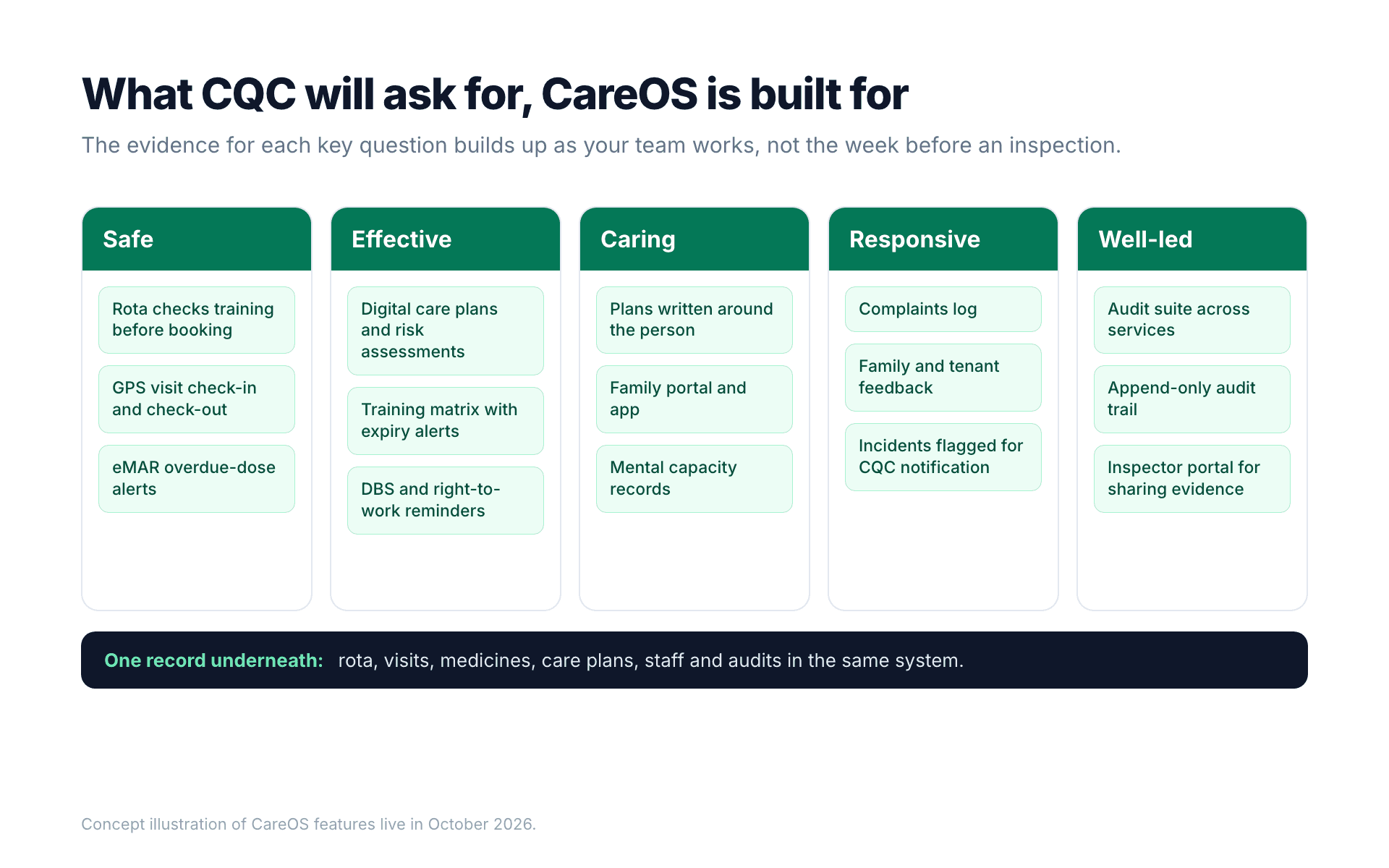 One record underneath every key question: rota, visits, medicines, care plans, staff and audits in the same system.
Safe: staffing, training and medicines
| What CQC looks for | How CareOS does it |
|---|---|
| Staff booked only when trained for the person's needs | In home care, you can mark training a person's care requires. The automatic rota will not book a carer without it, and a coordinator booking by hand gets a warning |
| Records that show who actually turned up | In home care, carers check in and out on the app with GPS, and managers are alerted to late, missed and overrunning visits. In care homes, staff clock in by scanning a QR code |
| Enough travel time between visits | In home care, CareOS works out travel time between visits and, from the rota you have planned, shows which carers' pay would fall below the National Living Wage before you run payroll |
| Medicines given correctly and on time | Electronic medicine charts (eMAR) that alert the team when a dose is overdue, record why a "when needed" (PRN) dose was given, and need approval before medicine can be hidden in food or drink |
| Staff checked as competent before giving medicines | In care homes, CareOS can warn, or stop, a staff member with no recorded medication competency from giving medicines. In home care and supported living, medication training can be made a requirement for a person, so the rota flags anyone without it |
| DBS checks, right to work and training kept up to date | A training matrix that tracks expiry dates (including the Care Certificate and dementia training), plus reminders before DBS checks and right-to-work documents expire |
For the detail, see our guides to care rostering software and eMAR software.
Effective and caring: care plans, families and consent
| What CQC looks for | How CareOS does it |
|---|---|
| Care plans and risk assessments built around the person | Digital care plans and risk assessments in every sector, kept up to date at the point of care |
| Families kept in the loop | A family portal and app where relatives can see updates (not offered for children's homes) |
| Mental capacity and deprivation of liberty tracked | In supported living, a register of DoLS and Court of Protection authorisations that alerts you 30 days and 7 days before one expires, plus mental capacity assessments. In home care, a form for recording mental capacity decisions |
More on this in our guide to electronic care planning software.
Responsive: complaints, feedback and incidents
| What CQC looks for | How CareOS does it |
|---|---|
| Complaints and feedback listened to and acted on | A complaints log, plus feedback surveys for families and supported living tenants |
| Incidents and safeguarding reported properly | Incident records that flag safeguarding concerns and anything you must legally notify CQC about, with the date you notified CQC and its reference number |
Well-led: leadership, audits and evidence
| What CQC looks for | How CareOS does it |
|---|---|
| Managers who know what is happening | Built-in audits (medicines, care plans, falls, safeguarding, supervision, staff files) in every sector. In home care, a report that gathers the information CQC asks for in its Provider Information Return |
| Evidence ready when an inspector asks | In care homes, a readiness view across all five key questions that shows where evidence is missing, plus a practice "mock inspection". In every sector, an inspector portal for sharing evidence securely |
| Records nobody can quietly change | An audit trail of changes that cannot be edited or deleted |
| Data kept secure | Rated "Standards Exceeded" on the NHS Data Security and Protection Toolkit (DSPT), the NHS's yearly data security check |
| AI used safely | AI drafts a care plan, and a person reviews it before anything is saved. Every use of AI is logged, and an organisation can switch AI off completely |
More on these in our guides to CQC compliance software, DSPT for care providers and AI care management software.
Already building for the new frameworks
CQC has not published its final adult social care frameworks yet, and CareOS is already getting ready for them. On our roadmap for early 2027:
- Inspection readiness in every sector. The care homes readiness view and mock inspection, extended to home care and supported living, and matched to CQC's new questions as soon as the final frameworks are published.
- Medication competency checks everywhere. The care homes check, extended to home care and supported living, so nobody gives medicines before they have been assessed.
- DoLS tracking everywhere. The supported living register and its expiry alerts, extended to home care and care homes, ready for the new legal test and for the Liberty Protection Safeguards whenever they arrive.
- A named sign-off on AI. A record of who reviewed every AI-drafted care plan, in line with CQC's emphasis on a person checking AI's work.
One account for home care and supported living
More than a quarter (27%) of homecare services now also provide supported living, so running both in one system matters. In CareOS, one account can run home care and supported living side by side. It keeps supported living tenancy records, compares the hours a council or funder paid for with the hours actually delivered (including shared support), and stops the same carer being booked in both services at once. See home care management software for how the home care side works.
A readiness checklist
Use this to get ready for CQC's new rulebook, and for CQC putting more weight on your records:
- Pull your evidence quickly. Could you produce care plans, medicine charts (MAR), rotas, training records and audits for any month within minutes?
- Check your rota against reality. Do your visit or shift records show who actually worked, and do they match your own safe staffing levels?
- Match training to people. Could anyone be booked with a person whose needs they are not trained for?
- Check medication competence before anyone gives medicines, and record it.
- Close the DoLS gaps. Review the people you support against the new legal test, and keep track of when each authorisation expires and any conditions attached.
- Fix leadership first. Run regular audits, give each action an owner and a date, and show that managers review the results.
- Get ahead on dementia training before CQC's guidance arrives.
- Write down how you use AI and technology: who checks the AI's work, your data protection impact assessment and how staff are trained.
- Get your pay records ready for the Fair Pay Agreement, including travel time.
- Get registration right first time if you are opening a new service or location.
In short
CQC is moving to a separate rulebook for each type of service, with simpler ratings and more weight on records, while the market it regulates changes shape quickly. The providers who will find the next two years easiest are those whose everyday systems already produce the evidence: rotas that match reality, training checked before anyone is booked, medicines recorded as they are given, and leadership that can see what is going on.
What CQC will ask for, CareOS is built for. To see how that works for your service, book a CareOS demonstration.
Sources and further reading
- CQC, State of Care 2025/26, published 23 October 2026, including the adult social care ratings, homecare fragmentation, care home consolidation, workforce and DoLS chapters
- CQC, Our March update: draft sector frameworks
- CQC, Our improvement plans for 2026
- CQC, Our May update: assessment priorities and records-based reviews
- CQC, Our June update: pilots of the new approach
- CQC, Our August update: assessment numbers and digital rebuild
- CQC, Rebuilding CQC: progress during 2025 and Our January update: registration changes
- CQC, A better registration process for new homecare applications
- CQC, Artificial intelligence in health and social care: CQC's role, expectations and plans
- CQC, Starting the next phase of local authority assessments
- GOV.UK, Changes to the definition of deprivation of liberty
- GOV.UK, Improved safeguarding and protections for vulnerable people: Liberty Protection Safeguards consultation
- Community Care, DHSC still mulling AGNI ruling's implications for Liberty Protection Safeguards implementation, 13 October 2026
- GOV.UK, Fair Pay Agreement process in adult social care: government response
This guide is refreshed every year when CQC publishes State of Care, and whenever CQC confirms a date listed above as not yet confirmed.
Frequently asked questions
Is CQC replacing the single assessment framework?
Yes. CQC plans to replace the single assessment framework, its one rulebook for every type of service, with separate ones for adult social care, primary and community care, mental health and hospitals. Under the drafts published in March 2026, the five key questions stay, the 34 quality statements are replaced by plain questions for inspectors (key lines of enquiry), each rating gets a description, and points scores are dropped. These are still drafts, so keep working to the current framework until CQC publishes the final version.
When will the new CQC framework start?
No start date has been confirmed. CQC's November 2025 plan aimed to start using the new frameworks at the end of 2026, with its wider improvement plan running to the end of 2028. CQC piloted the new approach from June to October 2026 and will review the pilots in November 2026. As of its August 2026 update the final frameworks had not been published.
What did CQC State of Care 2025/26 say about home care?
80% of the 2,121 homecare services rated under CQC's current approach were good or outstanding. There were just over 13,500 homecare services in April 2026, 42% more than in 2019, and the market is splitting into small agencies: those caring for four or fewer people make up 30% of it. Almost 1 in 10 homecare jobs were vacant.
What is CQC planning for long-standing good services?
For some services rated good in all five key questions, with a rating more than six years old, CQC plans an assessment focused on people's experiences and outcomes, backed up by observation and a targeted review of records. The service also needs a registered manager in post, no serious risks in CQC's data and no enforcement action under way. Care plans, medicine charts, rotas, training and audits need to be complete, current and quick to share.
When does the Fair Pay Agreement for care workers start?
The government's timetable is for negotiations to begin around April 2027 and the first Fair Pay Agreement to take effect from April 2028, with 500 million pounds of funding in its first year.
Does CQC regulate children's homes?
No. Children's homes in England are regulated by Ofsted, so State of Care and CQC's new frameworks do not apply to them directly. Health services that children's homes work with are regulated by CQC.
Can software guarantee a good CQC rating?
No. No software can earn a rating, and CQC does not check or approve individual products. Good software makes the evidence CQC asks for, such as rotas, medicine records, training, care plans and audits, part of everyday work, so it already exists when an inspector asks for it.
Keep reading
- Domiciliary Care Software in 2026: The Complete Buyer's Guide for UK Home Care AgenciesWhat domiciliary care software actually does, the features that matter, how CQC, DSCR and DSPT should shape your shortlist, and a scoring method to compare vendors without being dazzled.
- National Living Wage Compliance in Home Care: The 2026 Guide for UK Domiciliary Care ProvidersPaying a carer £13 per contact hour does not mean they receive the National Living Wage. Which hours and payments count, how to calculate the effective hourly rate, and how to find shortfalls before payroll.
- Electronic Care Planning: What Makes a Care Plan Live Rather Than LaminatedA paper care plan is accurate on the day it is printed and quietly wrong thereafter. What separates electronic care planning from electronic paper: linked risks, tracked reviews, point-of-care access, and an audit trail that makes the record evidence.
CareOS by care setting
The platform is one system with a workspace per setting. See what it looks like for yours:
See CareOS against your own worst-case Monday
CareOS is UK care management software: rostering, eMAR, care plans, compliance and finance in one system, with a workspace built for each care setting and designed around CQC, Ofsted and DSCR requirements.
Book a demo